


On July 30, around 170 people gathered at Testarossa’s shaded patio a few minutes from downtown Los Gatos as part of an event meant to shine a light on Santa Cruz Mountain wines.
David Dockendorf, assistant winemaker at Martin Ranch in Gilroy, was coolly handling pour duties—the line never seemed to end, as attendees shifted back and forth between stations.
“You never know what kind of attendance you’re gonna get,” he said, noting sometimes people are primarily focused on drinking, while other times—like at this one—grape aficionados are hoping to learn more about the liquid itself. “Love it.”
Debbie Gerow, a woman in her 60s from Menlo Park is one such student of the grape. She arrived with a contingent of four from her wine-drinking group.
“How are all the wineries doing down there?” she asked Dockendorf.
“Ebbs and flows,” he replied.
“I came down expecting a lot of pinot noirs,” said Gerow, who grew up in Los Gatos—having arrived from Wichita, Kansas at four years of age. “There’ve been a lot of viogniers.”

The wine industry has been on the forefront of global affairs, with the day’s (July 30) edition of the top-rated “The Daily” podcast from the New York Times focusing on the risk from wildfire smoke to this year’s Bordeaux vintage over in France, and alcohol continuing to play a starring role in the cartoonish trade war with Canada.
On this side of the pond, winemakers have been dealing with their own climate challenges, with record-breaking heat moving harvest timelines up. One winery rep at the event even told of a fellow winegrower who’d already begun harvesting their grapes.
John Locke, co-owner and co-winemaker of Salinas-cellared, Santa Cruz-based Birichino said they lost as much as 5% of their business, when Canadian sellers stopped taking their product.
“I can’t say I blame them a lot, but it is disappointing,” he said, adding he understands the We don’t want to be the 51st state sentiment. “They took the wines off the shelves (and placed them) into the warehouses.”
Locke says that affected about 150 of their cases.
Janice Gali, owner of Gali Vineyards—which has a tasting room on West Main Street in downtown Los Gatos—said when Canada nixed American wines, it created a backlog on shelves across the rest of the marketplace.
Meanwhile, with the legalization of marijuana and younger-Gen drinkers choosing wine less frequently than older folks, the sector’s sales have tanked.
Nevertheless, Locke is optimistic. He says they’ve been doing well in international markets (besides Canada)—including recently scoring a new importer in Germany. And their revenues are up for the year, if only slightly.
“I don’t think it’s going to go away overnight,” he said of the changing tastes.
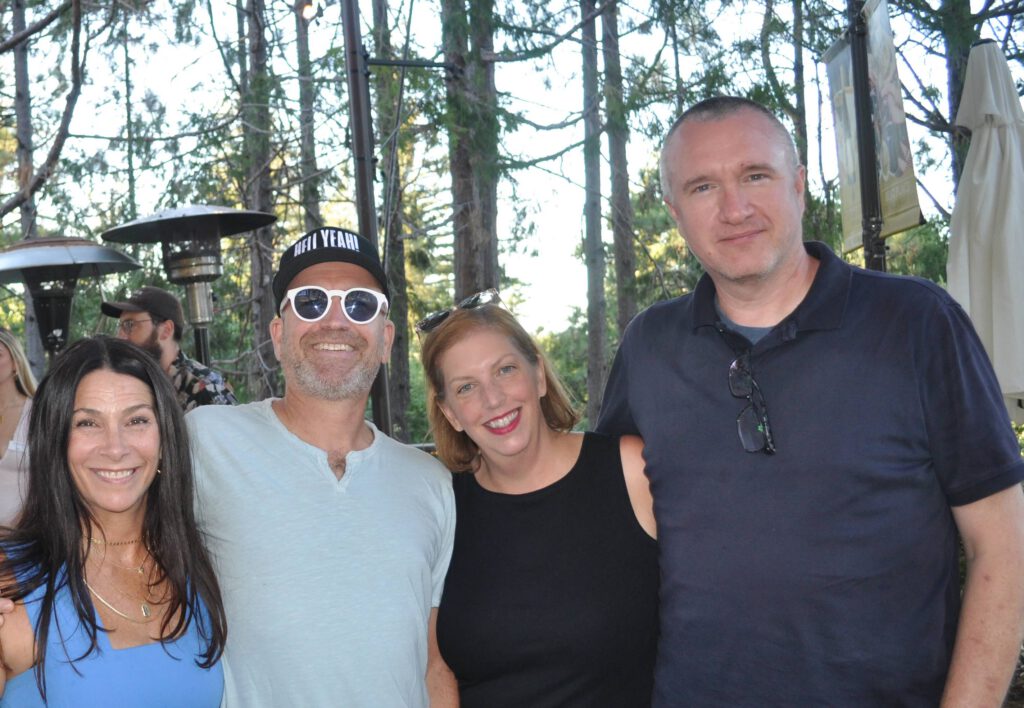
Keikilani McKay, the executive director of the organization putting on the event, the Santa Cruz Mountains Winegrowers Association, said when she was in Vancouver for the World Cup, she heard this message loud and clear: We’re not going to be buying Californian or American.
SCMWA, which is in charge for marketing our local wine region to the world, just implemented a big shift, to be able to regroup and continue putting its best foot forward.
They won approval for a new Santa Cruz Mountains Wine Improvement District, switching from a dues-based funding approach to a 1% charge to consumers.
It’s been a little controversial, and not everyone wanted to sign up. But it is starting to bring in new revenue that can be deployed to talk-up our terroir.
“The dues-based model wasn’t working out in the way that we needed,” McKay said. “A few other regions did pass it.”

They were hoping it might generate $575,000. However, with sales down so much, it’s looking like it’ll bring in closer to $350,000 in the first year. But that’s still about double what they’d usually get in dues.
“It’s not a huge windfall,” McKay acknowledged, adding she sees this as a way to make sure local growers—from Santa Cruz to Saratoga, Scotts Valley, Capitola, Watsonville, Los Gatos, Portola Valley and Woodside—have “a small seat at the table.”
Dave Moulton, the owner and winemaker at Burrell School Vineyards, said it’s too early to tell how much the new assessment could help the local wine industry.
“There’s a lot of contention,” said Moulton, a former SCMWA president, describing how he mulled over whether or not to disclose the new charge on their receipts. “I know in the long run it’s going to be a positive.”
In the end Burrell School opted to raise the overall price 1% and not break-out the assessment as a separate line to make the sticker price artificially seem lower, he said.
“It’s like a hotel tax,” he said. “It’s just more consistent funding.”

Marty Mathis, the owner of Kathryn Kennedy Winery in Saratoga said the amount of money they have to fork over was cut in half, since they don’t have a tasting room.
“It reduced my contribution,” he said.
Mathis explained that SCMWA often brings in media from outside the region to write about local wineries.
“I’m happy with it,” he said of the job SCMWA has been doing. “We don’t have a budget to do anything like that.”
McKay says even though the Santa Cruz Mountains AVA is a bit of an underdog—just 1,500 acres of growing area in a 100-mile-long stretch—the region has quite the story to tell.
“Our wineries are mostly under 2,500 cases (sold annually),” she said. “We’re so micro we have to work on shouting our name out.”
But as the climate continues to heat up, a region with exposure to both the Pacific Ocean and the San Francisco Bay is a big plus, she added.
“The trench of the Pacific is very deep,” she said, referring to the unique geology of the Monterey Bay.
This year, the improvement district plans to install wine trail signs, continue external brand work and conduct media tours.