

What do you do when you are growing too much of something everyone used to want, and now, suddenly, consumers want something else? Santa Clara Valley once boasted 100k acres of prune plums, apricots, peaches and cherries, post WWII. By 1960, those orchards were gone: the growing population needed housing.
To the north in Hopland, beer hops were all the rage until Prohibition, when pear orchards took over. When cheaper pears began coming from Washington and then Argentina, out went the pears and in came grapevines. Similarly, in the 1970s, the prune orchards of Sonoma began giving way to vineyards, and the vast apple orchards of Sebastopol gave way to chardonnay and pinot noir.
Farmers have been dealing with this for centuries. Where farming meets fad, farmers are almost always caught off guard. Predicting the next “it” thing is nigh impossible.
But that’s exactly what local vineyard owners are trying to do in the face of declining wine consumption and the rise in interest of varietals not necessarily planted here.
Most of the 250 plus vineyards in the Santa Cruz Mountains are planted to chardonnay, cabernet and pinot noir. Nearly 2/3 of them were planted after 2001, with a big surge in pinot noir plantings after 2004’s “Sideways.” Prices skyrocketed and everybody wanted the “heartbreak” grape, despite its nickname.
Now we have too much pinot noir, and the price per ton has dropped. The heartbreak is real. So, too, is the bank break.
(Read Part 1 of our Spring 2026 vineyard industry series here.)
(Read Part 3 of our Spring 2026 vineyard industry series here.)
So what’s a grower to do?
Says local viticulture expert, Joaquin Casanueva of Alesia Viticulture, “This is the perfect time to be grafting over pinot noir to something else, like chenin blanc, albariño, sauvignon blanc, or even chardonnay.”
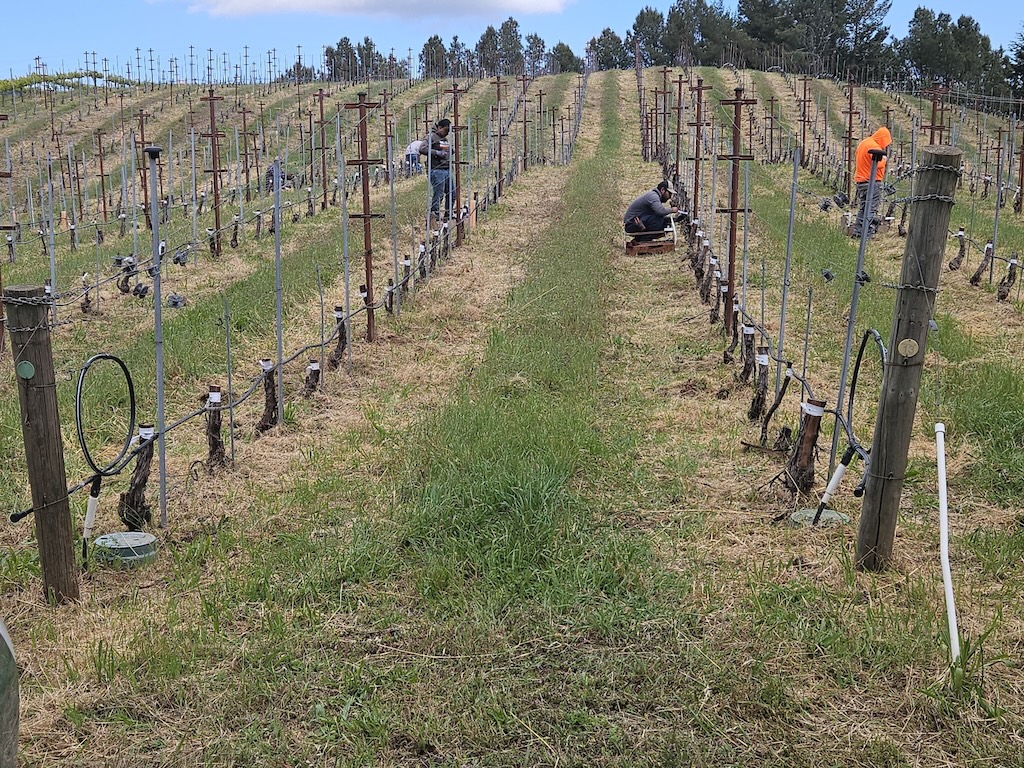
What is grafting? It’s the process of keeping the trunk of the vine in the ground, and cutting off its upper extremities. Basically, you chop off its head. Then, you insert a piece of the plant material, called budwood, that you want to grow, bind it with a bit of tape, and hope it takes. The heads are then typically burned. It’s rather a gruesome ritual, like some sort of vinous rite of passage, where the vines lose their heads but remain to support new life.
In the past, Dave Moulton at Burrell School Vineyards has used grafting to convert several rows of chardonnay to petit verdot to use as a blender in his Valedictorian blend. The vines dramatically overproduced, and he came up short on chardonnay, so he grafted some back. Finding balance is always tricky.
Viticulture consultant Ken Swegles believes that over 80% of the 250 or so vineyards in the Santa Cruz Mountains were planted after 2000. Those established earlier include Mount Eden, David Bruce, Beauregard, Ridge, Burrell School, Wrights Station, Zayante and Cooper Garrod.
Today, he estimates that 20% of those vineyards are cabernet sauvignon, with approximately 25% chardonnay, 35% pinot noir and the remainder a split between Rhones (syrah and grenache), pinot gris (Bargetto and Lago Lomita), other Bordeaux varieties (merlot, cab franc, petit verdot) and zinfandel.
The real pressure locally is on pinot noir. There is definitely a glut of it.
We spoke with Mary Lindsay of Muns Vineyard, one of the post 2000 plantings high atop Loma Prieta Ave in the Summit area, where they grow pinot noir and syrah. She says that in order to meet changes in the market, they are in the process of grafting some of their 12.5 acres of pinot vines and 1 acre of syrah to white varietals.
“We sell almost all our fruit to wineries like Calera, Calerrain, Stockwell, El Vaquero and Sonnet,” says Lindsay. She says they dropped a lot of fruit in 2025, observing that some local people are going out of business. “Local vineyards are having a hard time selling fruit. It’s not getting better, and some are selling dirt cheap.”
Given the climate, and the investment she and her husband, Ed Muns, have already made, she says, “We realized we need to pivot: you have to be adaptable. We talked with Ken and Cole (of Madson Wines) and decided to bud over about 2 acres to aligoté.”
This white Burgundian varietal is a favorite of Swegles, who convinced Mark Bright of Saison Cellars (tasting room in Los Gatos) to plant aligoté, along with chardonnay, at his mountaintop property in Ben Lomond. The property has since been sold due to divorce, but Casanueva reports that the aligoté there looks great.
Aligoté is prized for its natural acidity and is considered the “poor man’s white Burgundy,” as prices tend to be dramatically lower than those commanded by the prized Chateaus.
Lindsay and Muns are working with Topnotch grafting who supplies the plant material for the grafting. “We want to do Chenin Blanc also, but none was available that was dormant,” says Lindsay. “We will do that next year. This is a big change for us.”
Fortunately, she says, they both enjoy white wine, and she’s already ordering aligoté from other wineries to do some research.
“It’s exciting and invigorating and has given us a renewed sense of interest.” Change can be good.
“We will be growing these grapes organically,” says Lindsay. “It’s important to Madson, and we don’t use Roundup anyway. We will be going to organic sprays and herbicides.”
She hopes to graft some syrah over to sauvignon blanc next year if they can find the budwood.
Meanwhile, she says, people can look forward to some white wines from Muns Vineyard in the next couple of years, in addition to their pinot noirs and syrah.
Muns is not alone in grafting. Gali Vineyards in Watsonville (Gali has a tasting room in downtown Los Gatos), converted some of their chardonnay to albariño at their 18-acre vineyard, a few years ago. It has proven highly popular and sells out immediately.
Owner Janice Gali tells us they are contemplating converting some of their pinot noir to other white varietals. The jury is out on what those might be, but what Muns is doing has certainly inspired contemplation.
*Joaquin Casanueva’s name was updated to correct a misspelling.