

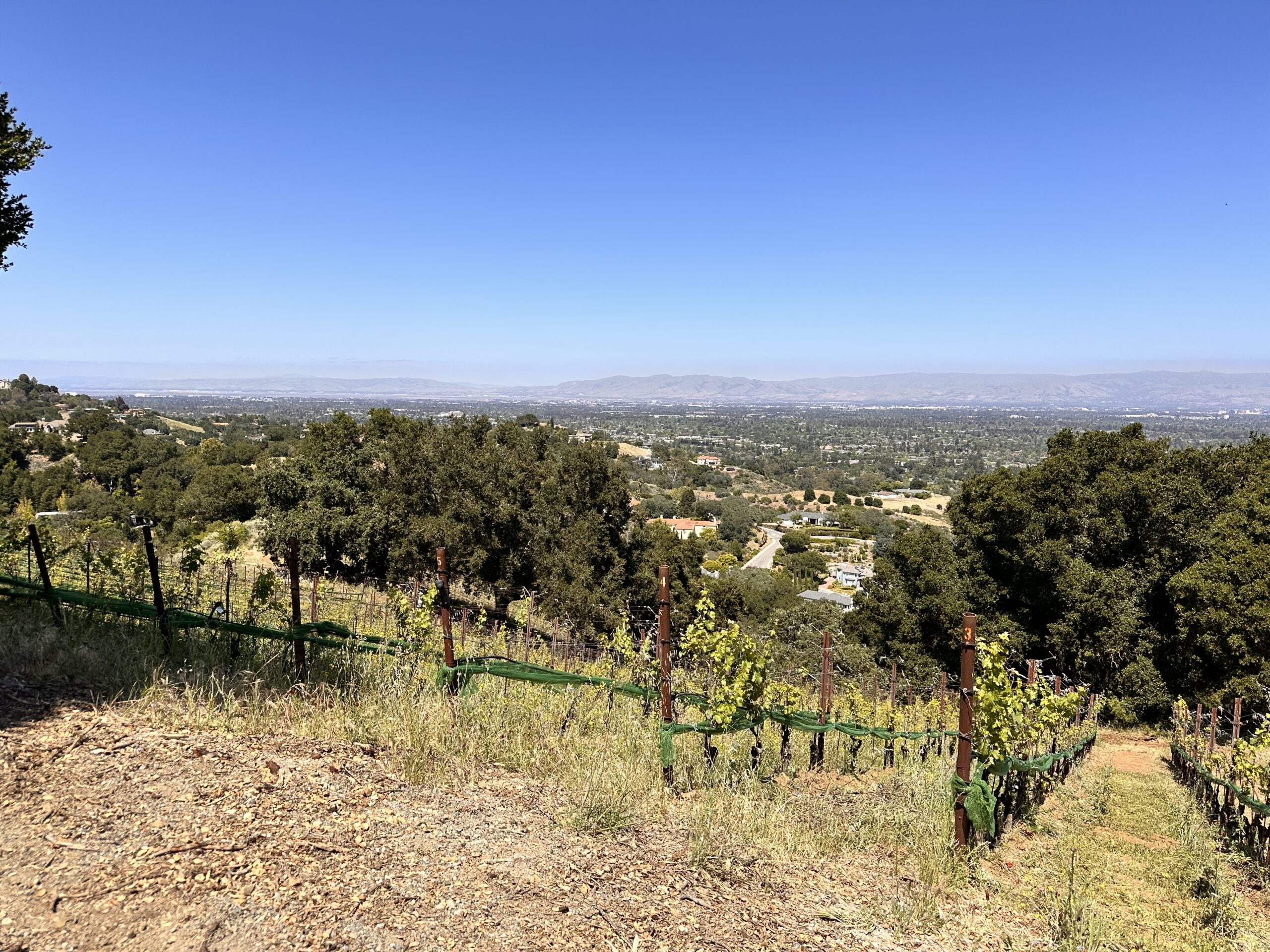
Anyone who grows anything knows working with nutrient-deficient soil is like trying to start a truck with a dead battery.
As with the atmosphere above (the air we breathe), the earth beneath our feet has a huge impact on what—and whether—we can grow crops that nourish us.
Soil health is critical to productivity, and has become a fundamental focal point of regenerative agriculture. It’s also key to producing quality grapes. Anyone with a small backyard vineyard has a small clue of the labor involved. Those with larger operations have a much larger one—and generally a very high labor cost to go along with it.
In this third part of our series on local vineyards, we’re going to look at some ways to assess and improve soil health and how some people are turning to technology—including mechanization—to deal with the high costs of labor.
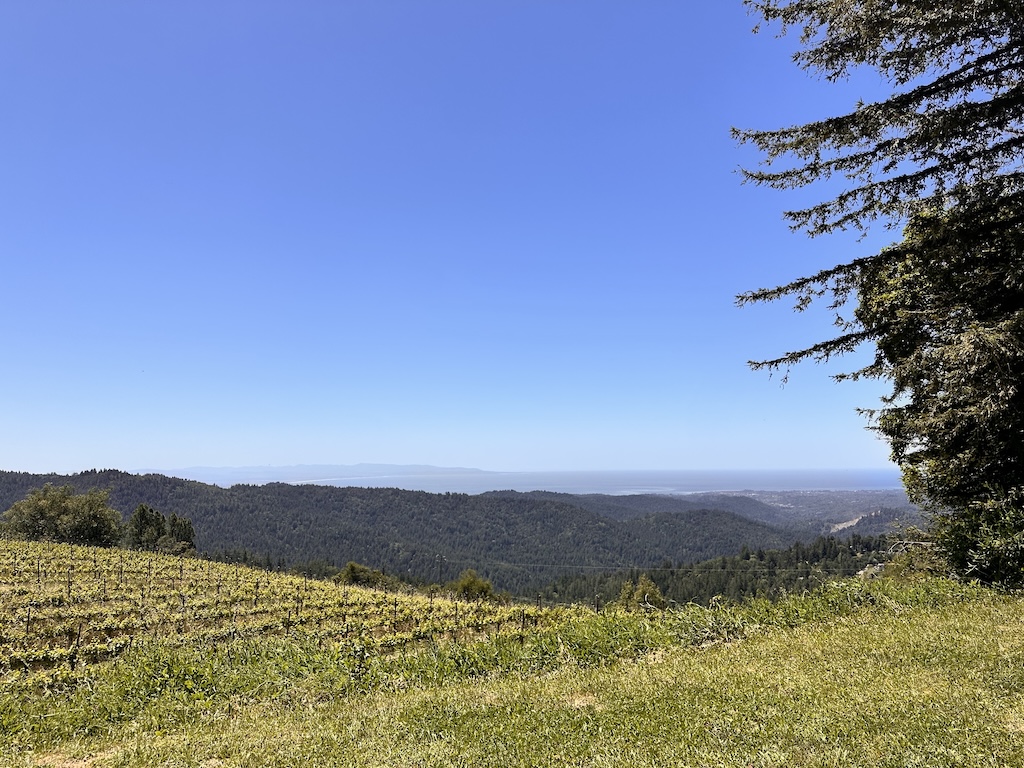
Viticulture expert Prudy Foxx recently invited Rory Shiel with Bio Yield Agri (of Bellevue, Wash.) to speak with local growers about building and supporting soil health. Sheil emphasized the need to complete “bioassays” on the soil to determine the population levels of good and bad microorganisms. The National Institutes of Health describes a bioassay as a procedure that lets you quantify the impact of a particular biological process.
(Read Part 1 of our Spring 2026 vineyard industry series here.)
(Read Part 2 of our Spring 2026 vineyard industry series here.)
Although Bio Yield does not conduct the assays, there are several companies that do.
This information can help inform decisions related to soil treatments, which frequently consist of adding nitrogen, phosphorus and potassium (NPK), in some combination. While these can be useful, Foxx points out that this can sometimes be ineffective if the soil biology is such that it prevents uptake of these minerals into the vines.
(Laura Ness / Los Gatan)
“Having a bioassay for soils prior to treatment is so very important,” says Foxx. “It’s beyond P, N, K—the same way that just taking straight vitamins won’t necessarily give you all that you need for yourself, either.”
Foxx did a trial with Shiel in a local vineyard in an attempt to combat trunk disease in a relatively young vineyard (about 9 years old) that had a block of pinot noir with ailing vines. Shoots would develop, but leaves would turn red prematurely and the vines would die. Initially, they thought the problem came from the nursery.
“Often you see a struggling vine, and you think it’s Pierce’s disease,” says Foxx. “But we had the vines tested and it was not. Sheil thought it might be soil-borne pathogens and suggested we do a bioassay.”
Based on the results of the assay, which showed pathogens that cause vine decline and black foot disease, Sheil inoculated the soil around the impacted vines with trachydermas that outcompete the negative pathogens causing trunk disease. Testing of the soil (three weeks later) indicated there were more positive organisms than negative. Although some severely-infected vines were too far gone to save, the pathogen was stopped in its tracks. Lesser-affected vines began to recover. Most importantly, no new vines showed signs of the disease.
Further, Foxx says, the production of untreated blocks (vs. treated blocks) was about the same—at three bins per block. But the “brix reading” (a measure of sugar in grape juice) was 23.6 in the treated area vs. 22.8 in the untreated area. “That is statistically significant for wine quality,” says Foxx.
More importantly, instead of having to restart the block entirely, they are replanting just the vines lost prior to treatment. Overall, the block appears to be fully recovering. Foxx comments that soil biology provides another lens through which to consider the portion of the vineyard you can’t see. “I decided to introduce Sheil to the growers, so they can make better decisions that might lead to beefing up their biomes,” she says.
The House Family Vineyards case
Jonathan Goodling, vineyard manager at House Family Vineyards in Saratoga, hails from Germany, where organic and biodynamic practices are far more common than in the US.
Foxx estimates that, at the moment, 60% of the vineyards in the Santa Cruz Mountains are farmed organically. She’d like to see that get closer to 100%.
House Family is one of them.
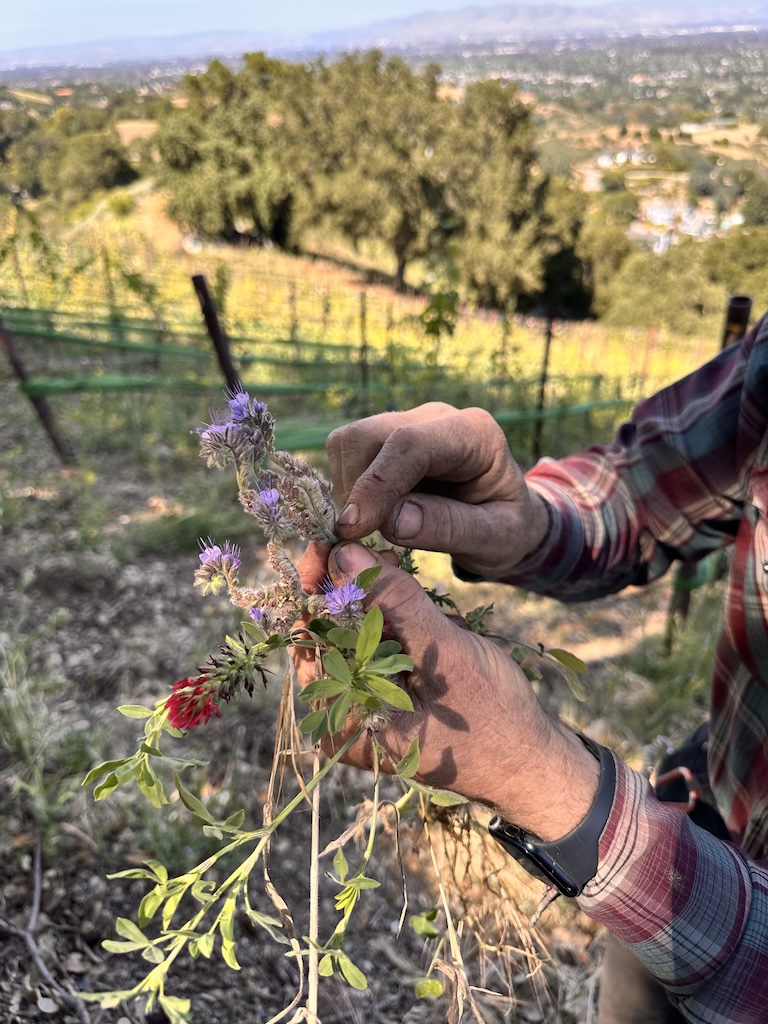
On a recent visit to the vineyard, Goodling showed off the various flora that filled the vinerows. It was quite a sight to behold: the red clover, purple vetch and yellow mustard—each of which has a different function (adding organic matter to the soil, increasing or fixing nitrogen, or reducing erosion—a significant issue on steep hillside vineyards like at House Family).
“I usually plant a crop mix that can add nitrogen, like clover and vetch, which are legumes,” explains Goodling, grabbing a handful of the growth. “They are the nitrogen fixers. We also have cereal grains like this rye here, which improves soil structure and scavenges excess nutrients, and then we have brassicas, like this mustard, for soil aeration.”
Excitedly, he points to a beautiful blue-purple flower that looks like a miniature French horn. (Or, perhaps a scorpion’s tail?) Called phacelia, it is known as “scorpion weed,” and has many benefits. Goodling praised it for the nectar-rich flowers that attract pollinators and natural predators, including hoverflies, ladybugs and parasitic wasps.
“They feed on vineyard pests like aphids and leafhoppers,” says Goodling. “Besides, I like to add beauty to my working environment.”
Goodling explains that these crops would soon be mowed down to create a blanket that will suppress weeds and also provide erosion control in the event of a late May or early June rain.
The process of mowing a cover crop can be labor intensive, especially on a steep hill. Removing undervine weeds, which were beginning to show up, is also very time consuming. Time is money, and the budgets are already stretched thin (especially given the intense price pressures on wine).
Foxx says labor costs are crushing farmers in every aspect: mowing, pruning, shoot-thinning, weeding, leaf-pulling, dropping of crop to achieve balance. It all adds up. You have to fix water pumps and maintain tractors, sprayers, weeders, equipment hauling trucks and ATVs, not to mention the fuel that it takes to operate all of the above. Everything costs more.
We asked a couple local winegrowers how they deal with hedging and undervine weed removal.
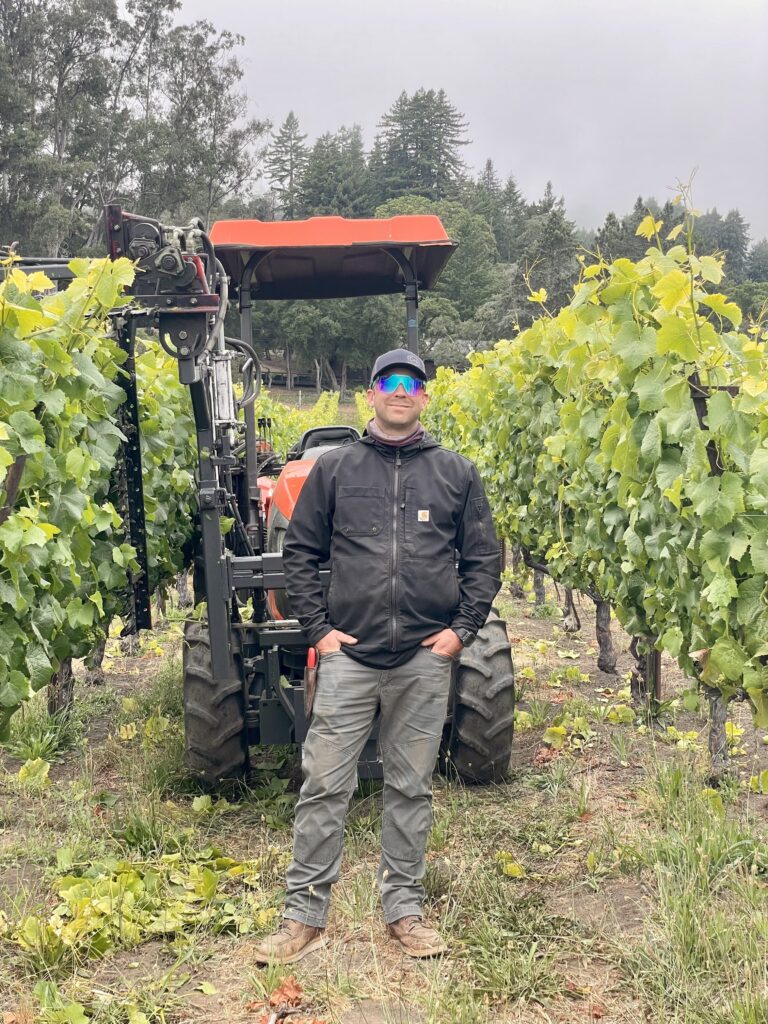
Tyler Wister of Full Circle Wines says he uses a Clemens undervine weeder at Lester Vineyards in Corralitos to remove weeds—and also to trim suckers from the vines.
“With this machine, I can handle 14 acres in two days, versus two to three weeks for human labor,” he says. He also uses a mechanical hedger to trim the vines, reducing labor costs by up to 90%. Math doth not lie.
At lofty Lago Lomita Vineyard (at 2600 ft) on Loma Prieta Avenue off Summit Road, Mark Porter has been using a Gramegna interrow harrow for the past eight years to keep the weeds clear from under the vines of his 12-acre vineyard. He’s on his second unit.
“It’s a trade-off of my time—and tractor diesel—compared to having a crew of six work for three days in the vineyard, each time it needs mowing or weeding,” he says, adding a crew day costs about $1,500 (for eight hours).
Porter usually has to mow and perform weed control with the Gramegna 2-3 times a year, so this saves him at least six—and generally nine—crew days yearly. He paid $14,000 for the Gramegna (easily the equivalent of nine days’ work).
He also uses a fleet of tractors for mowing, spraying, compost spreading and cover crop seeding, tasks which smaller vineyards often do by hand.
Greg Perrucci of Perrucci Family Vineyards on Kennedy Road in Los Gatos, advocates exactly that. He says there is no substitute for putting the work in. And with a steep vineyard in a residential area, hand labor rules. When asked if he’s doing anything new process-wise to save labor costs, he answered, “Can’t short-change quality!”
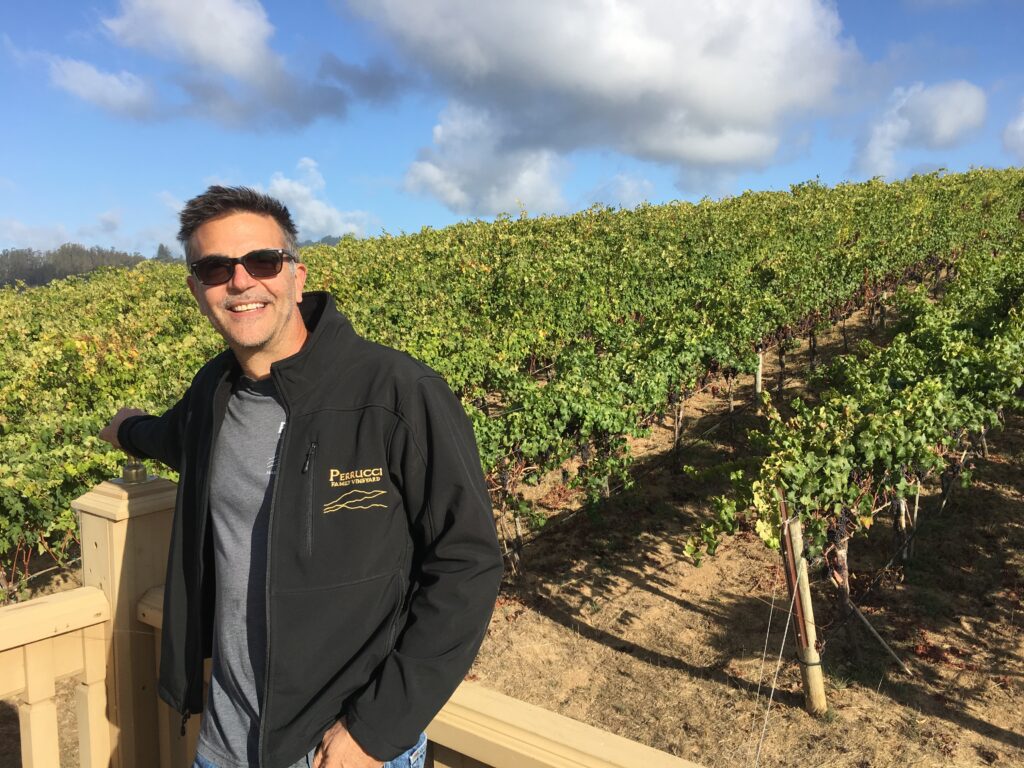
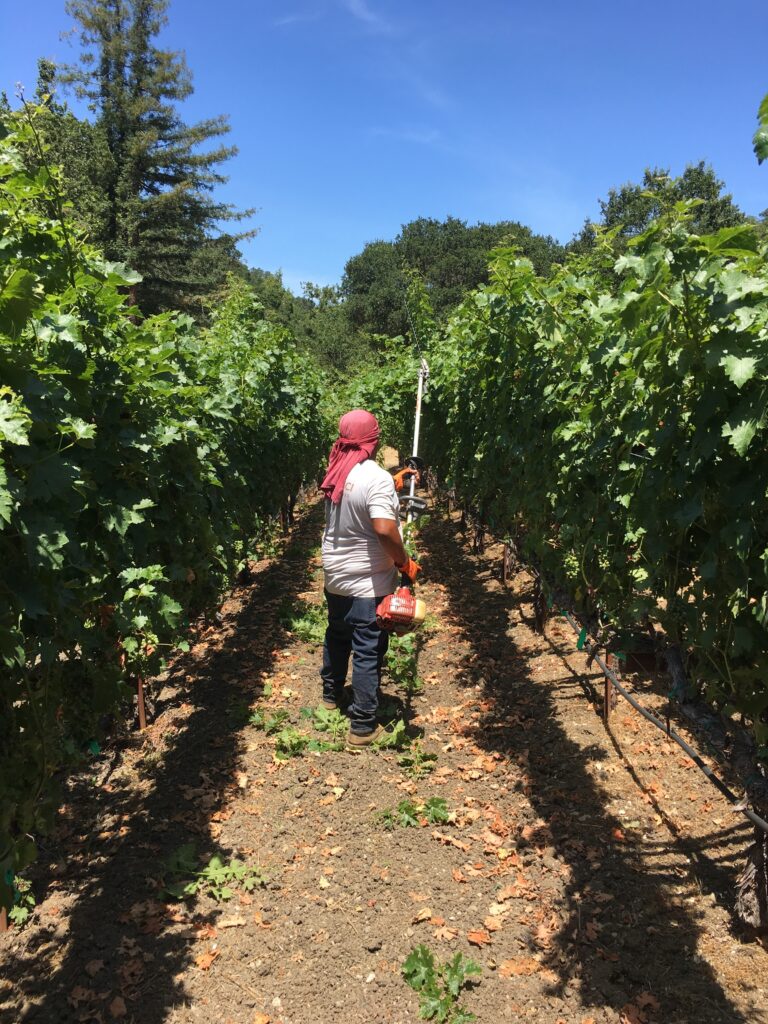
(Courtesy of Perrucci Vineyards)
Perrucci uses string trimmers and weed-whackers everywhere to control unwanted vegetation. He figures it takes about 6-8 hours per acre on flat terrain and 8-10 on hillsides (of which there are plenty on his property).
Perrucci follows a “no disc or till” policy.
“We tend to be overly cautious about flinging rocks into the shoots and neighbors’ windows,” he says.
Plus, tilling and discing can disturb the soil biome (and costs more in manpower and fuel).
He’ll do shoot-thinning as needed. “We decide when and how much based solely on vigor,” says Perrucci.
“Similar decisions are made regarding fruit-drop. But with good thinning decisions, we don’t need to do much of that.”
As always, Mother Nature calls the shots: if it’s a really hot summer, fruit will ripen rapidly.
A persistently cool summer with early season rains would likely require fruit drop to achieve ripeness. All we can do is react to it.