

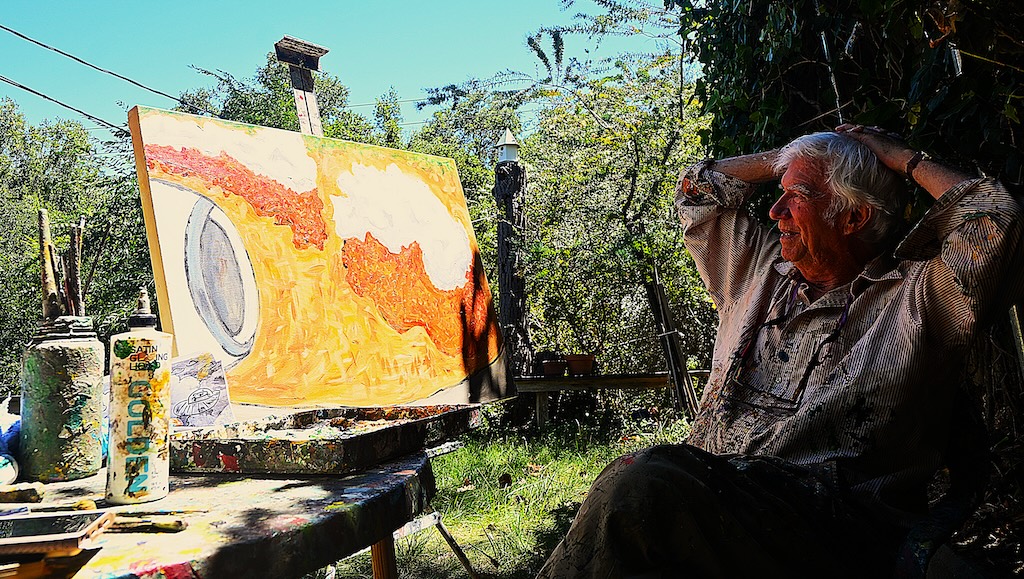
Living in our midst we have some very interesting folks. One of these is Rudy Rucker, living quietly, painting away, in his outdoor studio in the Santa Cruz Mountain foothills. His studio consists of a plastic chair, a table, brushes and paints in a knapsack nearby. I headed over to his home on a warm summer afternoon.
After writing 38 science fiction books, working as a professor (teaching computer science at San Jose State University for 20 years) and developing a reputation as a prominent mathematician, he’s now focused on painting. In his words, his paintings depict, “the exploratory and non-digital nature of painting, and the luscious mixing of the colors. Sometimes I have a specific scenario in mind. Other times I don’t think very much about what I’m doing. I just paint and see what comes out.” Looking at his recent works, what emerges is whimsical bright hues with amazing messages.
Transrealism
“My main career was always writing,” he said. “I have always loved the beat writers, like Jack Kerouac, Allan Ginsberg. And I love science fiction. So I always wanted to be a beat science fiction writer.”
Rucker’s books are known for injecting wild mathematics and computer science into his stories. He’s known globally as one of the original founders of the cyberpunk literary movement. His “Ware” tetralogy, is a groundbreaking sci-fi novel series, pioneering a transrealism literary style. They blend real-time life and fantastic elements. I recently read, Software.
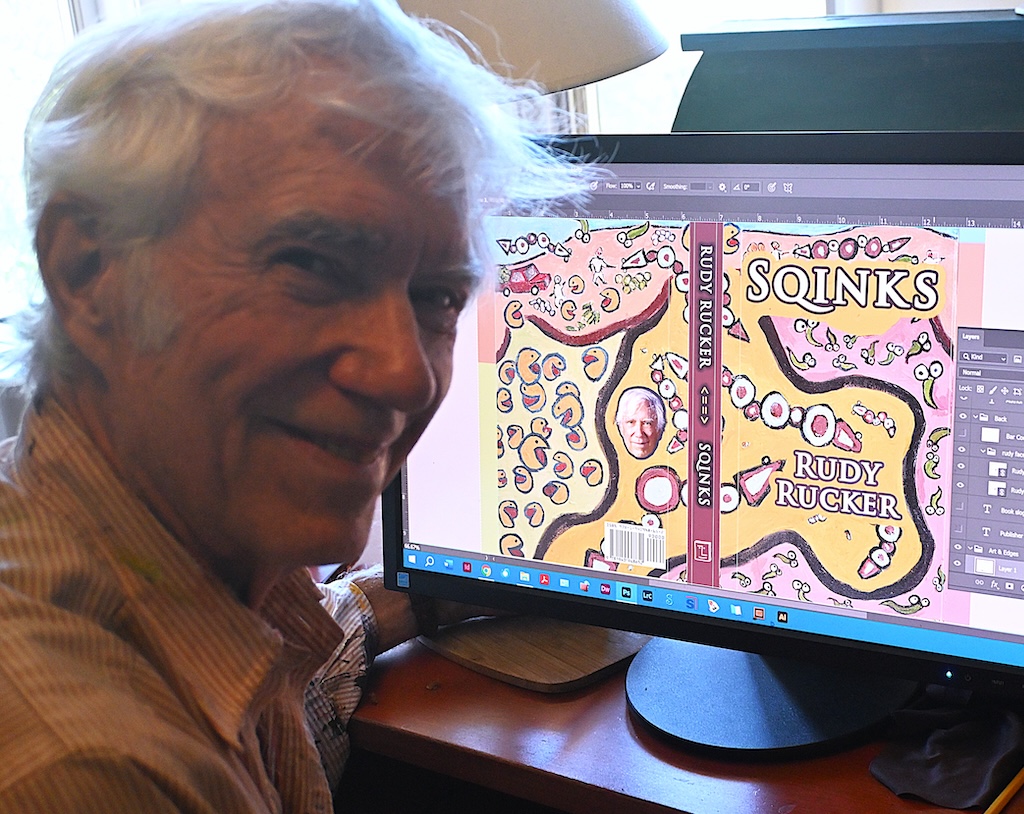
Cyberpunk classic / “Software, the one that started it all”
Software is a 1982 cyberpunk science fiction novel. This is his first book in the Ware tetralogy (series of four connected works), was celebrated as a “transrealist” novel, together with a nonfiction transrealist guide “Infinity and the Mind.” Normally, my recreational reading does not consist of sci-fi, so this was truly a journey into the unknown. The cover artwork in this paperback is by Joe Devito. A statement on the cover read, “The astonishing cyberpunk classic! The one that started it all” It also noted the novel won the 1983 Philip K. Dick award. I thought I had better read this prior to our interview. Would this book explain cyberpunk and his paintings? I was intrigued. Reading a new genre of fiction provided respite from doomsday scrolling.
While reading Software, I could not help but think how much this book, written back in the 1980s, remains relevant to today’s times. Robots are mentioned. A frosty freeze ice cream truck is involved with shifting characters and new body parts. It was, to say the least, a “far out” trip to the end. And now, his paintings seem to carry out messages from beyond the fringes of imagination. He took up painting in 1999 while writing a novel about the Flemish master Pieter Bruegel the Elder.
Sci-fi lives on
Rucker says computers were always interesting to him. “But it was a day job,” he said. “It wasn’t my whole soul.” It was cool to see how graphical interfaces progressed as computers got better, he said, adding, “The main thing was writing the novels, and the nonfiction.” The spark to lead him to his current medium of painting began with his writings.
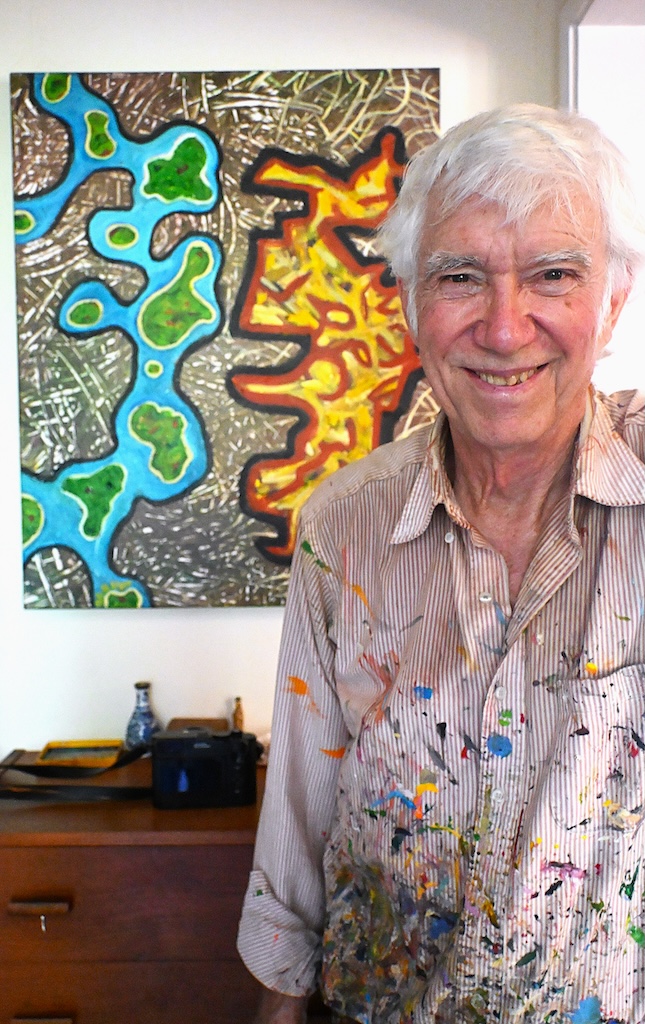
“My pictures are often realistic in that they contain recognizable objects, but fantastic in their use of heightened color, cartoony simplifications and odd scenarios,” he told me in his backyard studio. “The genre is sometimes called pop surrealism. Some of my pictures seem to tell a story. The stories may relate to my novels, or they may be free-floating parables, ambiguous—with their precise meaning unknown.” Some of his paintings do tell quite a whimsical story. In his book of paintings, Better Worlds he inserts, “Notes on the Paintings,” at the end describing his works. These are personal messages from Rucker about his unique style. These descriptions are not mundane, and your own interpretations might differ. This is what art appreciation is all about.
After seeing his acrylic paintings, currently hanging downtown, I liked one piece “kawaii,” very much (roughly translated from Japanese as something like “cute”). During our interview, I learned that prints are also available. The bright colors, unusual shapes and forms all help his paintings jump up and off the canvases. I would call it “sci-fi style.”
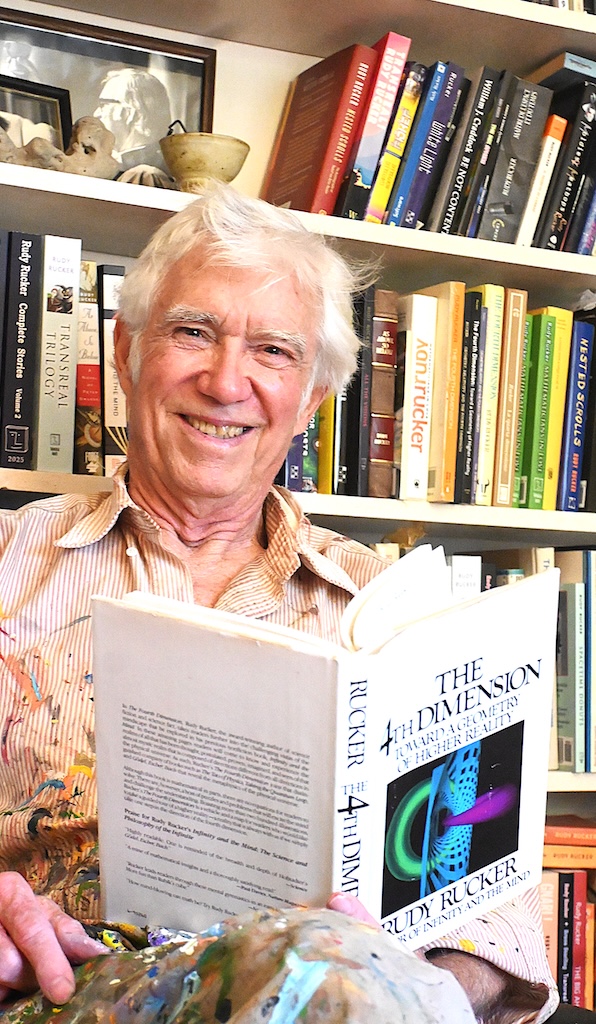
On my visit to his home, he presented me with his book, Better Worlds, which is dedicated to his family. The book chronicles his 291 paintings.
Back to Software
On the back cover of Software, there’s a promotional blurb that reads, “The last gasp of the baby boomers.” And perhaps it is? Going on, here’s an excerpt: “It’s 2020 and the entire state of Florida has been turned over to millions of pheezers (freaky geezers), who are mostly content staying stoned on geriatric acid, grooving on old tunes and saving up for artificial organs. But one old pheezer still has big ideas. Cobb Anderson has just been contacted by the rebellious bopper robots he fathered and helped to free back in the 20th century. They made him an offer he can’t refuse—the ultimate high—immortality!” I really enjoyed this book. Much of it has become our reality since it was first published. It tells of robots and humans that are interchangeable. Is this happening now? Shall we start with driverless cars and AI-created art?
This is not an art or a book review, it is an invitation to view today with glasses on from an earlier time. Why not take a look at what a mathematician, professor, a sci-fi writer—and now painter—puts onto his canvas of choice.
Rucker has written: 26 novels, 5 popular science books, a textbook, a book of essays, a book of short stories, a memoir, a book of journals, and a book of his 291 paintings.






Great article on Rudy’s World ~ nicely curated glimpses of a multifaceted man.
This is a wonderful profile of Rudy Rucker! His ability to blend rigorous mathematical concepts with ground-breaking cyberpunk fiction and vibrant visual art makes him one of the most fascinating creative polymaths of our time. Rucker’s pioneering work in transrealism—anchoring mind-bending scientific ideas directly into real-life personal experiences—has left such a lasting impact on speculative fiction. It is truly inspiring to see his ongoing artistic journey in painting highlighted alongside his literary and academic achievements. Thank you for featuring such a rich local artist spotlight!