
Daniel Roberts, KPCR station manager
Los Gatos has perfected the art of looking untroubled: tree-lined streets, handsome storefronts, a downtown polished to within an inch of its life. But politics has never had much respect for appearances, and lately the cracks have become harder to ignore.
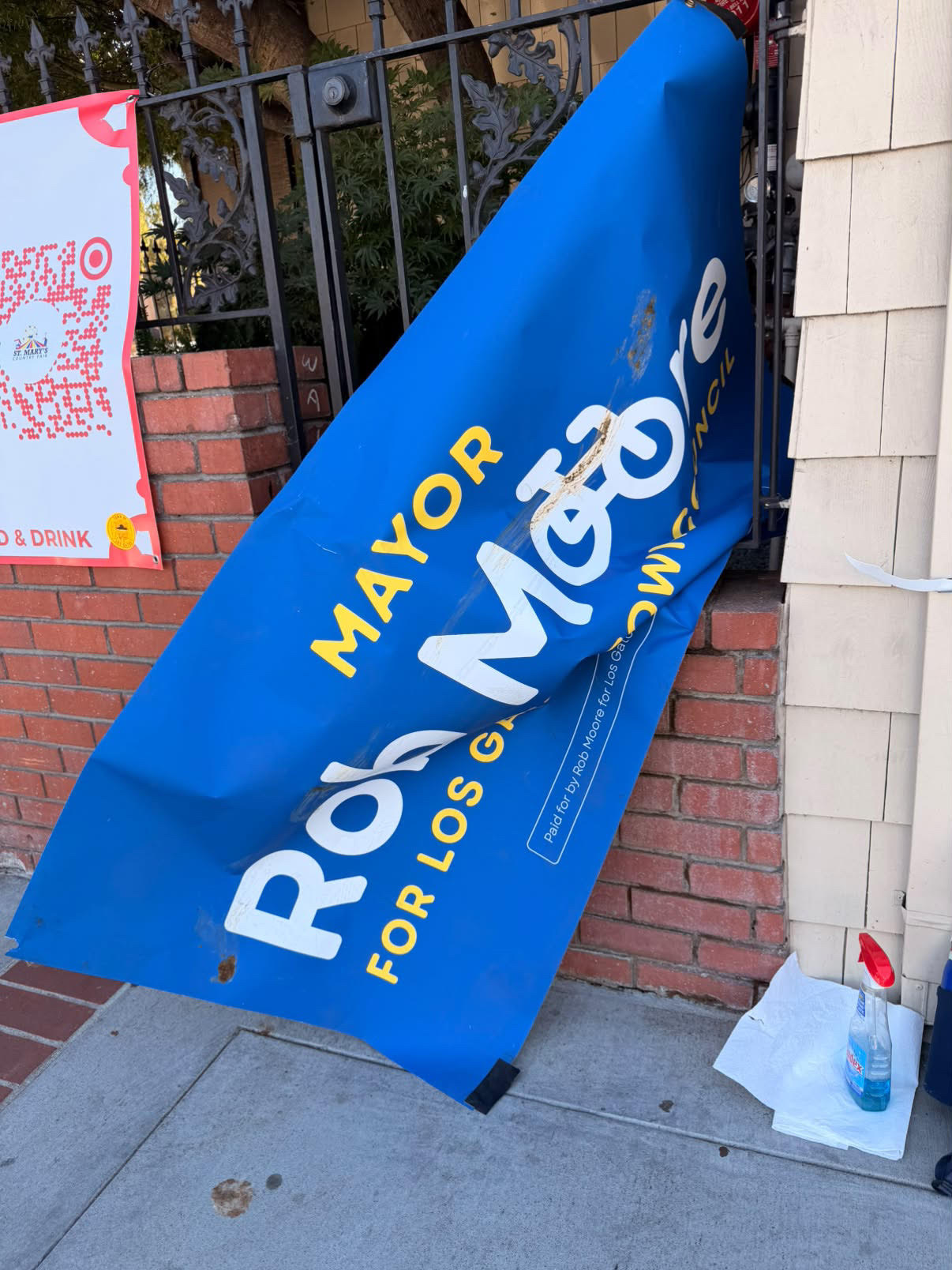
With three Town Council seats at stake, campaign signs are disappearing and endorsements are stirring debate. Mayor Rob Moore supplied photographs of a damaged banner and a message from Los Gatos Cleaners reporting a stolen sign: “Only the pole was left.” Who removed it is unknown.
Councilmember Matthew Hudes used a personal email to endorse only Mary Badame and Rob Stump, though three seats are available. The Santa Clara County Democratic Party endorsed Moore, Jeff Suzuki and Steve Raspe. Federal Election Commission filings show more than $1,000 in Stump contributions to Republican candidates and committees from 2020 to 2024, including about $534 directed to Donald Trump-related committees.
Against that backdrop, Pirate Cat Radio invited all six candidates to talk policy. Moore, Suzuki and Stump appeared October 14; Heidi Owens and Raspe followed October 17. Denise Leffers moderated, with Cody Guerrero producing. Badame could not attend. KPCR subsequently asked all six candidates identical written questions on police funding and license-plate readers; their replies are distinguished below from remarks on air.
Housing brought agreement on avoiding another delay, but different ideas for getting there. California certified Los Gatos’ Housing Element in July 2024, after an extended process that exposed the town to Builder’s Remedy proposals. Badame abstained on the initial 2023 adoption and voted against the revised plan in June 2024, before certification.
Suzuki said the effort needed someone “specifically dedicated” to the Housing Element; Moore also called for more planning staff. Stump favored earlier preparation and outside expertise. Raspe offered a timetable: “Let’s start right now,” with consultants and a coordinator. Owens argued that the Council should “own the project,” rather than delegate responsibility to another committee.
Immigration enforcement revealed sharper divisions. Moore, Suzuki, Owens and Raspe favored additional limits on cooperation with federal authorities. Moore recalled proposing a local measure in 2024: “We don’t cooperate with ICE unless we absolutely have to.” He said no colleague seconded it. Stump argued California’s SB 54 was sufficient, while opposing an immigration detention facility in town.
Automated license-plate readers produced a distinction between objections to Flock Safety, the town’s vendor, and objections to the technology itself. Suzuki questioned Flock’s data security on air: “Just on that alone, I would support ending the contract with Flock.” Owens went further: “Flock is not the issue. Surveillance technology is the issue.” In writing, she opposed plate readers regardless of vendor and proposed a voluntary camera registry and stronger surveillance oversight.
Moore raised concerns about Flock during the broadcast. In a later written response, he said, “I have immense trust in the Los Gatos-Monte Sereno Police Department. I do not have that same trust in Flock.” He opposed renewing the vendor’s contract, but supported a police-owned system with retention limits, audited searches and restrictions on outside access.
Stump supported plate readers subject to tighter safeguards, saying the town “should not be using Flock” if those standards could not be met. He later proposed giving the vendor 90 to 120 days to accept independent audits and tougher restrictions before replacing it. Raspe, in an emailed answer, identified “the accumulation, retention and access of that information” as the central privacy risk, favoring departmental control of the data. Badame’s written response supported continued plate recognition alongside a public review of privacy protections.
On police funding, written answers showed broad support for maintaining department resources. Badame favored more Community Service Officers; Owens identified grants and vacancy savings. Stump and Raspe emphasized patrol staffing. Moore prioritized filling officer and dispatcher posts, community policing, wildfire readiness and mental-health response partnerships.
Beach traffic produced competing prescriptions. Moore and Suzuki discussed congestion pricing to discourage Highway 17 cut-through traffic; Stump suggested local restrictions and changes to navigation apps. Owens floated ramp metering, while Raspe defended planned corridor improvements as a way to move bottlenecks away from town.
Wildfire discussions brought the question of getting through town back to the question of getting out. Candidates addressed evacuation routes, vegetation management, communication and neighborhood preparedness.
These are the stubborn realities behind the campaign signs: housing deadlines, public safety, traffic, fire risk and privacy. There are no easy answers, and the next Council will inherit every one of them.
Eventually, the campaign signs will come down, the election emails will stop, and Los Gatos will return to its familiar rhythm. The problems, of course, aren’t going anywhere. For nearly four hours, candidates had the microphone to tell residents how they would tackle them. Their disagreements are worth hearing.
Both complete roundtables are available at kpcr.org/los-gatos-election-special.