
Just five sports have been featured at each Summer Olympic Games since the inaugural 1896 Games in Athens, Greece. Fencing is one of these.
This Bay Area Fencing Club (BAFC) location in Los Gatos was founded in 2022, with 19 students and a dedicated group of parents and professional coaches.
Today’s club welcomes over 250 students ages 5-80. There’s a second facility in Pleasanton, and more that 400 athletes around the Bay Area participate. Students come from Danville to Monterey to train with the top notch professional coaches here in Los Gatos.
BAFC is one of the fastest growing fencing clubs in the nation. Local students have matriculated into elite institutions such as Cornell, Chicago and New York universities.
Following the 2024 Olympic games, there was a record high of 45,000 USA Fencing members, up from roughly 19,000 members in 1999.
UC San Diego just recruited 17-year-old Skipper Cartright. He trains right here in Los Gatos.
Coach Lisa
I arrived at BAFC just as students began arriving for the 6 o’clock class. Every hour welcomes another age group. Coach Lisa Posthumus was waiting to greet me at the front desk along with Andy Peng, club owner. Peng got into the sport due to his daughter, a fencer.
Posthumus coached men’s and women’s fencing at Stanford University for 25 years and was a national champion. She is known for connecting with “free-thininkg, brilliant student-athletes.” Posthumus opened with, “we use three weapons at this club: foil, sabre and épée.”
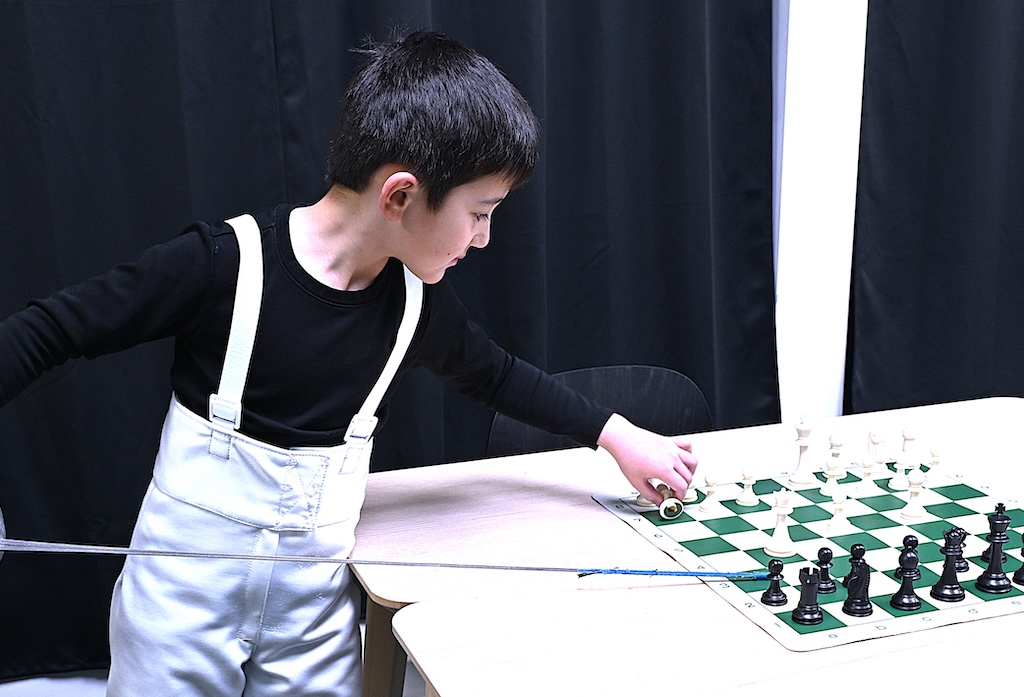
“We have areas for parents to sit, students to do homework or play a game of chess. Fencing is called physical chess where you really do have to be able to out-think your opponent; strategically while physically out maneuvering them.”
Siblings share the joy of fencing
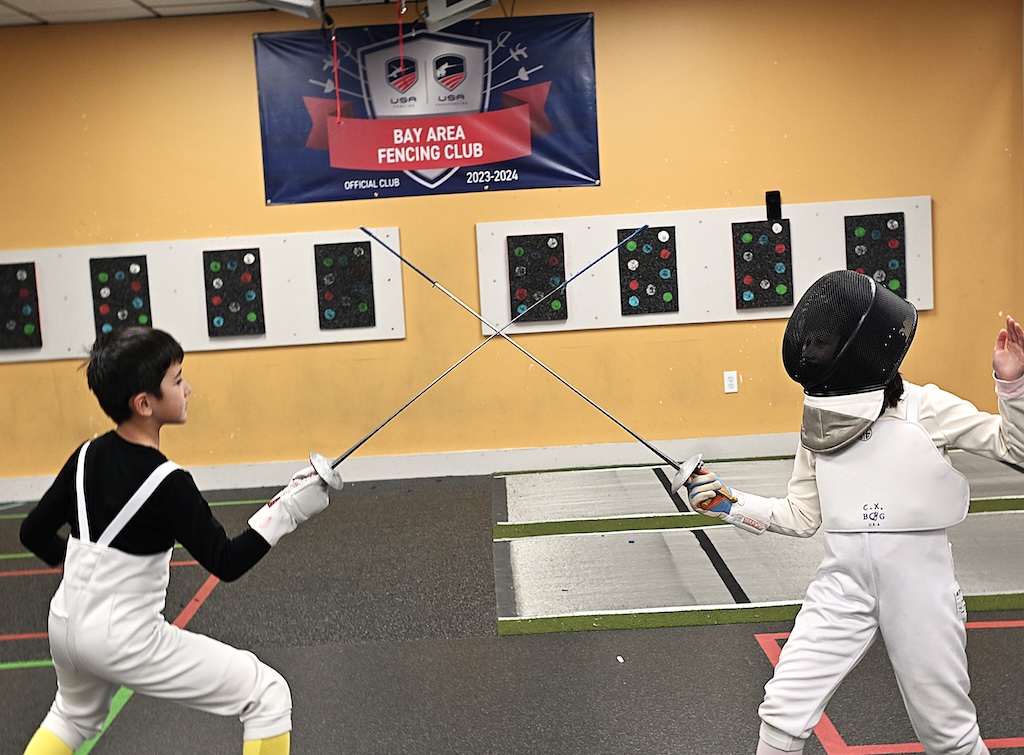
Posthumus gave me a tour around the facility, introducing me to Yutu Xie, 47, and his children Caden, 9, and Chloe, 6. Chloe was in a private coaching lesson. Caden agreed to pose for photos. Chloe has been in three bouts. “My brother fences at a lot of competitions, both locally, regionally and nationally,” she said. Posthumus added, “(Caden) had enough points to qualify on the ladder—currently he is in the youth 10 group.”
There is a popular saying, “Fencing is physical chess.” It refers to how the sport pushes students to think strategically. And that helps develop maturity.
To start a bout, two fencers salute each other. While this is an individual sport, it is built on the partners, coaches and teammates who push each other daily. Teamwork, sportsmanship and integrity is part of the fencing lifestyle. Opponents may become lifetime friends.
At any age
Posthumus said seniors can attend adult classes. “Our suggestion would be to take a few private lessons first, just to get used to the movement (and) meet the coach,” she said. “Come in regular clothes—we would donate/loan the clothing and mask needed to participate. If the adult wanted to continue, eventually they would buy their own equipment.” In fact, the club has competitors as old as 80.
“Our 80-year-old member, the veteran in his age group, won gold in Vet-80 Men’s Foil,” she said, meaning Adrian Sessions—currently ranked 4th in the country in his division. “He trains here.” Profile: usafencing.org/profiles/adrian-sessions
Posthumus added, “All signs lead to this being the fastest growing Olympic sport internationally.” Note: fencing is a very safe sport. The injury rate is one of the lowest among all the Olympics disciplines.
The brain and the body are involved in that physical chess-match. Endurance plays a key factor on how a bout will go. These contests are analyzed and studied. Fencers scrutinize videos of their opponents to observe their style and possible weakness. They also learn more about themselves. Later on, opponents may become friends.
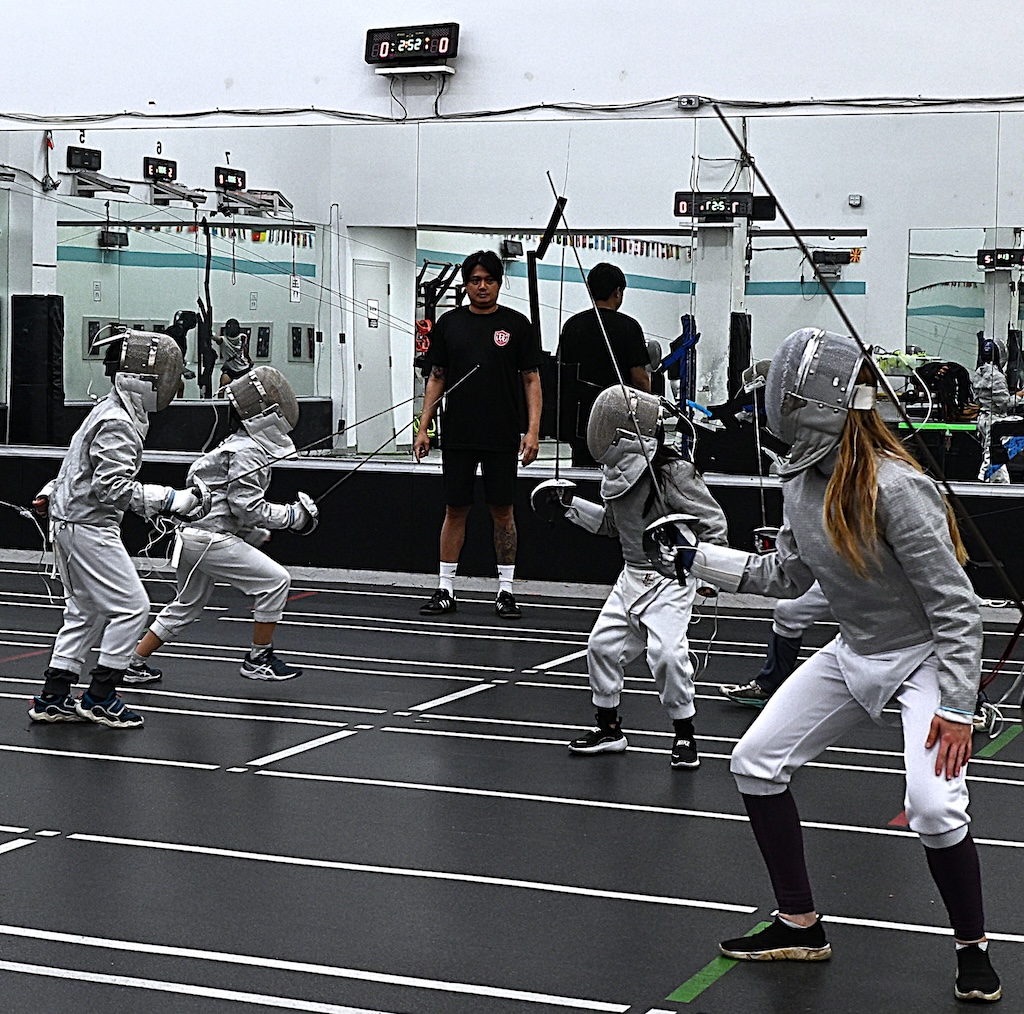
Each bout has a referee. A fencer plugs-in prior to a match, for electronics to record every “touch.” Different weapons have different rules on where a “touch” is allowed, and how they are scored. BAFC is primarily a foil club, meaning that most students don’t use an épée or a sabre.
The highest level of fencers train almost every day: working out in the gym, working on techniques and reviewing videos of previous bouts.
All coaches at BAFC were competitive fencers. Coach Susanna C. Napoli combines her brilliant competitive career on the global stage with world-renowned Italian precision and tactical approaches. Coaches are selected for their expertise and high ethical standards.
Do you or your children need a constructive place to vent your frustrations? Well, fencing is a way to “attack” in a safe environment while working your brain power. Forget “road rage.” Pick up a foil instead. The safe, fun and challenging learning environment at the BAFC is designed to train all in an elevated manner. Outmaneuver with your foil.
Look for Bay Area Fencing Club fencers on the streets of Los Gatos at the Children’s Holiday Parade, Dec. 5.
Local fencer Bob Lipp
Monte Sereno resident Bob Lipp at 79 started fencing at a Los Gatos adult education class in 1997—the year he turned 50. He was kind enough to share his thoughts and photos with the Los Gatan. “I’ve lived in Los Gatos for over 50 years,” he said, recalling how he joined the California Fencing Academy that was in Los Gatos. “I fence épée, which is the most common sport for veteran fencers; it’s slower than foil or saber. In 2007, 10 years after I started, I qualified to join the US Veteran Epée Team, representing the US in the Veteran World Championships that year—and again in 2012.”
“Much of veteran fencing comprises two groups: people like me looking for something new and interesting—where one gets plenty of exercise without getting bored (just the opposite!)—and people who once fenced a long time ago and are returning. The latter includes a number of ex Olympics athletes, making it quite a challenge at the highest levels. I’m 79 now and slowing down quite a bit. But fencing is a sport one can pick up at any age and continue indefinitely—women, too.”
You can learn more about the Bay Area Fencing Club’s website.