
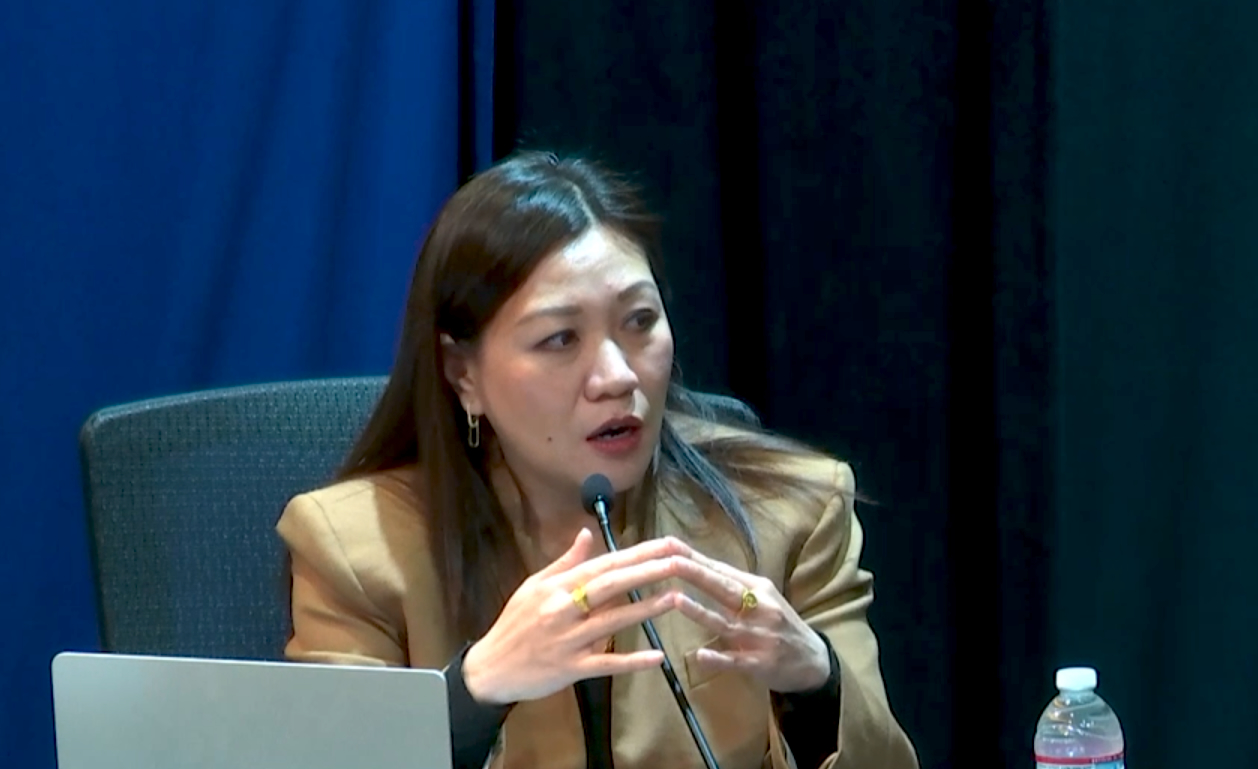
As Flock Safety rep Lily Ho worked her way through slides showcasing how the company’s automatic license plate readers have helped solve crimes across California, during an April 9 Saratoga City Council study session, she arrived at the one about a November 2023 SoCal police action.
“This one’s a good one,” she said, with the eager-but-hushed tone of a true crime podcaster. “It’s a serial killer. We’ve found many serial killers. And those are exciting ones to find…they’re just very difficult cases to crack.”
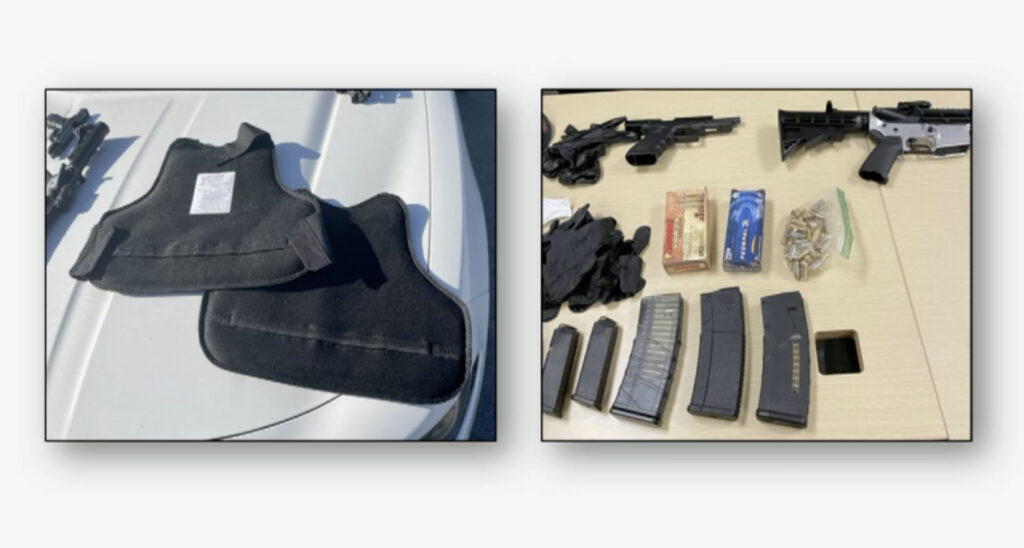
Her voice broke into something of a laugh, as she outlined how a Los Angeles County employee was found dead following a robbery and shooting at his home—and how police searched the Flock database for vehicle photos from nearby Flock license-plate-reading cameras. Beverly Hills Police made a traffic stop and arrested the suspect, Jerrid Joseph Powell, who was also tied to the fatal shootings of three homeless men.
In April last year, criminal proceedings against Powell were paused, after one of his attorneys, Derek Dillman, expressed concern about the defendant’s “ability to rationally assist in his defense,” according to City News Service. Powell was scheduled to be back in court on Wednesday for a status update.
The presentation highlighted the almost-giddy attitude of proponents of these fixed automated license plate reader (ALPR) cameras, as they argue for the benefits of a technology they say has, on the one hand, the power to close cases even the most sardonic and wily of detectives have failed to crack, but on the other hand, they claim, is definitely not mass surveillance.
Saratoga has 72 of these Flock cameras installed throughout its 12.78 square miles, most paid for by neighborhood groups. Seven are covered by taxpayers, out of the General Fund. Data is retained for 30 days, before it is destroyed. Under California law, license plate photos cannot be shared with out-of-state agencies.
“There’s an idea that this is a mass surveillance tool. It is not. License plates are only searched when there is a reason for search—a criminal reason for search,” Ho said, adding courts have often sided with Flock, “—if there are clusters of these camera networks in your town, it does not indicate where you go to school, where you shop, any personal habits of anyone’s life.”
Flock has been under increasing pressure to maintain its presence in the Greater Bay Area, as communities like Santa Cruz, Los Altos Hills and Mountain View have sided, for various reasons, with activists who’ve adopted the mantra “Get the Flock out,” referencing a vulgar word that cannot be printed in this family newspaper article. Several people spoke strongly for and against Flock Safety during the study session, including deputies who said the system was a great tool in the law enforcement toolbox.
The Santa Clara County Board of Supervisors’ recent decision to stop using Flock Safety has led to an interesting situation, where cameras are still installed all around Saratoga, and yet the Santa Clara County Sheriff’s Office can’t tap them to assist with investigations anymore.
On a national level—between December 2024 and October 2025—Flock was used by 19 agencies to track “50501 protests,” “Hands Off protests” and “No Kings protests,” according to the Electronic Frontier Foundation.
“Sometimes searches explicitly referenced protest activity; other times, agencies used vague terminology to obscure surveillance of constitutionally protected speech,” an EFF release states. “Three agencies used Flock’s system to target activists from Direct Action Everywhere, an animal-rights organization using civil disobedience to expose factory farm conditions.”
In a recent update to Los Gatos Town Council, Los Gatos-Monte Sereno Police Chief Jamie Field said the technology is becoming less effective there, as criminals adjust their tactics, now that they know there are license plate readers spread throughout town (though, she emphasized it can still be quite helpful in generating investigative leads.)
Saratoga’s homeowners associations are sold on the usefulness of the tech.
Some Silicon Valley residents say the ship has already sailed on preserving personal privacy.
“Those who are professing a lack of privacy, just look at your own cellphone. Privacy is wishful,” said Uday Kapoor, a resident of the Horseshoe neighborhood.
Kapoor is a former engineering director at Oracle—a company which, in 2024, reached a $115 million settlement over accusations it violated people’s privacy rights (including claims it built detailed profiles of users, such as about their location, purchases and political views).
“And ALPR cameras are not a weapon,” Kapoor said. “Terminology such as ‘warrantless surveillance’ is inappropriate for our village. So, I would urge the City Council to empower the neighborhood.”
But it was this same familiarity with technology that caused the Flock rep to stumble—if only a little—in her fielding of razor-sharp questions from municipal rule-makers.
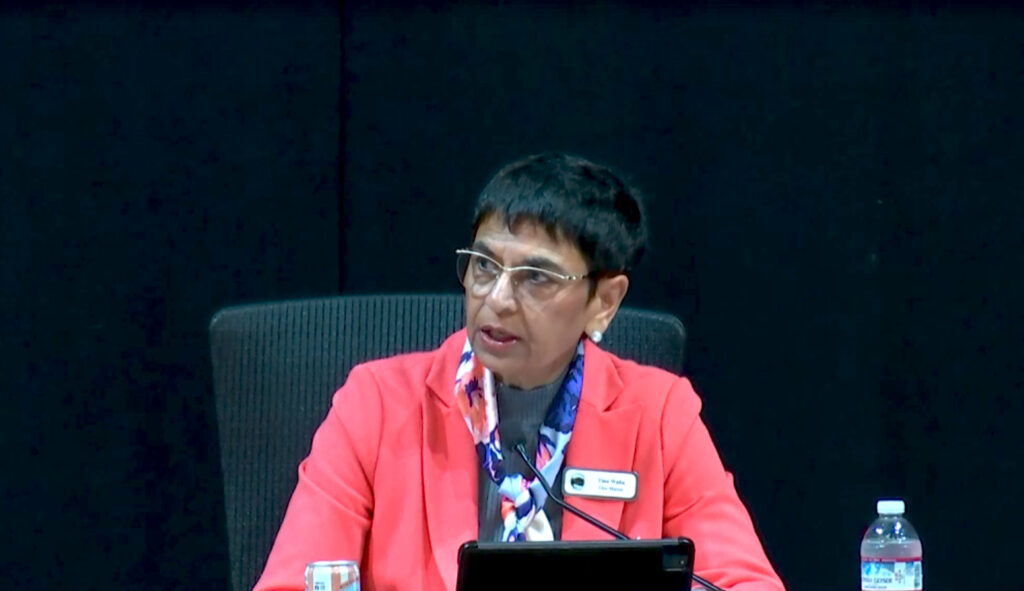
Tina Walia, who’s previously worked as a business analyst in the semiconductor industry and a tech sector market researcher, wanted answers about data deletion.
“You mentioned all the data is deleted after 30 days. At the same time, I understand that there is anonymized data that is retained? by Flock, so, how does that work?” she asked.
“We pull this from across our entire system—a small percentage, less than 1%—and we use that data,” Ho replied. “We scrub it of any information…but we use those images to train our machine learning models.”
The Flock rep explained they had to reprogram their AI when Elon Musk’s Tesla released the Cybertruck, for example.
“Our machine didn’t know what to do with it,” she said. “Just literally didn’t know what to do. We pulled over 1,000 images of the Cybertruck and trained it, so that, if you were to search ‘Tesla truck’, it would come up.”
Walia asked if any independent studies had verified that it was, in fact, “less than 1%” of the data being retained—and if that data can’t be “reverse-engineered” later, for sure.
Ho was not prepared for this level of interrogation.
“Yeah, good questions,” she responded. “I mean, I suppose—I would have to go back to our engineering teams to check on that. But, the more customers we get, the more images we get. That percentage probably shrinks.”
Walia wasn’t letting her off the hook just yet—including for her last half-answer.
“Okay that’s only the percentage. But can it be reverse-engineered—and not remain anonymous anymore?” Walia pressed.
Ho’s answer was anything but definitive.
“I don’t believe so,” she said. “Yeah.”
Walia asked if the company shares with anyone besides law enforcement.
“No,” she said. “We are not sharing with anybody. Period.”
But she added a small number of engineers at Flock do get to pull data when requested by customers—but noted this would be recorded in a permanent audit log.
Councilmember Yan Zhao, who holds a Master’s Degree in Electrical Engineering from Santa Clara University and spent decades in the semiconductor industry, was curious about what those audits say about the overall security of the Saratoga ALPR network.
‘We have never been hacked. Full Stop.’
—Lily Ho, Flock Saftey
“For all those audits, have you found any cases that, you know, we’ve violated any of the policies and the procedures that’s set by the Board of Supervisors?” she asked.
Neil Valenzuela, who’s in charge of Santa Clara County Sheriff’s Operations for the region, said a “technical issue on Flock’s end” resulted in Houston Police Department officers having access to the data of Saratoga residents, temporarily.
“It was some sort of technical glitch,” he said. “But that was rectified pretty quickly—because of the frequent audits.”
“So, what is (Flock) doing to kind of prevent this type of hacking and, have any data been stolen, or been hacked in the past?” Zhao asked the Flock rep, referring to the all-too-often occurrence of receiving an alert from a company that your data has been compromised.
“Yeah, I want to be clear,” Ho said. “We have never been hacked. Full stop. We’ve never been hacked.”
But according to a Nov. 3 letter Senator Ron Wyden (D-Oregon) and Representative Raja Krishnamoorthi (D-Illinois) to Andrew N. Ferguson of the Federal Trade Commission, passwords for at least 35 Flock customer accounts have been stolen, and security researcher Benn Jordan has captured a screenshot of Flock accounts apparently up for sale on a Russian-language cybercrime forum.