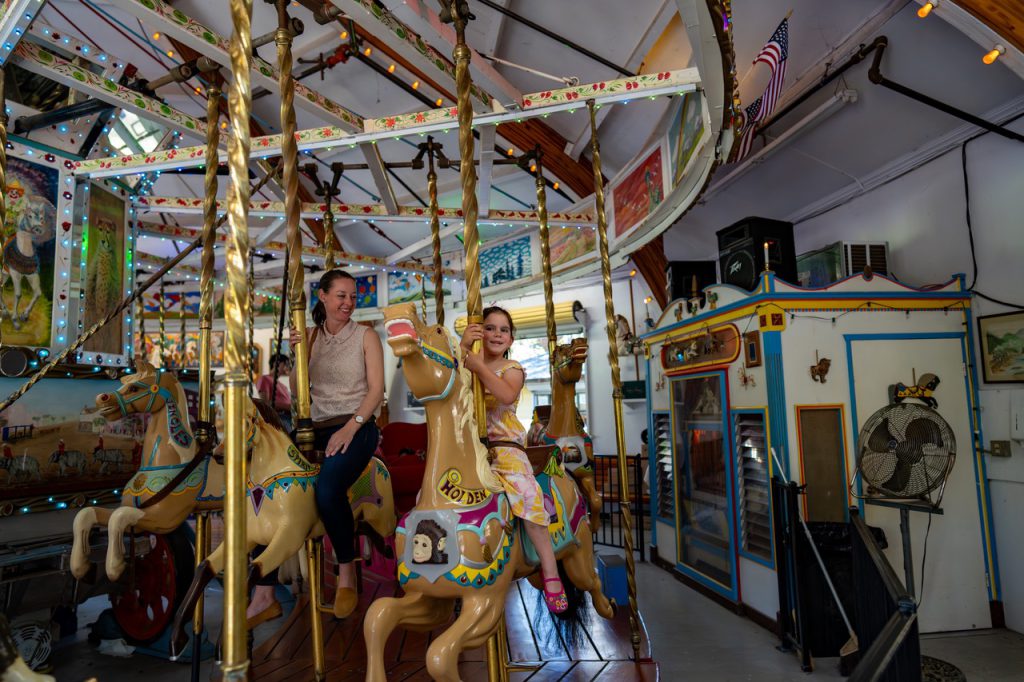
Saddled on their chosen steeds, children gleefully wave to their parents amidst the festive sound of a Wurlitzer organ.
For some, riding the carousel is a new experience. For others, it’s a cherished childhood memory passed from one generation to the next.
Billy Jones Wildcat Railroad Inc. purchased the W. E. “Bill” Mason Carousel in 1980. After 10 years, and thousands of volunteer hours, the carousel was restored and ready for riders. But the work never stops to keep the historic carousel spinning.
For Cheryl Stuermer, it’s been a passion project.
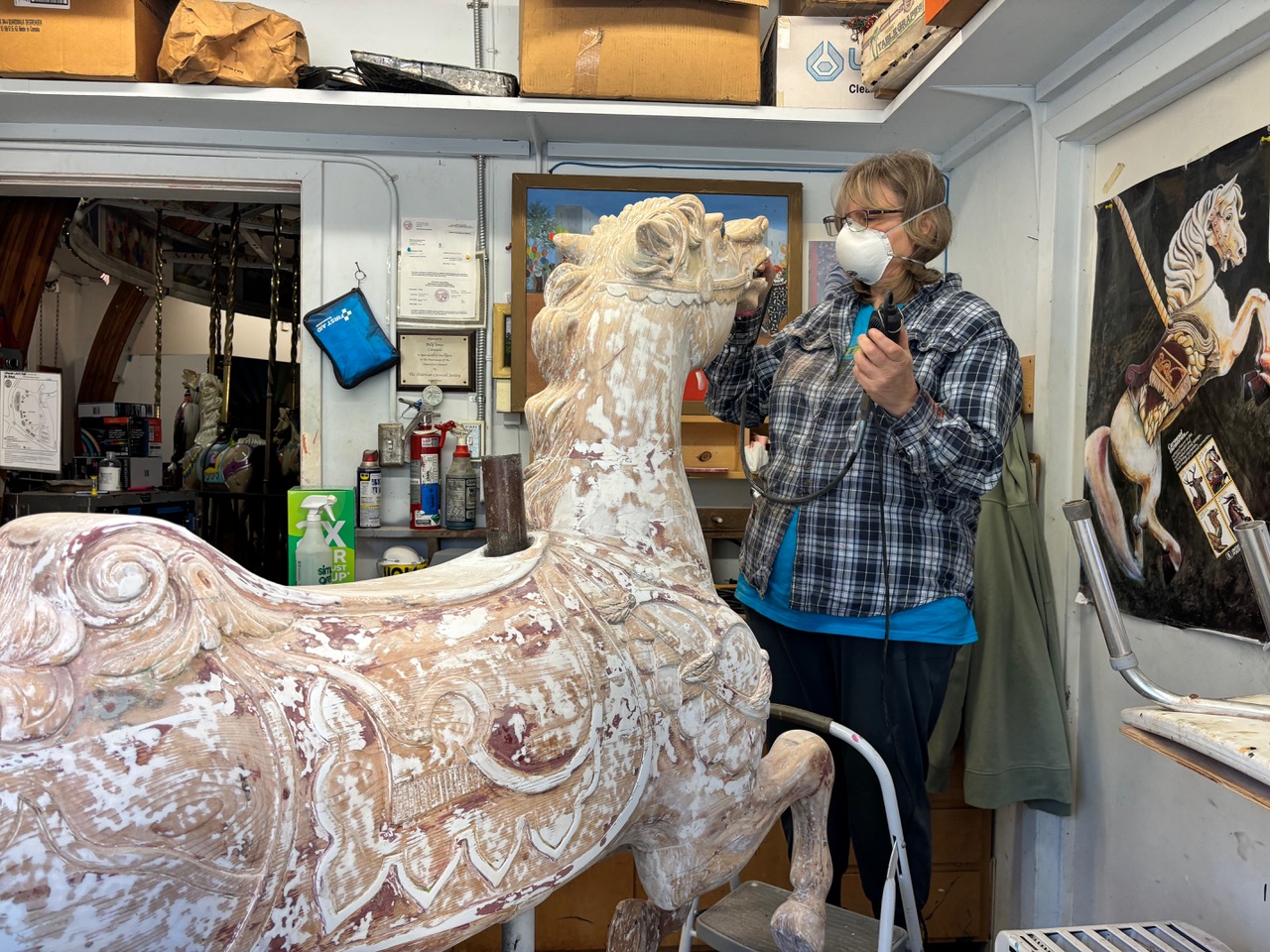
I find Stuermer in her workshop, window open, delivering a gold-standard dental treatment to her steed, Jungo. Stuermer doesn’t notice me lurking, a habit formed from streams of visitors on their stroll through Oak Meadow Park. Dremel in hand, Stuermer sands enamel paint between the horse’s teeth, his lips curled back in a whinny.
The whirring power tool is too loud to talk over, so Stuermer switches to hand sanding. I’m brimming with questions, but I think it’s best we begin at the start.
Why carousel horses?
“I am a graphic artist by trade,” she said.
One day, walking through the park, Stuermer ran into volunteer Kathy Murphy.
“I stopped and asked her what she was doing. I shared my background and said I’d really like to have a try. That’s all it took! I had a volunteer form in my hand before you knew it. It was good timing because the second workroom was finished and ready to go.”
It’s lucky Stuermer loves to try new things because painting the 3D form of horses was a new skill to master.
“I started off painting blank horses without carving. There was a real learning curve with specific brushes for pinstriping enamel paint. Transferring designs by tracing and taping didn’t work, so I had to draw freehand straight onto the horses.” Stuermer found support from online tutorials and carousel restoration groups.
Where do you find inspiration?
“Originally, it was a circus carousel, so I want to reflect that with bright colors and showcase similar designs. On arrival, the smaller horses were renaissance themed, chin to toe with fleur-de-lis. Right now, all volunteers are moving to get everything on the same page.”
Varied methods of painting through the years have added difficulty to the process.
“Some horses were painted with latex which becomes gummy with stripping.”
Mindful of preserving the quality of the wood, Stuermer works on small areas at a time, applying the least toxic formula to strip paint.
“The original canvas was disintegrated, the oval frames were missing their mirrors. Previous restorers took great photos and captions, but all of the horses had to be taken apart, re-carved and re-glued. Some weren’t salvageable, so a volunteer with fiberglass skills created molds from two of the horses. They’ll be used if we need to create horses in the future.”
Stirring trouble like Stuermer stirs paint, I ask, Which horse do you favor?
“Pegasus! Red and orange, he looks like he’s on fire! He was fun because I had to paint perfect swirls.”
Straight from the horse’s mouth. Named prized horse, Pegasus nickers, feeling one’s oats. Phantom and Groovy (the only fiberglass horses) have their chins tucked and legs bucked ready to dislodge me out of the workshop window. Jungo is the biggest naysayer. You can’t blame him, it’s not a fair race when he’s in the buff, lacking any color or dressage to his ornately carved barrel.
Our interview pauses when a young family stops by to watch. Their knee-high jockey rode Bullseye over the weekend. He’s excited when Stuermer shows him a pink and blue polka dotted design tacked to the workshop wall, but not everyone is as giddy with Jungo’s new look.
One little girl burst into tears as Jungo’s dappled gray coat was sanded away.
“How can you take his spots?”
Stuermer promised her that Jungo’s spots would reappear, and as more children took an interest, she polled their preferred colors. A dead heat finish confirmed equal splits of pink and blue.
The only regularly running historical carousel in California outside of amusement parks, Stuermer delights in doing her part to keep it in service. Not only has she peeled back paint, but also the carousel’s history. A year of research at Berkeley revealed the English carousel was built by Savage in 1910 and advertised at the 1915 Panama-Pacific Exhibition.
How can we retain this treasure for future generations?
“In 2017, we added our ‘Adopt-A-Horse’ fundraiser. $100 is the minimum pledge, with a one year commitment. The funds cover specific horse and carousel improvements, while giving back to our community.” Volunteers are welcome with open arms.
A fun way to donate and keep them spinning in circles could be to visit the Billy Jones Wildcat Railroad this weekend and saddle-up a horse!
The Billy Jones Wildcat Railroad’s spring schedule is currently in effect: 10:30am-4:40pm Saturdays and Sundays.
Applications can be found online at bjwrr.org/volunteers.