

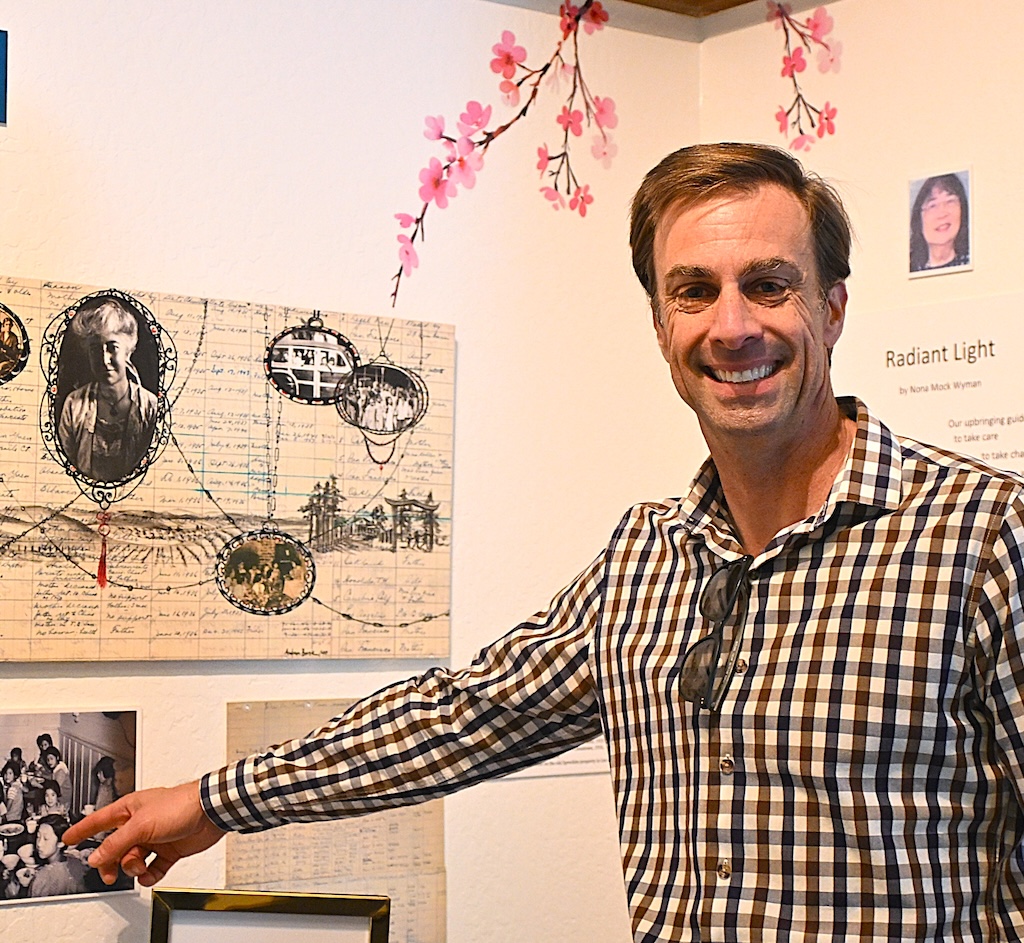
Pacific Clinics has quite the legacy. It grew out of a merger between Eastfield Home of Benevolence, a San Jose orphanage, and the Ming Quong residence, which assisted Chinese children who needed support, starting decades back.
Pacific Clinics envisions “a world in which all people realize health and well-being,” and is known as California’s largest nonprofit community-based behavioral health care provider. The organization offers a wide range of social services, including foster care and other housing programs, as well as adult and early childhood education initiatives. Their current staffing level? 2,100 state-wide.
Walking the Site
Last week I had the opportunity to visit the “Los Gatos Site” with Darren DeMonsi,
director of fund development in the Bay Area. “This is our 13-acre campus,” he said. “It goes from the upper campus, up by the arch, and it runs down here.” By down here he pointed to the Spreckels Avenue side of the hillside property. Before this became a group home (we’re talking more than a century-and-a-half ago) this was home to the Spreckels Mansion.
Onsite foster therapy
DeMonsi led me down the outdoor stairs to a small cluster of offices. “This is where a child in foster care can come and be with staff and receive therapy,” he said.
These youth can arrive here to meet with a staff member, or to connect with their parents or guardian. (These would be children who do not live here.)
“This is a neutral environment—a neutral place where meetings can occur outside the home,” DeMonsi said.
Check-ins with both the foster parent and the foster child help to enlighten how things are going, how they could be better, or how they could be better supported with different resources. A meeting here might also involve a biological relative.
On site “cottages”
DeMonsi adds, “the residential group homes program ended in 2018.”
Currently there are five cottages on the site, where one professional parent resides with a child-client. One is a duplex that’s being remodeled into two separate living areas.
The length of time an individual child stays here could be anywhere from three to six months (though some foster clients stay longer.) The length of time is determined by the progress the child-client makes.
The onsite cottage used to house residents in the board-care days past. “These buildings are not ideal for the type of service that we are providing, and for the intensive foster parenting,” DeMonsi went on. “We are doing what we can to transform the structures to be more efficient in terms of how we use them.”
But it’s a key part of coming up with a longer-term solution. “—or a long term placement, unlike group homes, which oftentimes are long term,” DeMonsi said. “This is temporary, until they can be placed in lower-level, foster care homes, or be reunited with biological families.”
“These kids have had multiple foster care environments. They just get bumped because their behaviors are too intense. And so, the goal really is to try and get their behaviors to manage the level that we can place them with their biological family, or a more permanent family situation,” DeMonsi explained. “Staying here at these cottages is almost like a triage situation, where we’re just trying to address the really intensive nature of their behaviors.”
Professional Parent Program
A so-called Professional Parent will stay onsite in these cottages with a single foster child 24/7. It’s an environment where this parent can live and work with the child in a neutral environment. “Maybe a client would stay here 15 months to one year,” DeMonsi said. “It’s very intense to get the behaviors down to a manageable level and then place them in a more permanent living situation.”
In the duplex cottage, they have a professional parent and a child on each side.
“So, it was a dorm style-multi bedroom kind of living situation, which was not easy to transition to the more intimate professional parent program where you have one professional parent for one child,” DeMonsi said.
With renovation underway, there will soon be five individual residential cottages.
“I think I would be very comfortable saying, we’re getting much better outcomes for the children that are in our professional parent program,” DeMonsi went on. “Or, to use a more professional name, Intensive Foster Care Services Program, that we did in the residential group home environment.”
“Eventually, with a professional parent with each client, they stay together 24 hours,” he said. “And, if there is a problem, the professional parent has the resources to go and get help.”
As our walk around the grounds was ending, DeMonsi offered me a tour of a bit of Eastfield Ming Quong Orphanage history, in the main building at the upper campus. Years ago the Strawberry Festival was a fundraiser.
“Coming up is this year’s fundraiser on May 16,” he said. “It will be held at Nestldown. Tickets are going fast and this event usually sells out. Shuttles will be running from West Valley College up to Nestledown.”
DeMonsi ended with, “We are hoping to raise close to half a million dollars.”
Do you have what it takes to be a Professional Parent?
Any individual age 21 or older can apply to become a professional parent (regardless of race, national origin, religion, sexual orientation, gender, gender identity or expression, marital status or family structure).
Applicants must be able to provide a stable, safe and nurturing home environment, in order to qualify. They must also have prior experience working with, or raising, youth.
Additional requirements include:
No other youth living in the home; and availability to provide full-time care in the home.
If employed outside the home, a second approved adult (like a partner or spouse) must be present to supervise the youth. This person must also complete all required training and background checks. Residence in or near Santa Clara County.
Who makes up a youth’s care team?
If extra care requirements come up while a child is living in Pacific Clinic’s Intensive Foster Care Services Program, a special team may be called.
In some cases, the child could be taken to a location where a more complete assessment can be performed.
Besides the professional parent, additional Pacific Clinics officials may include: a facilitator, a social worker, a clinician, a family specialist or a family partner who supports the youth.
Beyond that, there may be additional, external entities supporting the youth, such as a Santa Clara County social worker, or a court-appointed special advocate.
It all starts with the volunteers.
Monthly, the Happy Dragon Thrift Shop donates around $50,000 to Pacific Clinics.
At the store’s recent general meeting, Pacific Clinics provided training on how to address the uptick in unhoused individuals visiting the shop.
Conrad Welsh, Pacific Clinic’s program supervisor, and Shanice Johnson, a project manager, explained how the Trusted Response Urgent Support Team (TRUST) can help.
This TRUST team can respond in as little as 30 minutes to assist with individuals who may be causing a disturbance.
Welsh and Johnson presented practical approaches to handling issues, setting boundaries and basic deescalation techniques—such as responding with compassion while protecting the volunteers.
Also at this meeting, these volunteers discussed upcoming deep cleaning and renovation plans. Stay tuned to learn about the new and improved Happy Dragon. And by the way, the bag sale is coming up April 24-25.