
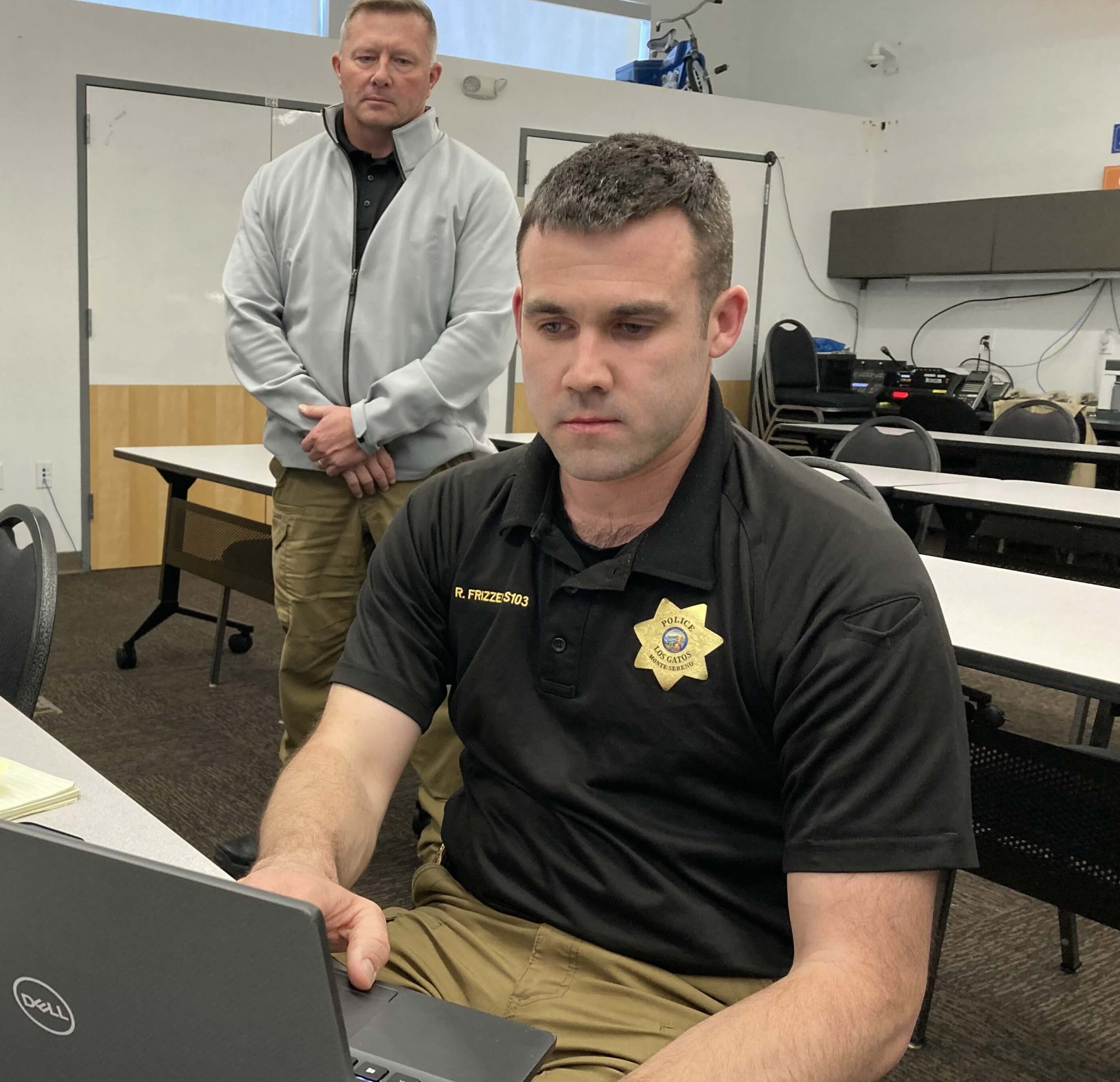
Detective Riley Frizzell crouched over a small Dell laptop at the Los Gatos-Monte Sereno Police Department Operations Center on Los Gatos Boulevard, Monday afternoon, hunting for a pickup truck.
There’d been plenty of activity going on at the Los Gatos-Monte Sereno Police Department in recent days: the semi-annual report to Council less than a week earlier, ongoing budget discussions in an era of cutbacks, the rise in scammers targeting local seniors and the upcoming Superbowl—which federal officials said will also play host to an ICE enforcement operation Feb. 8.
He ticked off a type of crime from the drop-down menu on the Flock Safety Group digital console, added the plate number and vehicle description and considered other filters to set up an alert within the license plate tracking software. He drew a box around the area he wanted to search.
Almost instantly, a series of photos of the suspect vehicle taken by cameras placed strategically across Los Gatos appeared on his screen. A notification pinged his cellphone.
Actually, he wasn’t tracking a hardened criminal, a missing person or an individual suffering from a mental health episode. He was following a coworker’s movements across town. But he wasn’t peeping on Det. Sgt. Harold Hoyt’s activities because he’d suspected the veteran officer of going rogue. Nope.
This was part of a demonstration of the ALPR (automated license plate reader) technology, provided to the Los Gatan newspaper by the Department, after Flock Safety was thrust into the spotlight, in the wake of neighboring Santa Cruz becoming the first municipality in the state to scuttle its contract with the company.
Community members over the hill were incensed to learn recently that Flock Safety data generated in Santa Cruz and Capitola had been accessed by out-of-state agencies on behalf of federal law enforcement, including ICE.
Frizzell says Flock has been an extremely helpful tool for solving a wide range of crimes, assisting people in distress and finding missing community members. And, investigators note, it’s a little more cumbersome to use than you might think, considering how quickly it times out (forcing you to log back in and confirm you will use the product responsibly).
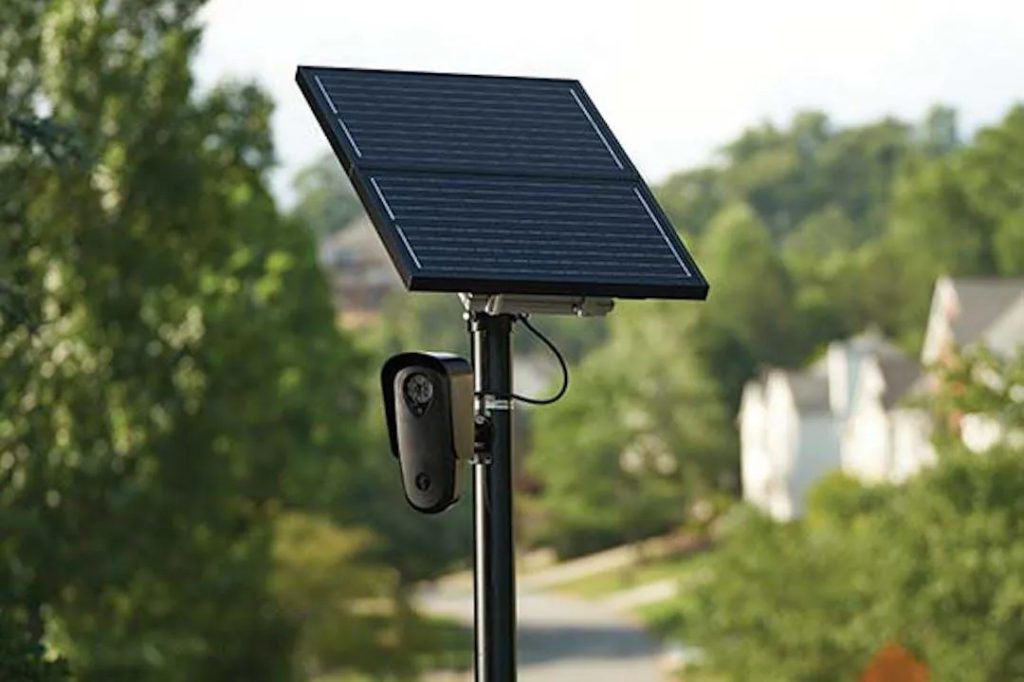
After Los Gatos secured a $100,000 Supplemental Law Enforcement Services Fund grant, on Nov. 3, 2020, it offered Flock Safety Group a sole source contract to set up and operate 15 license plate-reading cameras in the community. The concept was to “augment traditional Police services in the deterrence, interruption, and investigation of crime,” prior town manager Laurel Prevetti said at the time.

In 2021, the Town entered into a two-year agreement term with Flock Safety Group for fifteen ALPR cameras at a cost of $78,750. The Town later added two cameras and, in 2023, Flock Safety Group increased their subscription price to $3,000 per camera annually (up from $2,500).
After that, Flock pitched Town officials on a different concept—a five-year (60-month) “master services agreement” for $255,000 ($51,000 per year) for the 17-camera subscription. The department built in an extra $40,000 for unforeseen costs, bringing the total to $295,000. The contract is set to expire in 2029.
Other private groups allow the Department to search their cameras, too.
Steve Clark, the former deputy chief of the Santa Cruz Police Department, who is currently the vice mayor for the City of Scotts Valley (which doesn’t have a contract with Flock Safety, but does have one with Axon for body-worn-camera management), said in a telephone interview he thinks the City of Santa Cruz went too far.
“On the one hand I understand why the council took the action that they did,” he said of Santa Cruz’ choice. “But on the other hand, I think they lost sight of the public safety purpose behind that (technology).”
You have to find a way to balance data privacy worries with public safety concerns, he added.
“Law enforcement has to admit there’s been some abuses of it, and they need to clean that up,” he said, adding you can address privacy concerns practically, without going overboard and buying in to “conspiracy theories.”
(Drew Penner / Los Gatan)
He remembered the case of a missing older lady that was solved with the help of an earlier generation of license-plate-reading technology. She turned up in LA when her gold Chrysler PT Cruiser was imaged down there, he said.
But it’s not just Santa Cruz turning its back on the traffic surveillance tool. Los Altos Hills also voted to terminate the contract with Flock at its Jan. 15 Council meeting.
“Effectively immediately, all Flock cameras in Town will go offline. Town Staff is currently in the process of getting the Flock cameras taken down,” reads a message on the peer Silicon Valley jurisdiction’s website.
In November, Oakland City Council’s Public Safety Committee decided not to move forward with a $2.25 million contract with Flock. But in the end it was revived and approved by the full Council in December.
Concerns about the misuse of Flock’s databases have been mounting.
On Jan. 6, Flock Safety posted a blog stating that it doesn’t have a contract with ICE or any other Department of Homeland Security agencies.
“Flock does not share customer data with any federal agency without a local customer’s explicit choice and control,” the company wrote.
But 404 Media, a digital outlet, reported last year that ICE officials had managed to tap into Flock’s nationwide network. Los Gatos opted out of this country-wide database, only sharing with Santa Clara County agencies; it keeps records for 30 days, unless they need to be saved as part of a civil or criminal case. The ACLU says that Flock’s terms and conditions allow the company leeway to share some information with federal forces, even if local jurisdictions try to restrict data.
And earlier this month, Home Depot investors, led by Zevin Asset Management, began pushing that corporation to examine its relationship with Flock, citing issues with how the company could be sharing data with immigration officials.
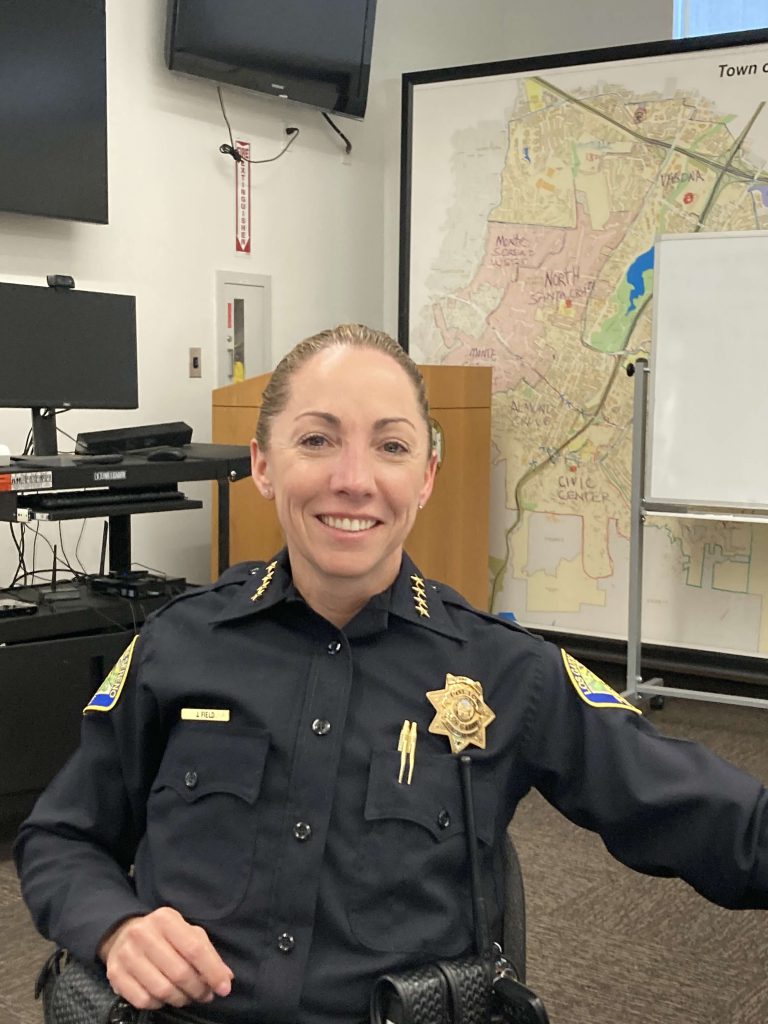
LGMSPD Chief Jamie Field says that she understands there are concerns out in the community. But, she added, while her department is eager to adopt new tech to fight crime, they are committed to making sure there are appropriate safeguards in place.
“We subscribe to the community policing model,” she told the Los Gatan. “I’m not going to jeopardize the community’s trust on one of these systems.”
During the Jan. 20 Los Gatos Town Council meeting, some of the department improvements came into focus: one new records specialist, three new trainees, four new members of the police explorers program (for younger residents), three new Disaster Aid Response Team members and the ongoing replacement of mobile data computers.
“We’re moving into a new era with the Los Gatos-Monte Sereno Police Department,” she told Council, adding they want to do this in a spirit of “trust and transparency.”
LGMSPD has expanded its drone program and added new citation software for automating enforcement actions.
(Drew Penner / Los Gatan)
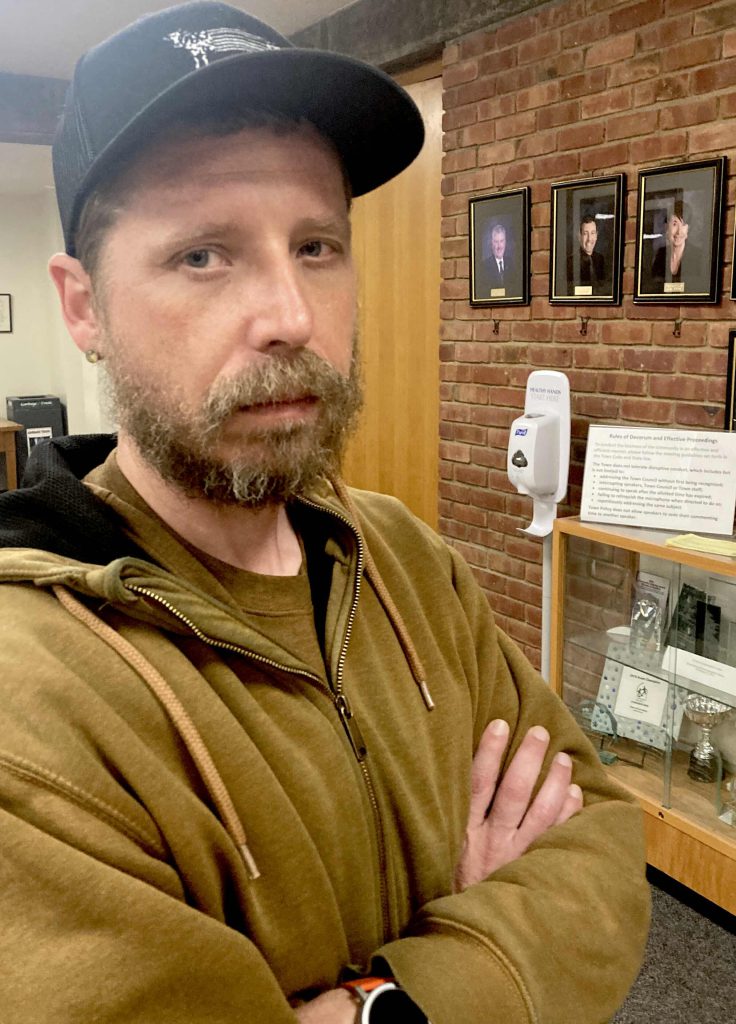
Los Gatos resident Austin Marshall spoke in person during the public hearing about his experience trying to request a series of documents about LGMSPD’s Flock Safety program using the California Public Records Act process.
Two of his four asks did not yield results.
“The Town came back and said there are no responsive documents,” he said. “I’m hoping that’s a mistake.”
He was supplied with a policy document, but the audit report he got was significantly blacked out, including the names of any agency besides the Los Gatos-Monte Sereno Police Department that’s been searching cameras across town.
“It’s controversial, in part, because it’s being abused,” Marshall told the Council of Flock’s system. “Every week it’s a new story.”
His other two requests had to do with training records.
When Councilmember Matthew Hudes asked why these documents were not provided, Town Attorney Gabrielle Whelan suggested it’s because they don’t exist.
“It would be a matter of whether or not the Town has them to provide,” she said.
Mayor Rob Moore asked the chief if Immigration and Customs Enforcement had accessed Los Gatos’ database.
“We have not had ICE reach out to us in that manner,” she said.
Chief Field said one of the new challenges faced by the Department is that criminals have been adapting, too, such as by obscuring their plates to avoid detection. This has meant fewer results from ALPR systems, though she declined to quantify the drop.
On Monday, Field told the Los Gatan that Marshall’s CPRA request had been reopened, to see if there might be Flock training records that were missed the first time.
She said that, while problems can arise with any new technology, it’s important not to overlook the benefits.
“I think we can ‘What if…?’ a lot of different aspects,” she said. “There’s all sorts of different databases that law enforcement has access to that could be used in ways that are unfavorable. There are bad actors in any profession.”
There are already guardrails in place, like state legislation limiting how local law enforcement can share ALPR data with federal immigration authorities and out-of-state agencies, she said, adding that crossing the line would likely be a “career-ending” move.
“What if we didn’t have systems like this?” she asked rhetorically, adding if a suspect vehicle connected to a violent crime arrives in the community, they’d want to know about that. “Yes, there’s risk in so many things that we do. But can we minimize the risk?”