

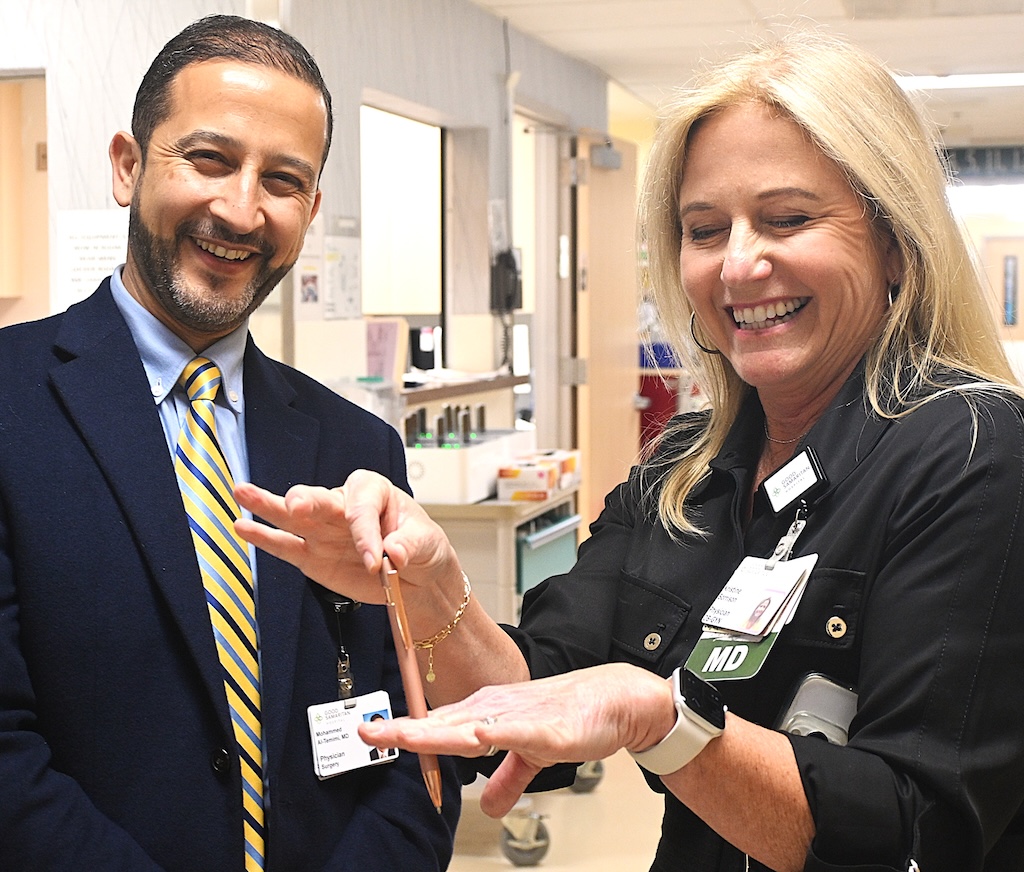
At Good Samaritan Hospital, a range of advanced, non-traditional surgical procedures are now being offered. On a recent tour I met with two surgeons, Dr. Mohammed Al-Temimi and Dr. Kristine Borrison.
Both are now using Intuitive Surgical’s “da Vinci Single Port” robotic platform.
These doctors, out of their scrubs, were eager to explain how robot-assisted surgery is performed.
With this new tool, surgeons perform complex but not-too-invasive procedures.
One small incision
“The robot is a tool that we use to perform surgeries,” Al-Temimi, a doctor specializing in oncology, colon and rectal surgery. “In the old days, people would make a big cut on the stomach to get inside and then do the surgery. Now we make a (one-inch) single cut. We put the camera and instruments into this small conduit incision. Then, we use robot-assisted platform tools to go through these little openings to do the surgery.”
I was beginning to understand that this is a giant improvement on the traditional old-fashioned way to perform surgery. It almost made me want to have a robot-assisted surgery myself.
Well, not so much. But, if I ever need surgery, I would want this method.
“Cutting-edge” technology
“The first thing that comes to mind is, like, are you doing the surgery, or is the robot doing it?” Dr. Al-Temimi went on. “No, the surgeon is doing the surgery, using the robot as a tool that has more precise movements and more clarity. It is like using a better quality lens.”
I also learned that the surgeons use the da Vinci SP to give the surgeon a 3-D view during the operation. The surgeon is in control, just like in the old days.
However, these days they can see around the targeted area.
No more going “under the knife”?
Borrison, an obstetrics and gynecology specialist—and the medical director for Good Sam’s robot-assisted surgery program—joined us as we walked down the hall to the operating room to meet the intuitive surgical da Vinci single port platform, affectionately called “SP.”
Dr. Borrison recalled, “The old way of a big incision, we just do not do that very much anymore. I did the first robotic surgery in 2010.”
She went on, “Because urology and gynecology were (the first) FDA approved for use with the robot. Then, general surgery came. And they’ve taken it over, because they do so much surgery. Both urology and gynecology are kind of deep in the pelvis. So initially, you know, robotic-assist surgery allows you to get into places that are harder to get around. The original robots only looked kind of in one direction—so you can only look one place at a time. Now this is the next level, where (doctors) could go all the way into all of the areas.” The da Vinci SP is wheeled towards the patient, and a team assists with procedures.
Is the scalpel obsolete?
Dr. Borrison’s enthusiasm was contagious.
“There’s a lot of different ways you can do a hysterectomy, but you know the old way of a big incision, you know, we just don’t do that very much anymore, because you can do it through the small incision.” Going on, she explained that the da Vinci SP is “—a tool. Just like the scalpel. It doesn’t cut anything. The surgeon uses a scalpel to cut…the surgeon uses the robot to assist with surgery. Bear in mind that the robot does nothing. It just is an interface that assists the surgeon and allows us to do more complicated things, because it kind of holds steady and allows us to manipulate things. But we’re doing all the movements. We’re making all the decisions.”
Binocular 3D vision
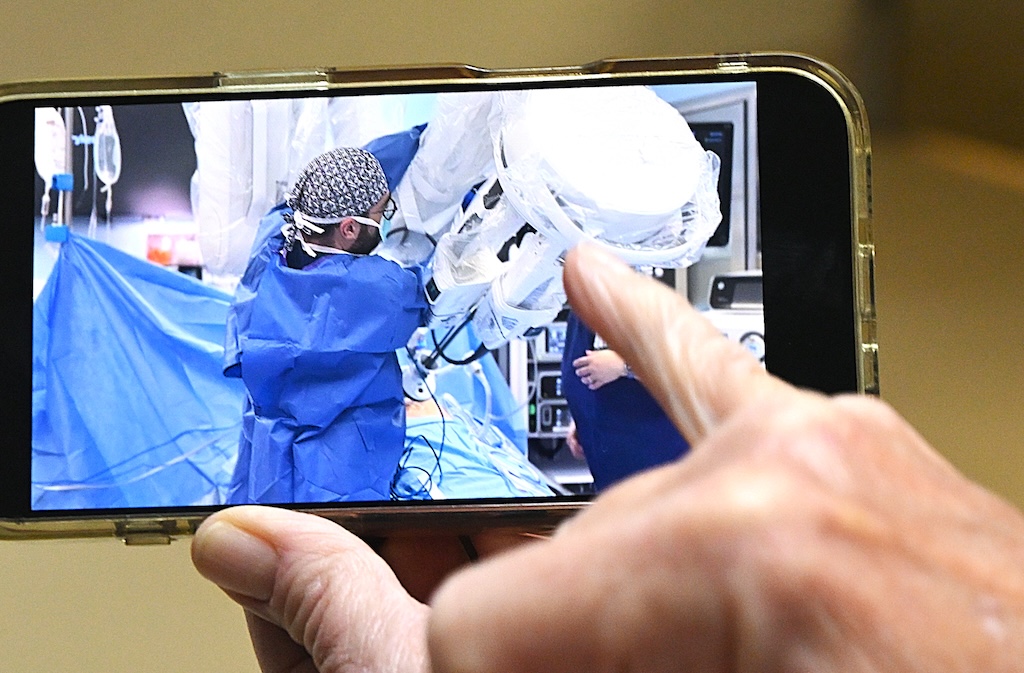
I asked Dr. Borrison about the robotic assist camera. “Better camera? Absolutely. We have 10x3D magnification, so we are up-close-and-personal sooner. On a traditional laparoscopy you would just have a normal camera. But, (with the da Vinci SP) we have—if you think about where you have two-binocular vision, right?—so you’ll see it. Because we put two eyes on it, so it makes the picture we are seeing in more depth in 3D”
Use for different surgeries
She then explained that the use of robotic-assisted surgery is used in many different areas of the human body when surgery is needed: “The use of robotic-assist has expanded to so many disciplines that you can not say which one is the most common.”
Dr. Temimi added there are many uses for robotic surgeons. “A lot of things are being done robotically now, from gynecological (proceedures) to erectile surgery, small intestine surgery to pancreas and liver surgery, (treating) hernias and (taking care of) lung (issues).”
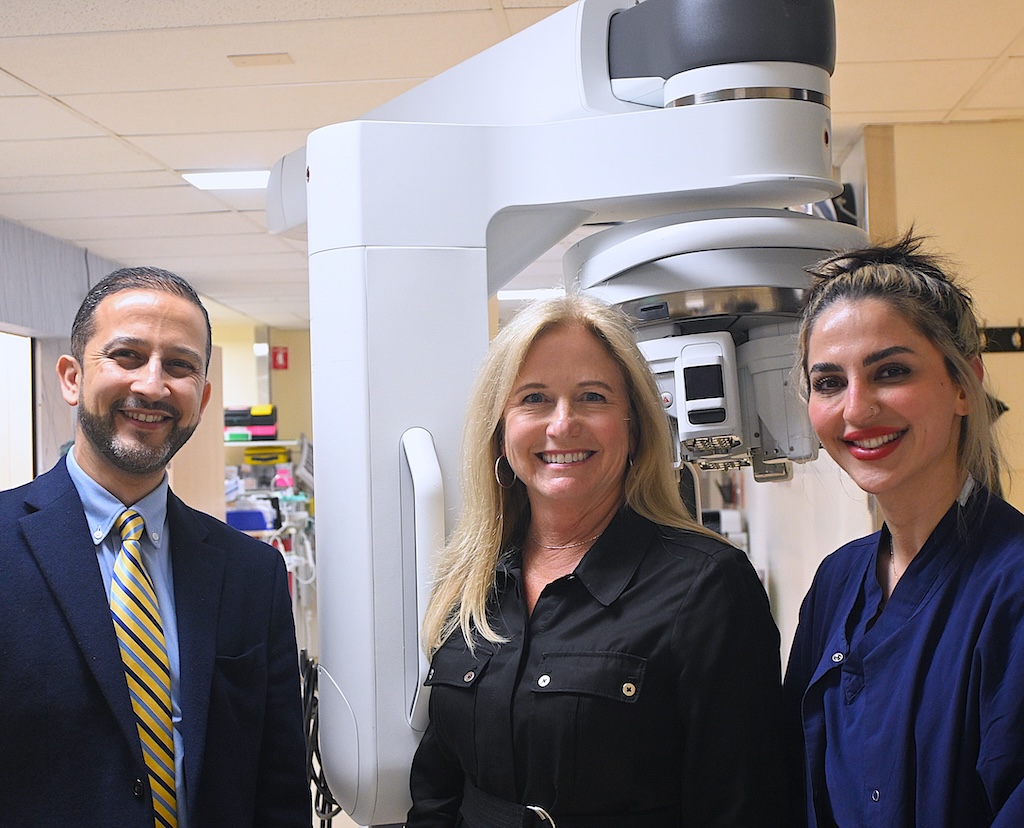
As we arrived inside the OR, Farah Osman, vp of surgery and CV service, greeted us with a smile. Osman was the only one in scrubs and on good terms with the da Vinci SP. She wheeled out this rather tall medical device. It sort of looked like an octopus. It has a console that goes with it. This is where the doctor doing the operation sits. As the console is sterilized and ready for the next surgery, it was not brought out.
Dr. Borrison explained how it all works. “There is one arm on this single port, and it comes in through the single port. This is all set up by the surgeon—exactly where we want the instruments to be, where we want the camera to be. We set it up how we want with the patient. And then we walk across the same room to the counsel leaving the assistant at the patient’s side.” A medical assistant monitors the patient throughout the proceedure. “We are all in the same room,” she concluded.
Dr. Temimi added, “This is the new iteration or one of the new versions of the robot that is single port. So, basically you have only one incision throughout the whole surgery.” Again that is why this is called the single port robotic assist. Previously surgeons used a robotic assist that had eight incisions.
Quicker recovery
Dr. Al-Temimi went on, “when you’re using your hands and making the big cut, the impact is mostly on the recovery. Using the da Vinci SP, the patient recovers faster, because they do not have to deal with a lot of pain, and the recovery is bigger. The probability of infection is less.”
Dr. Borrison added, “because these technologies have advanced, we can get around a lot of things that we couldn’t…through the small incisions before. So, there are fewer and fewer reasons that we need a big incision.” That used to mean a longer recovery time—and a big scar.
Dr. Temimi agreed and added, “As a surgeon, you plan the procedure; the robot has very little to do with that. You looked at the imaging and decided that this is the right fit for the operation. You decide where the incision is going to be, based on your analysis, and then you put the robot on (head in console)…It’s like a phenomenal tool.” Dr. Borrison noted that, sometimes, the patient can go home the same day as their operation. “It is almost like playing an organ,” Borrison said. There are feet controls, and the surgeon’s fingers fit into ports that fully control the robot. The da Vinci SP holds everything steady, offers a better view and has smaller instruments that can make more precise moves. It is truly “cutting edge” technology.
A local creation
The da Vinci SP robotic assist manufacturer, Intuitive Surgical, is headquartered in Sunnyvale. Bay Area hospitals are frequently among the first to adopt new medical technology. Good Sam is moving this direction—encouraging the use of minimally-invasive equipment and robotic instruments.
“Our surgical team receives continued training on the use of these instruments, staying up-to-date on the latest developments in surgical technology,” is how the hospital’s website puts it.
Now, about that next operation?