

“I can’t find them anywhere.”
A chill down the spine. A spike of adrenaline. Heart stopping, dropping—then racing. Panic spreads like contagion.
When a loved one with autism has gone missing, time freezes.
For those with autism spectrum disorder, a simple wander can be dangerous.
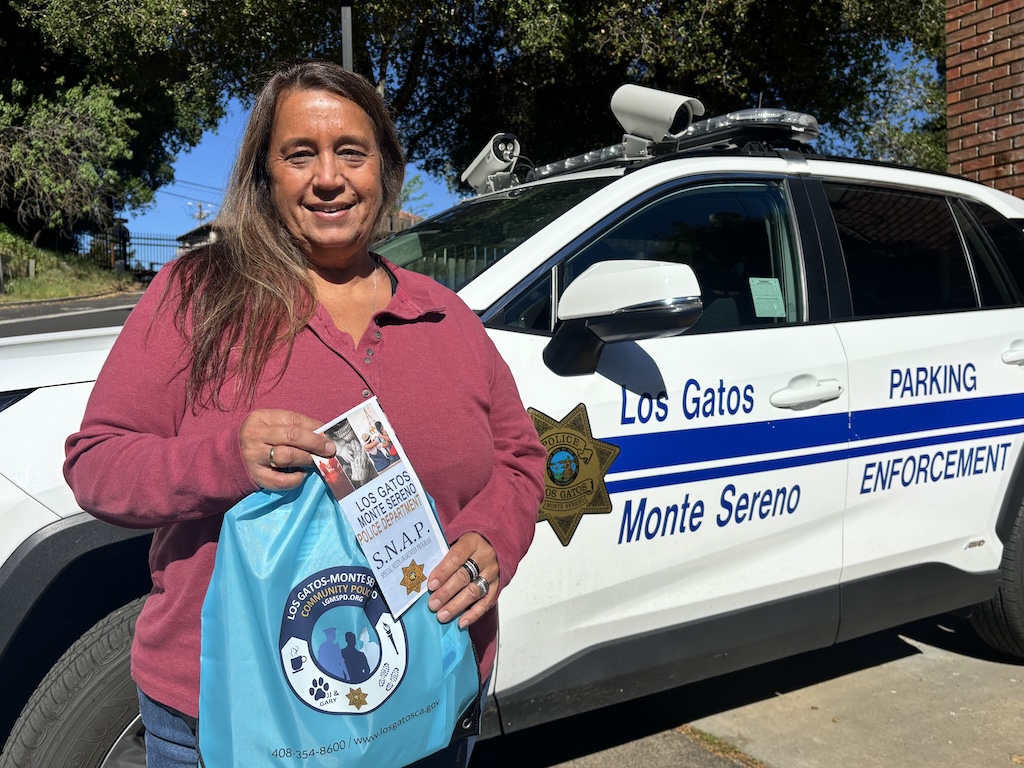
And Los Gatos-Monte Sereno Police Department Community Resource Officer Jackie Rose, who was recently nominated for a Chamber of Commerce award for her contributions, says too many tragedies are preventable.
Six years ago, Rose learnt how a mother and child were trapped in a house fire. Terrified, the child sought shelter in a closet. Unaware of the neurodiverse child’s instinct to hide when overwhelmed, first responders were unable to locate the child, she said. Both mother and child lost their lives in the blaze. Rose felt tragedy could’ve been avoided in this instance.
Determined to protect others with disabilities, Rose developed SNAP (Special Needs Awareness Program), a voluntary and confidential initiative designed to provide first responders with information to adapt their actions to situations involving people with disabilities.
“When a call comes in, dispatch checks if the address or license plate is a SNAP participant,” Rose said. “We’re lucky that Los Gatos dispatch shares information with the fire department. Other cities don’t.”
“When working with SNAP participants, first responders have the ability to turn off lights and cut sirens—common triggers for sensory overload for neurodiverse people,” said Rose.
Potential topics of conversation and personal interests are kept in the file. This helps first responders to build rapport and trust, she added. Anticipated behaviours are also listed, to reduce the risk of misinterpretation.
For one Almond Grove neighborhood family, SNAP proved invaluable when their young son went missing. Rose recalled how first responders were successful in locating the child within twenty minutes, thanks to information in the database.
With 1 in 31 children living with autism—and a plethora of Los Gatos-area clinics providing therapeutic services for ASD, and mental health more generally—it’s surprising that less than 30 Los Gatans are enrolled in the program.
SNAP was advertised on social media, and goodie bags were distributed at events. Rose provided approximately 300 welcome packets last year to new homeowners, including SNAP pamphlets and enrollment forms.
Rose shared SNAP with City of Santa Clara officials, who adopted the initiative there. However, College of Adaptive Arts Executive Director, Nicole Kim, said she was unaware of the program, despite the Saratoga-based college serving more than 200 students with disabilities each semester.
Also unaware of the program was Emma Luong, an associate professor who is herself on the spectrum. “This is a great tool,” she said. “Sensory overload feels like a pressure-cooker with a valve that’s not releasing. When the pressure blows, it’s hard to know how to manage that moment in a safe way.”
Research shows that 20% of autistic teens are stopped by police by age 21. That’s higher than their neurotypical counterparts. Lack of eye contact, inappropriate verbal response, or a lack of response—AKA expected behaviors for neurodiverse people—can be misinterpreted as signs of criminal activity, drug use or guilt.
One apparent example was Alexander LaMorie, a 25-year-old man on the spectrum. He was shot and killed in March in a confrontation with three Howard County, Maryland, police officers after he called for a wellness check. Knife in hand, LaMorie walked toward the officers and did not comply when they demanded he drop the weapon. LaMorie was a fierce autism advocate who lived in a purpose-built apartment for those with disabilities. He’d also just reported being the target of an extortion scam. Autism advocates have called for a transparent investigation.
“Some people with autism are very literal,” Luong said. “Specific directions help us to understand what we need to do with our physical selves. Instead of telling us to move, tell us where you want us to move.”
The limited reach of SNAP suggests there are still gaps in the local system, at least for now. Drowning is the leading cause of death for children with autism. And considering we live in an earthquake prone area—and with fire season around the corner—experts say it’s essential to have a safety plan in place for those most at risk, including our autistic loved ones.
Local service providers for those with disabilities are encouraged to share SNAP pamphlets and cards at their place of work.
For more information about how to help distribute SNAP pamphlets, visit losgatosca.gov/2583/SNAP or call (408) 354-8600.