
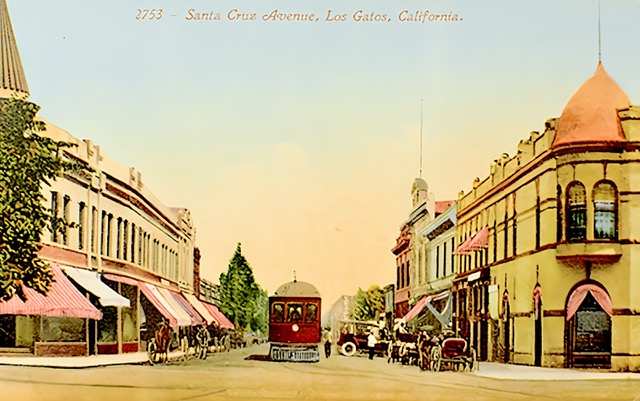
Imagine how convenient it would be to step aboard a trolley in downtown Los Gatos and relax in comfort as you travel to Palo Alto or San Jose. It would be a reliable and time-efficient way to commute without worrying about getting stuck in bumper-to-bumper traffic. You could take your family all the way to Alum Rock Park on a summer afternoon or explore new restaurants without the expense and hassle of finding a place to park. What’s amazing is that you’re not imagining a distant future, you’re reliving the past!
In the late 19th century, shortly after the advent of electricity, entrepreneurs began developing plans for streetcars which could travel over long distances using electric power. Several private companies applied to Santa Clara County for licenses to operate a rail line powered by overhead wires between San Jose and Los Gatos, mostly via existing roadways. In an era when the automobile was considered just a toy for the very rich, public sentiment was strongly in favor of a so-called “inter-urban” transportation system. Merchants believed that it would stimulate business, students thought it would offer easy and reliable transportation to school, and people anticipated an inexpensive and convenient way to explore new destinations.
After several unsuccessful attempts by competing companies to raise funds and secure rights-of-way, the San Jose – Los Gatos Interurban Railroad began operating in March of 1904. The 18-mile line ran down the center of Main St. and North Santa Cruz Ave. then along Saratoga – Los Gatos Rd. (Hwy 9), Saratoga Ave., and Stevens Creek Blvd. before terminating in downtown San Jose.
Trains ran hourly at speeds up to 30 mph. Compared to a four hour horse-and-buggy ride between Los Gatos and San Jose, a complete trip with multiple stops took only 30 minutes! There was also a short extension along Big Basin to Congress Springs.
The streetcar business proved to be extremely profitable. Within five years, three other interurban lines were operating in the valley. At the height of the electric trolley’s popularity in 1915, 126 miles of track crisscrossed the area.
Compared to the traditional railroad, with huge, lumbering steam engines, the little electric streetcars were a marvel of early 20th century engineering. They were quiet, efficient, and featured innovative safety features such as air brakes. Each car comfortably seated 52 passengers. The interiors were elegantly finished in handsome carved cherry wood, with brass trim, electric lights, etched glass sliding doors, and genuine leather seats.
The interurban line ran daily mail and express cars. During harvest season, boxcars were leased to orchardists to haul fruit to local canneries. In 1910, special trains with observation cars were introduced so that riders could tour the area during springtime when the orchards and wildflowers were in full bloom.
The trolley ultimately fell victim to the advance of the automobile as more people were able to afford the convenience of personal transportation. Ridership declined and the business quickly became unprofitable. Streetcars also became a nuisance when competing with increased automobile traffic, occasionally resulting in accidents. They were ultimately deemed obsolete, and service was discontinued in March of 1933 just 30 years after inception.
It’s ironic that the Valley of Hearts Delight — with slightly more than 100,000 people in 1920 — had a more advanced public transit system than today’s Silicon Valley with a population of 2 million.
Alan Feinberg is an award winning local historian and founder of the LOST Gatos Project www.lostgatos.com. Since 2015, his mission has been to generate enthusiasm among Los Gatos residents for remembering and preserving our town’s unique character and historic treasures before they’re lost forever. For more Los Gatos history, download the free mobile app Discover LOST Gatos by Alan Feinberg, Peggy Conaway, and Sandy Decker and take a self-guided walking tour through our historic downtown.