By Ruslan Kraynov
When equipment fails and then starts working again a few minutes later, there is a very tempting thought: “Maybe it fixed itself.”
But those intermittent failures can become some of the most expensive. That’s not necessarily because an expensive component has failed, but rather, because the most valuable thing disappears: information about what was happening at the moment of failure.
Sometimes all you need to do is take a photograph, note the time the problem occurred, and make one accurate observation about what the machine was doing right before it stopped.
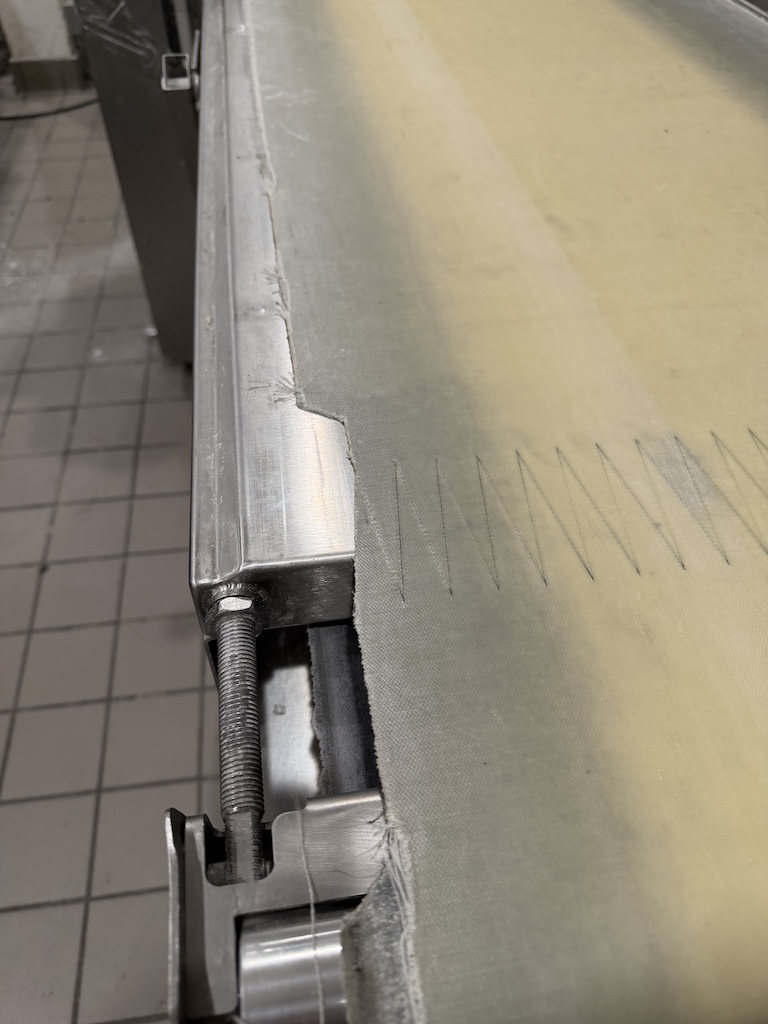
A recent problem involving an industrial dough-processing machine shows how quickly a small mechanical issue can become a production problem.
One edge of a long conveyor belt was badly damaged, along with part of the adjustment mechanism.
For a production bakery, that is not a cosmetic defect. Without a reliable belt, an important piece of production equipment can effectively be taken out of service.
The obvious conclusion is easy: The belt is damaged, so replace the belt.
But that is only half of the job. The more important question is, Why was the belt damaged in the first place? Among the things that should be checked are belt tracking, roller alignment, tension, bearings and whether the belt is contacting part of the machine structure.
If a new belt is installed without correcting the underlying cause, the replacement may gradually track to one side and begin damaging itself along the edge all over again. A deviation of only a few millimeters, barely noticeable at first, can eventually become a production shutdown—and a repair costing thousands of dollars.
So a useful question during almost any repair is: “Are we correcting the cause, or only replacing what was already damaged?”
Another case looked completely different. A coffee machine worked normally for about a month after installation. Then, its drainage became progressively worse until the machine could barely discharge water. The natural suspicion would be that it was an internal problem: a drain pump, valve, sensor or control system. But the problem was actually outside the machine.
The drain hose had been installed almost horizontally. The wastewater was supposed to leave primarily by gravity, but a long section without sufficient downward slope gradually retained water and residue. Small amounts initially passed through. Over time, resistance increased until what had appeared to be a perfectly functional installation became a genuine drainage problem.
Another case involved a commercial refrigerator in an office. The evaporator gradually accumulated a heavy layer of ice. Eventually water would appear. The refrigerator had been defrosted, inspected and repaired more than once, yet the problem kept returning. Looking only at the refrigerator, it was reasonable to suspect the automatic defrost system. But there was an important operating condition: the refrigerator door was being opened very frequently.
Every door opening brings warmer, moisture-laden air into the cabinet. When that air reaches the cold evaporator, moisture condenses and freezes on its surface. The more frequently the refrigerator is opened, the more ice the defrost system has to remove.
In this case, the system was not necessarily broken. It had simply been configured for one operating pattern, while the refrigerator was actually being used in another. The normal defrost cycles were no longer sufficient to remove all of the accumulated ice. After the other components were checked, the solution was much simpler than replacing another major part: the controller was adjusted so defrost occurred more frequently and lasted long enough to remove the accumulated ice.
We are used to making data-driven decisions in almost every other area. Yet the operating history of physical equipment often exists only in the memory of whoever happened to be standing nearby when it failed. When that person leaves the jobsite, much of the information leaves, too.
Connected equipment is gradually changing that. Some systems can already retain fault events, defrost history, parameter changes and other details. But it’s important to remember that having the information is not the same thing as using it.
Ruslan Kraynov owns KONGRA LLC, an independent appliance and equipment repair business serving the Bay Area: kongra.org
He used ChatGPT 5.6 Sol as an editorial and research assistant to help write this story, which is based on real unlying cases.