
We all need those reminders — the little sparks of inspiration on why we chose a certain path when there was a simpler alternative right in front of us. Returning to the California Scholastic Press Association journalism workshop as a counselor this past July was mine.
The two-week annual intensive, hosted on Cal Poly, San Luis Obispo’s campus, celebrated its 75th anniversary this year. The workshop, which began as a boys-only sports journalism workshop in 1951, now trains high school journalists on a variety of aspects of journalism — including political reporting, feature writing and public relations.
Reporters from publications including The Wall Street Journal, The New York Times, NBC and the Los Angeles Times teach classes exposing students to beats ranging from crime and politics to obituaries and features. Students write multiple stories each day under tight deadlines, covering mock press conferences, interviews and breaking-news scenarios designed to force them to quickly determine the most newsworthy information for writing.
I attended the workshop as a student in the summer of 2024 before my senior year of high school. It was an election year and over those two weeks, I watched breaking news unfold through the eyes and perspective of my instructors. Joe Biden announced on X that he was dropping out of the presidential race and current President Donald Trump was shot in the ear at a campaign rally in Butler, Pennsylvania.
I still remember one of my instructors from the NYT immediately logging onto his computer to write and file a story related to the fallout on deadline — seated right next to us in class. I knew then I wanted to be exactly like him.
I learned so much about news fundamentals and strong journalistic practices as a student that year that carried me through my first year of college. Coming back this year as a counselor to help the instructors and look after the students, it was refreshing.
The same certainty for journalism I had in 2024 was fading.
Coming into Boston University as a journalism major, I was elated to finally be surrounded by people who cared enough about journalism that they wanted to study it in college.
Don’t get me wrong — my time at the Saratoga Falcon newspaper at Saratoga High was rewarding, but for most students there, the paper was an afterthought. It had a robust staff of 70 by the time I graduated and my advisor, Michael Tyler, was nothing short of supportive of the stories the publication wanted to chase after.
But for a STEM-focused, academically high-strung school, why would the arts take precedence? For most students, the class fulfilled a graduation requirement, and then those who enjoyed it decided to stay with it until they graduated.
I’ve learned, though, that if you want to pursue journalism seriously, it isn’t enough to just enjoy it. You have to love it.
And I mean LOVE it.
Let’s be real — the pay is rarely glamorous, work-life balance is difficult under the 24-hour news cycle and much of your work is consumed in minutes — if readers even make it past the third paragraph (so, if you’re reading this, I’m happy you’re here!).
When my introductory classes at BU didn’t challenge or engage me, I started to question whether I truly loved it. Coming back to the Bay Area this summer, where the default career paths often seem to be engineer, doctor or — if neither works out — “pre-broke,” it was easy to question whether journalism still has a place.
Add to that an industry wrestling with artificial intelligence, shrinking newsrooms and changing business models, it is hard to picture what the profession will look like in ten years.
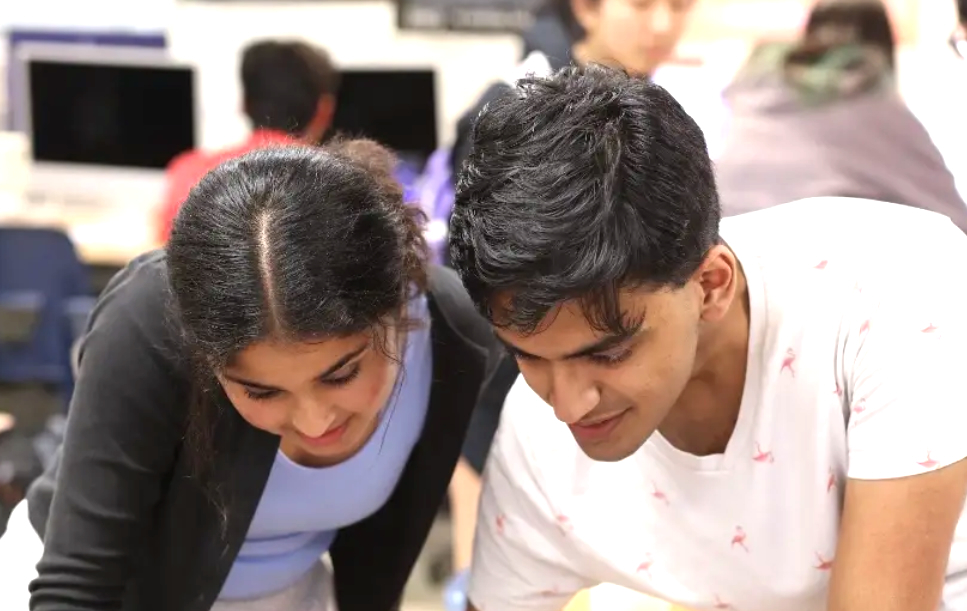
Yet, for two weeks, I watched curious students from all over the West Coast raise their hands and ask how to structure a lede, understand their rights as journalists and tackle some of the ethical dilemmas today facing the profession.
Being back alongside CSPA’s instructors — reporters whose bylines I read every day — made the profession feel “human” again. To have instructors take the time out of their work to spend time investing in the next generation’s development — as volunteers, might I add — is special.
Their passion was contagious and reminded me of why the industry matters.
In celebration of 75 years, the association held a reunion. Six decades of CSPA alumni came and spoke about where life had taken them after the workshop. Some became journalists. Some did not.
I spent an afternoon listening to generations of reporters describe how the profession had transformed over the course of their careers. Typewriters to computers. Notebooks to smartphones. A morning, afternoon and evening paper to a fully online 24-hour news service platform.
Journalism never disappeared. It has evolved.
The news itself isn’t going anywhere — that I am sure — just the form in which we deliver it.
I’d be remiss to say I wasn’t a little jealous of the generations that came before me, when newspapers landed on doorsteps three times a day. I’d also be lying if I said I wasn’t nervous about where this industry is headed.
But I’d be lying to myself if I said I didn’t want to help shape whatever comes next.
I’ve never been particularly superstitious, but I do believe that sometimes life has a way of reminding you why you started. I never thought I’d be so grateful to spend 12 days living in a stuffy dorm and sitting in a classroom sweating because it had terrible air conditioning.
Thank you, CSPA, for being that reminder. For helping me rediscover the little spark that first convinced me journalism was worth choosing—and for reminding me that, despite everything, it still is.