
If the West Valley Muslim Association had proposed a by-right high-density housing development (and it could have)—instead of a slight extension of hours—the build would already be sailing towards automatic approval.
That’s because, in California, certain housing projects receive an automatic green light if it takes the municipality more than five public meetings to take action.
And May 13 was the fourth hearing on the Conditional Use Permit modification request for the Los Gatos Islamic Center. It came and went without a decision, once again.
Instead of the current 10pm closing time, WVMA wants a 10:30pm operations cutoff, plus half an hour to vacate the premises (and 11:30pm, plus an extra half-hour for dispersal, during Ramadan, when sunset is prior to 7:30pm; and midnight and half-an-hour for exiting when sunset is after 7:30pm).
They are agreeing to be bound by new morning hours limitations (being allowed to start arriving 1.5 hours before sunrise—so, about 5:50am this year, at the earliest).
“This has been a long, drawn-out process for our community,” said WVMA founder Razi Mohiuddin after the Planning Commission item was continued, keeping his messaging upbeat. “The diligence on this is really commendable.”
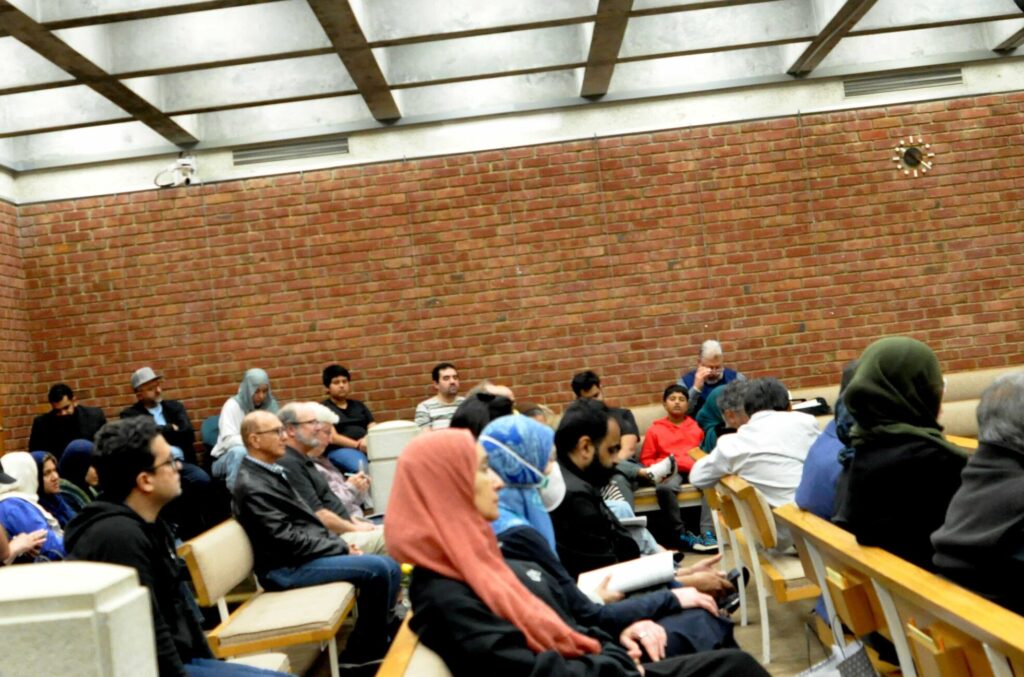
Pleasant laughter could be heard amongst the Muslim attendees as they filed out, with the lack of definitive action from the Planning Commission beginning to verge on absurdity. Some had come from more than an hour away for what they’d hoped would be last time.
The item had been at the finish line, after a compromise at the last hearing resulted in a unanimous vote. Staff said the item could be finalized later via a simple “consent motion,” meaning it wouldn’t have to be debated again.
That was until Town officials looked at several of the conditions placed on the mosque’s CUP and decided they might be against a federal civil rights law called RLUIPA, which protects freedom of religion.
It states that the government is not allowed to treat one religion differently than another when it comes to land use matters.
And so, after Commissioner Emily Thomas recused herself (due to the proximity of her home to the mosque), Town Attorney Gabrielle Whelan ran through the reasons why the prior decision likely wouldn’t stand up to legal scrutiny.
“It used to say that there would be an annual compliance review in perpetuity,” Whelan said.
(Drew Penner / Los Gatan)
This wouldn’t be acceptable, she said, since Los Gatos doesn’t subject its other religious groups to this level of oversight.
But, because at least one other worship site does have a three-year compliance review period, staff suggested this approach could be a way to keep tabs on the Muslim group without treating it unfairly.
However, amongst the changes, staff tried to slip in a major additional restriction to Islamic activities allowed during morning hours.
“It previously spoke to ‘hours of operation’ in general,” Whelan said, adding staff decided to make a distinction between prayer and other activities in the pre-dawn hours.
The new rules would say that “worship” is allowed in the morning at the Farley Road site—but nothing else. That represented a major new restriction beyond what Planning Commissioners had even asked for.
But the biggest change was the finding that limiting the number of worshipers to the number of vehicles allowed in the mosque parking lot was inappropriate.
“We were not able to locate any other conditional use permits that had a limitation on the number of vehicles,” Whelan said, adding it was sort of an ineffective tool anyhow, since public parking is allowed on both sides of their street.
And the restriction on amplified sound had to go, too, since staff couldn’t find another religious-institution CUP that included such a requirement.
“Staff is proposing an alternative condition that would provide that the applicant must comply with the Town’s noise ordinance,” Whelan said.
(Drew Penner / Los Gatan)
Planning Commission had hoped that the Los Gatos-Monte Sereno Police Department would be available to provide traffic control training to mosque officials. However, the Department wasn’t interested in taking on this job, so that point had to be reworked. Now WVMA is being asked to look for an outside organization to offer such classes.
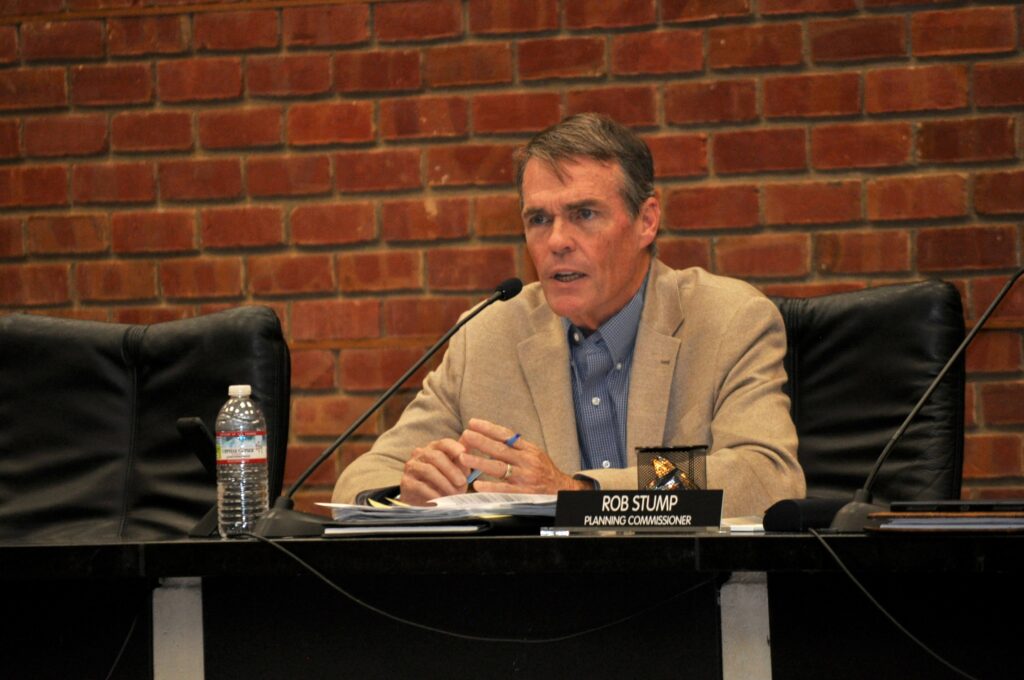
Because the document had been redlined so much, Planning Commission voted to reopen the public hearing—but not until after Commissioner Rob Stump suggested a new 720-person straight attendance cap.
That was essentially a new approach to arrive at the same numbers—derived from a maximum-calculation of an average of four people per vehicle.
(It was unclear if Stump was envisioning the number rising to a maximum of 920 people allowed at all times, once WVMA renovates their lot to include more parking spaces—which is a requirement.)
And he put in a max capacity of 869 into his motion for during Ramadan. That comes from the number of seated individuals allowed in the building under total occupancy rules. However, it represents a reduction during the holy-month-of-fasting nights—from Stump’s prior motion, where he brought up the idea of using the “max capacity”—meaning up to 1,217 standing individuals. (His new motion would currently be an increase of 149 people during Ramadan mornings from what was previously supported unanimously—but actually a reduction of 51 people when the parking lot is improved, as last meeting’s version allowed for 920 people at that point, pre-dawn.)
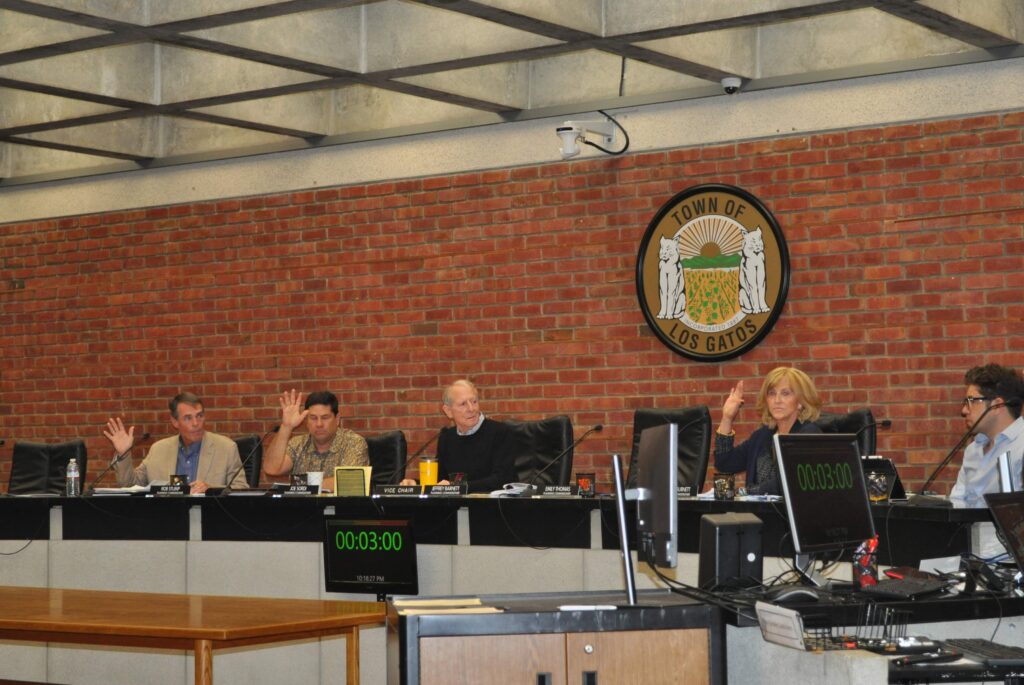
This set off a tense back-and-forth between Stump and Vice Chair Jeffrey Barnett, who was leading the meeting in Chair Kendra Burch’s absence.
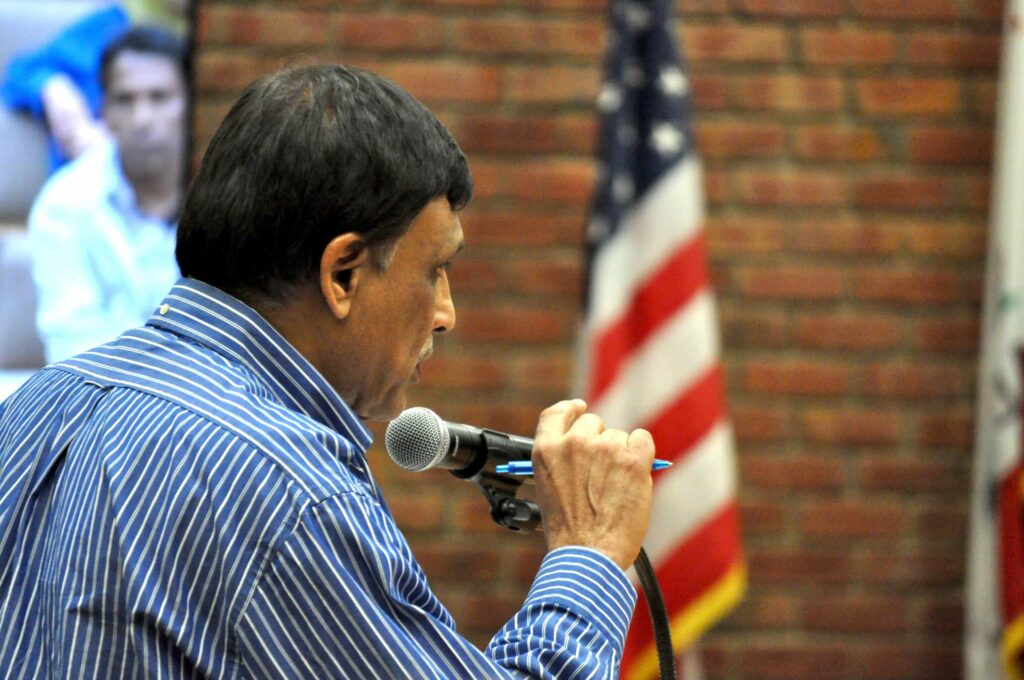
(Drew Penner / Los Gatan)
Barnett asked staff about the legality of Stump’s new attempt to cap the number of Muslims coming into the Farley Road neighborhood.
Staff said at least two other local religious institutions have parking limits that use a ratio of 1-to-4, so it might be defensible.
Barnett asked if there are those that don’t have such limits. Staff confirmed some don’t.
Plus, the Town Attorney noted, even if you do put in a restriction based on parking, you’d have to justify it, based on how RLUIPA works.
“We’ve got 3,500 people a week travelling through that neighborhood,” Stump said. “They could have 3,500 people at their site a day. So, what is really the restriction?”
Barnett said he stood in strong opposition to Stump’s revived attendance cap.
“We’re interfering with the First Amendment and the RLUIPA rights,” he said, suggesting the consequences for violating those could be severe. “I think that those need to be deeply considered.”
Already the NAACP has warned Planning Commission not to make a decision rooted in Islamophobia.
The motion to restrict attendance based on parking spaces—passed 3-2, with Joseph Sordi, Susan Burnett and Stump in support; Barnett and Adam Mayer voted against.
Speaking first after the public hearing was reopened, Razi Mohiuddin, the WVMA founder, spoke politely with focused change requests to the new motion.
He called the three-year compliance review period too onerous. And he said changing the wording of the opening-hours rules to say congregants can’t be on the premises except for “worship” would expose them to the risk of people questioning whether certain types of fellowship really should be considered valid Islamic worship.
Currently they have a prayer service followed by a brief talk and a small discussion group, he said, adding on some occasions they’ll even have coffee together.
“We are under intense scrutiny,” he said, adding he’s afraid people will use this as a tool to come in and say, “‘Ah, you can only pray and you must leave.’”
The prior Friday, they had to spend time with the deputy fire marshal, after yet another complaint, he said.
And at this point, they’d rather just have a flat closure time, Mohiuddin continued, rather than language that gives worshipers a specific period of time to vacate the premises, as that’s hard to manage.
In regards to capacity, Mohiuddin pointed out that 869 is not the ceiling—1,217 is.
Stump’s interrogation of the Muslim leader on this point was so off-putting to Barnett that the Vice Chair cut him off with, “I think he understands the question.”
Mohiuddin maintained his composure, asking that the total number of worshipers explicitly include offsite parking arrangements—something that was previously discussed—punctuating his request with, “—if that’s okay with you.”
The Farley Road neighbors made it clear that they feel the Town isn’t going far enough to restrict traffic in the neighborhood.
Jim Ratcliff, speaking over Zoom, said he and the other residents have seen little in the way of meaningful enforcement. He doesn’t want the Town to remove the ongoing compliance review period.
“They’re going to be able to amplify outside,” he said. “I want limited activities on the weekend…I want a cap on the cars per day. I want some relief from this traffic…There needs to be a balance here.”
Former Monte Sereno mayor Javed Ellahie, who is Muslim, pointed out that the parking restrictions on other worship facilities have nothing to do with capping the number of attendees to the facility. They are simply that: parking restrictions, he said—adding the regulations can’t be used in reverse as a weapon.
He asked people to consider if it was reasonable to expect you could say, “Close the church down!,” if they had more people at a service than their parking ratio specifies.
Another Farley Road resident suggested closing parking on one side of the street and instituting permit parking in the neighborhood might be another solution.
And a speaker questioned whether WVMA is really facing financial burdens, since it’s in the process of buying a former Mormon church at 20125 Bollinger Road in Cupertino—hoping to come up with millions of dollars to pay for that by June 12 (they’d raised around $339,000 by our print deadline, which rose to $539,000 by May 20).
In the end, Planning Commission decided to punt the decision to the May 21 meeting.
*The story has been updated to correct the proposed seasonal late-hours exceptions specifics, and to clarify the number of noticed meetings