

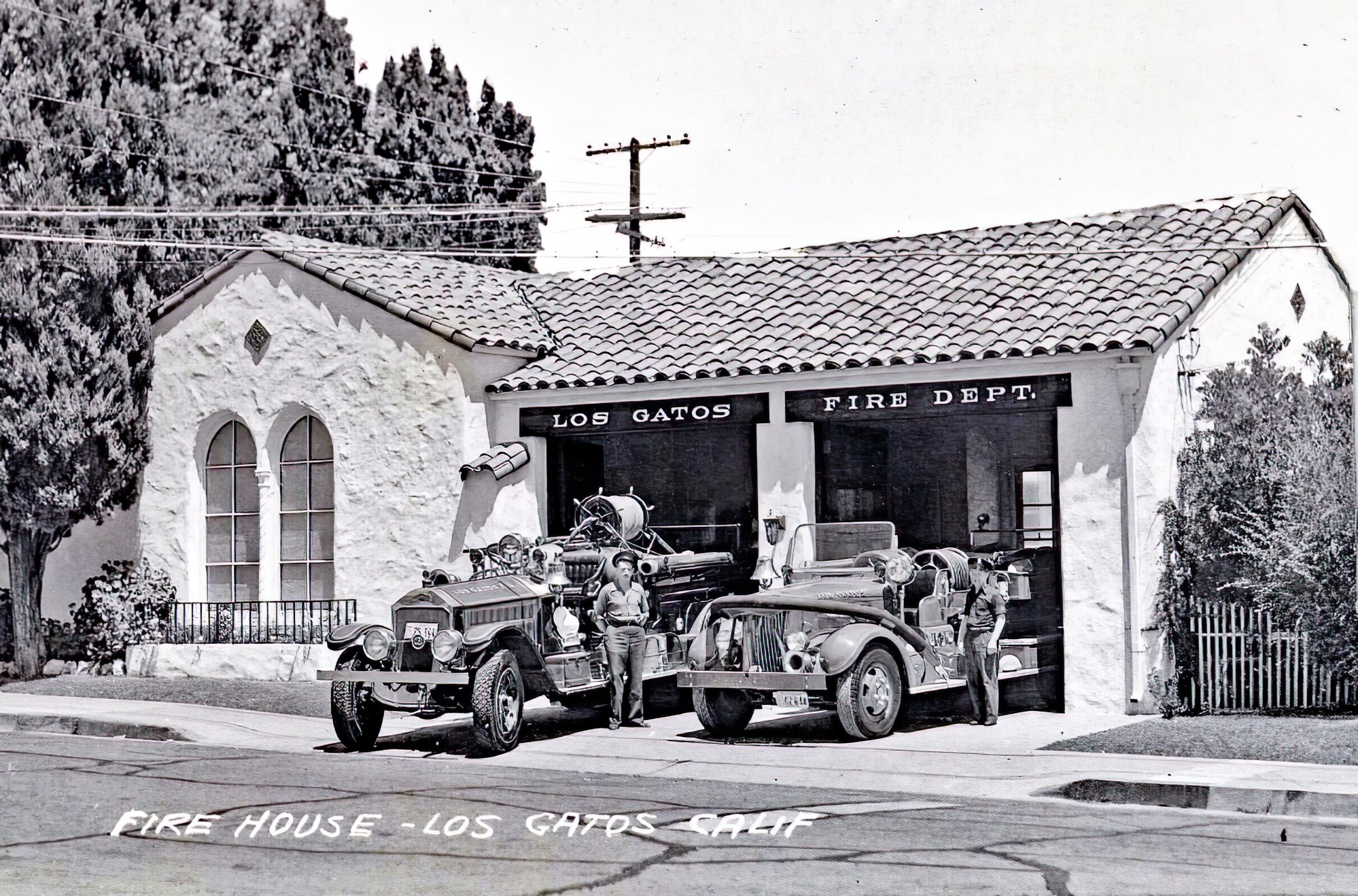
The old fire station on the corner of Tait Avenue and West Main Street is a familiar sight to those of us who live on the West side of town. The Spanish Revival style building, with its stucco walls, low hip roof clad in red clay tiles, broad eaves, and arched entry, is a typical example of a small civic building in Northern California during the early 20th century. Despite its age, it looks almost the same as the day it was built nearly 100 years ago.
Ironically, the fire department’s first headquarters burned to the ground in the Great Fire of 1901 which destroyed almost the entire downtown business district. They continued to operate without a home for the next 25 years since a replacement wasn’t an important consideration for the all-volunteer department. The part-time “fire laddies” as they were affectionately called, were paid $2.50 to $3 each time they were called to a fire.
Investment in modern firefighting equipment was a priority. With the passage of bond issues in 1915 and 1916 the town raised enough money to purchase two state-of-the-art fire engines to replace its aging 19th century hose carts and hand-drawn hook and ladder wagon. The first was a combination chemical and hose truck (on the right in the photo) and the next was a more substantial 750-gallon pumper. The department was justifiably proud of their American LaFrance fire engines which were considered to be the finest that money could buy.
American LaFrance, based in Elmira, New York, was one of the oldest and most prominent manufacturers of fire apparatus in the United States. Their fire engines were renowned for their toughness, durability, exceptional quality, and strong performance. The familiar red engines became a staple of fire departments throughout the country.
A successful $30,000 bond issue in 1926 made it possible for the town to finally construct a permanent fire station. The original floorpan, with the main entrance at 4 Tait Ave., included compact living quarters and a chief’s office. The garage facing Main St. housed the fire engines. The station opened in 1927 and served the community for nearly 40 years.
It found a second life as the town’s first history museum when the fire department moved to a larger facility on University Avenue. in the 1960s. The garage became exhibit space and the office and living quarters became curatorial and storage rooms. This adaptive reuse preserved the original exterior features while interiors were reconfigured for exhibit circulation. The story is an archetypal one in preservation: a small-town civic building whose scale makes it both historically recognizable and practically reusable.
When the history museum relocated to the Forbes Mill Annex, the space was converted into a dedicated art museum. The two museums merged in 2015 to form the New Museum of Los Gatos (NUMU) and their exhibits were moved into the former library space in the civic center. Both buildings have remained vacant ever since.
There’s been considerable discussion and speculation over the past few years about the future of the fire station. Last month, the Planning Commission voted unanimously to recommend that the Council approve a zoning change for the town-owned property from Central Business District to Single-Family Residential Downtown with a Landmark and Historic Preservation Overlay. The Town Council subsequently voted 5-0 to approve. Since the property is also in the Broadway Historic District, we can be confident that any exterior renovations to convert the building into a private residence will be very strictly controlled.
Alan Feinberg is an award-winning local historian and founder of the LOST Gatos Project www.lostgatos.com. Since 2015, his mission has been to generate enthusiasm among Los Gatos residents for remembering and preserving our town’s unique character and historic treasures before they’re lost forever. For more Los Gatos history, download the free mobile app Discover LOST Gatos by Alan Feinberg, Peggy Conaway and Sandy Decker and take a self-guided walking tour through our historic downtown.