
Let’s welcome the newest addition to our vibrant downtown dining scene, Heritage Pub & Chop House, with a brief look at the history of their iconic home.
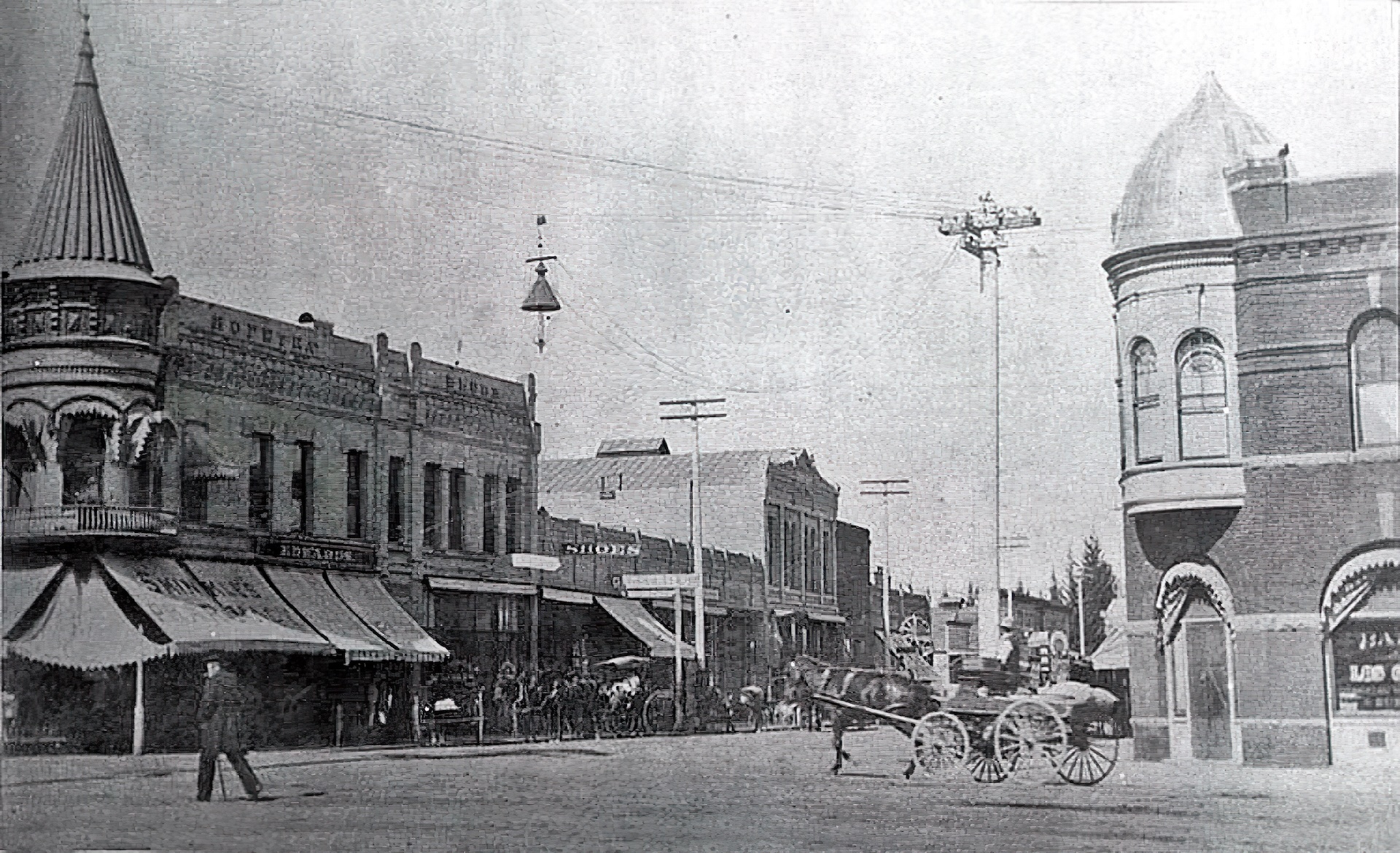
With its second-story circular bay window topped by what’s known in architectural circles as a “witch’s hat” roof, the Queen Anne-style building on the corner of North Santa Cruz Avenue and West Main Street has been a prominent feature of our historic downtown almost since the day it was built.
It’s been photographed, sketched, and painted countless times. In fact, it’s so well recognized that our Chamber of Commerce has a symbol of the tower as their logo and a photo of the building on the cover of their 2026-7 Official Destination Guide. Yet the history of this landmark building—and the story of the man who built it—have largely been forgotten.
The property was developed by a Dutch immigrant named Sake Anthoons Hofstra who was born in Friesland, The Netherlands, in 1830 and emigrated to the United States at age 24. He settled in the predominantly Dutch community of Holland, Michigan, where he spent most of his life (with the exception of a brief period in the 1890s when he lived in San Jose).
In 1891, perhaps sensing the opportunity for investment in the rapidly growing town of Los Gatos, he purchased real estate here on North Santa Cruz Avenue. His first project was a single story commercial building at #9-13 and a companion two-story building at #15-17. The latter had five retail stores on the first floor and the Independent Order of Odd Fellows (IOOF) lodge on the second.
He added the familiar corner building (#1-7) in 1895 and named it the Hofstra Block. If you look closely at the photograph, you’ll notice the single story building in the middle, but you may need a magnifying glass to read the faint Hofstra Block lettering on the left parapet.
Shortly after the project was completed, Sake’s name appeared in newspapers all over the state. Much to his chagrin, he had fallen victim to a group known as the “gold brick swindlers.” Hofstra paid $10,000 cash (about $300,000 today) for what he thought were gold bars that turned out to be made of brass. He never recovered his money, but was instrumental in landing the crooks in prison. He told police that he was such an easy victim, he thought he must have been hypnotized.
When Sake died of heart disease in San Jose in 1897, he left the property to his daughter Irene Wilhelmina Hofstra Markres who sold it shortly thereafter. The new owner, George W. Scott, added a second story to the middle building in 1905, making the three separate buildings appear as one. His original upper floor tenant was E.E. Place’s furniture store and mortuary.
It was converted into Mountain Charley’s saloon in 1972 and now houses Heritage Pub & Chop House. Coincidentally, both this restaurant and Gardenia are in properties formerly occupied by the same family-owned funeral parlor.
The property traded owners over the years, one of whom changed the name to La Cañada (Spanish for “canyon”) sometime after 1912. It’s currently owned by the Farwell and Bacigalupi families who restored it after it suffered extensive damage in the Loma Prieta earthquake. Although his name has long since been erased from the façade, Sake Hofstra would be proud to see that his property is a major contributor to our Downtown Historic Commercial District.