

Just a few blocks from where the Seattle Seahawks were battling the New England Patriots for football’s biggest prize Sunday, giant turquoise boxes and palms were bathed in sunset rays, as a nearby mid-rise office building hummed.
Around a paved bend, inside a hacienda-style structure, an assortment of people of all different backgrounds, including from various Latin American countries, had gathered at Pedro’s Restaurant & Cantina to watch Bad Bunny perform a halftime show destined to create waves before it began.
“Everyone knows he’s going to say something,” is how 47-year-old Rigo Aboyte put it.
Aboyte worked at the Pedro’s location in Los Gatos for seven years. These days he runs a mango business in Mexico. But he’s returned on vacation.
A murmur of excitement arose as people remarked at how Bad Bunny, the top-streamed artist on Spotify who is from the American territory of Puerto Rico, would indeed be singing totally in Spanish.
People smiled—and even laughed—at the various ornaments of the performance, but no louder than the set piece that paid homage to Maria Antonia “Toñita” Cay, the owner of Brooklyn’s Caribbean Social Club.
One person was draped in a large Puerto Rican flag, others waved smaller ones.
Vanessa Rojas, one of the employees, was enthralled. She couldn’t help but sing along.
“The song I liked the best is ‘DeBÍ TiRAR MáS FOToS,’” the San Jose resident said in Spanish. “Because, we often forget to save memories of what we love most.”
Rojas, who is originally from Columbia, said she appreciated the message of unity that Bad Bunny portrayed.
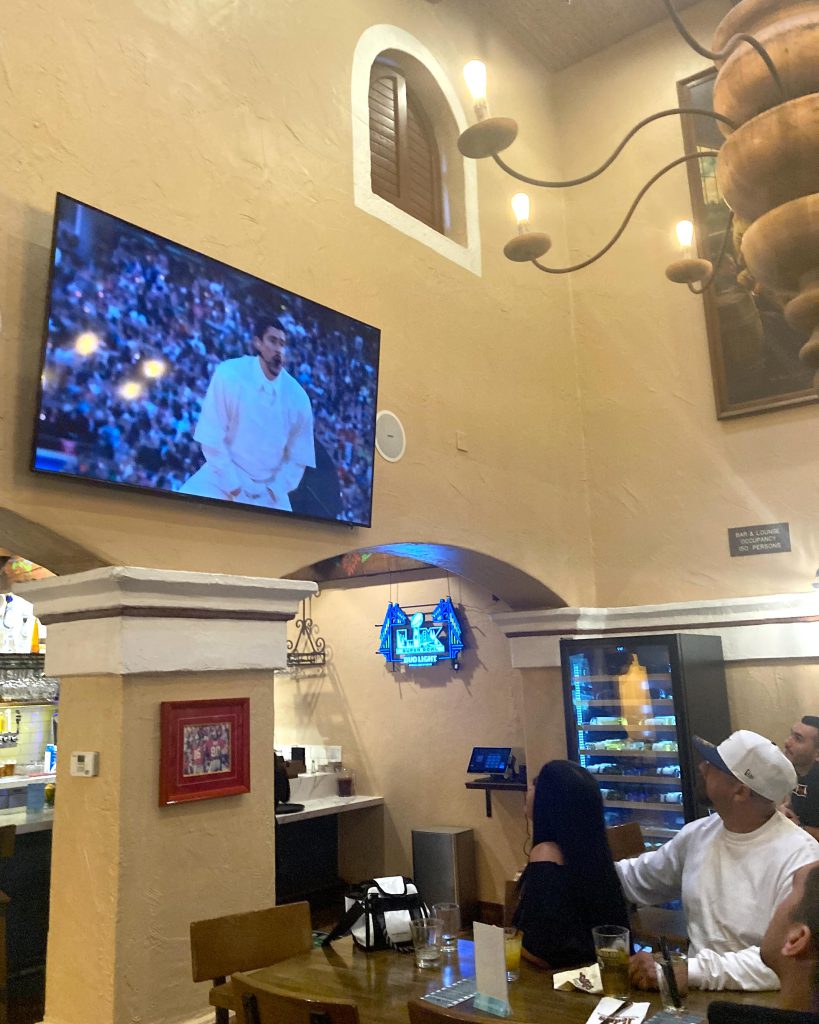
(Drew Penner / Los Gatan)
The specter of the Trump administration’s heavy-handed—and many argue unconstitutional—approach to enforcing America’s immigration rules hung over the lead-up to the Super Bowl.
That resulted in the deaths of two white American citizens—Renee Good and Alex Pretti—who opposed the influx of Immigration and Customs Enforcement and other federal officials to the streets of the Twin Cities of Minneapolis and St. Paul.
“ICE out,” Bad Bunny had said during a speech at the Grammys exactly one week before his Super Bowl halftime performance. “The hate gets more powerful with more hate. The only thing that’s more powerful than hate is love. So, please, we need to be different. If we fight, we have to do it with love.”
At Los Gatos Town Council on Tuesday night, several public commenters asked Los Gatos to follow in the footsteps of the neighboring communities that have made it clear they won’t allow federal immigration officials to use municipal resources. On Saturday night, Mayor Rob Moore told the newspaper he wasn’t interested in spending his political capital attempting to get this issue back on the agenda at this time, after he was the lone vote in favor of the idea the last time it came before Council. However, he’d be open to doing something later on, he added.
Five people would be injured in a shooting downtown San Jose on Sunday night; that followed the two killed after gunfire broke out nearby, early that morning. Those incidents weren’t part of an ICE enforcement operation or a protest.
‘it was life-changing’
—Maggie Mitchell
Over in Santa Cruz, just before kickoff, as 6-8-foot waves crested at Steamer Lane, the iconic surfer statue sported a black shirt that read “ICE OUT”, while a healthy outcropping of protesters lined Mission Street to voice displeasure with the current immigration policies. Even a motorcyclist heading over Highway 17 hump was displaying an anti-ICE message. The Los Gatos-Anti Racism Coalition had held another vigil for the people who died at the hands of federal authorities the previous day.
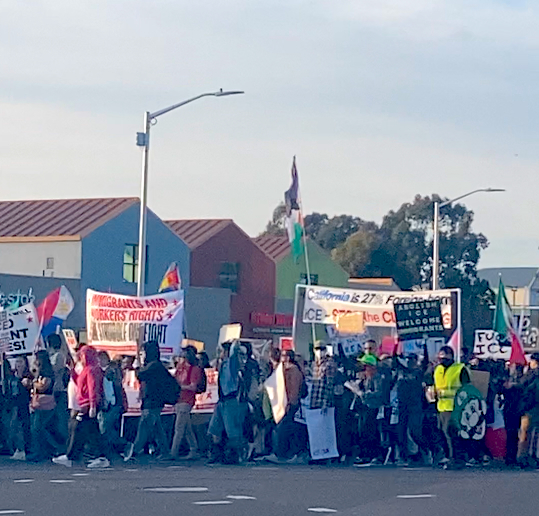
Compared to the demonstrations at the Winter Olympics in Italy, which targeted America’s immigration policies, amongst other grievances—and led to clashes with police as Vice President JD Vance took to Milan—the Santa Clara action was pretty tame.
Around 500-1,000 people marched through the streets outside Levi’s Stadium. Organizers and a police officer at the scene confirmed there were no arrests. Local officials and activists said they were not aware of ICE having made an appearance, contrary to initial statements from the Trump administration that were later clarified.
The 60th Super Bowl did, however, feature a US Navy and US Air Force flyover to conclude the national anthem, in celebration of the country’s 250th birthday—the first time they’ve ever done something like that at such a scale.
“You have to hit your time over the target of ‘Home of the Brave’ at that moment, and nothing duplicates something that is high stress, high stakes like the Super Bowl,” U.S. Air Force Sports Outreach Program Manager Katie Spencer told Military.com.
Major General Kent Hillhouse, U.S. Army (Ret.), president of the Veterans Memorial & Support Foundation of Los Gatos, visited Moffett Field ahead of time to honor the participants and pay tribute to America’s service members.
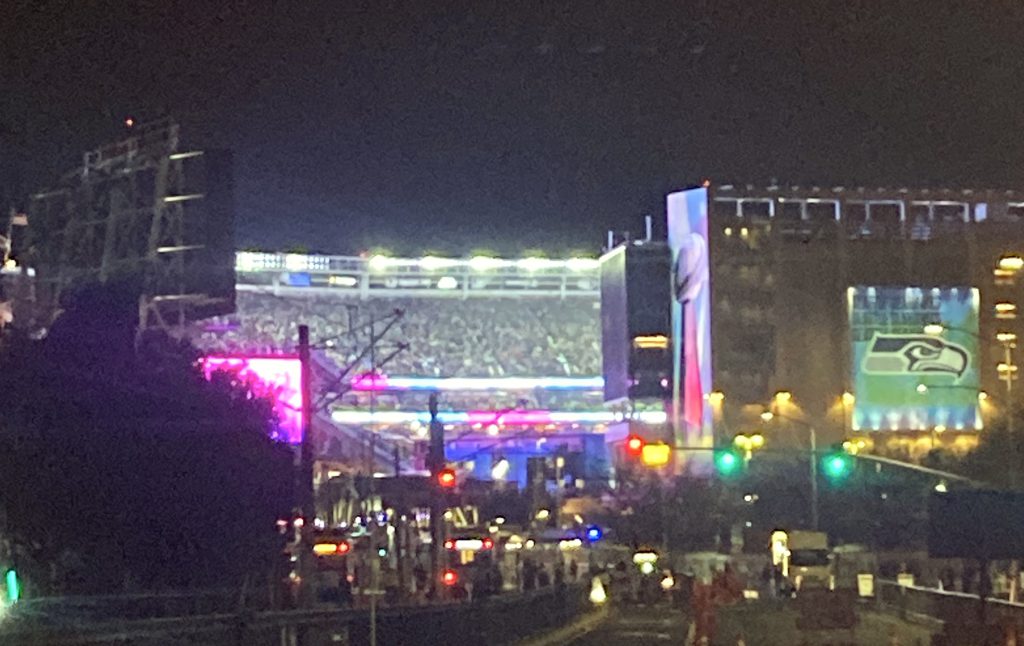
(Drew Penner / Los Gatan)
“America remains the land of the free because of the brave—and General Hillhouse proudly represents that legacy,” a spokesperson for the organization said.
There weren’t any overt Grammy-style call-outs in Bad Bunny’s halftime show. Instead, he commanded a powerful spectacle filled with joyous, subtle statements, oozing with sexuality and plenty of heartwarming scenes.
What did Rojas think about the approach Bad Bunny decided to take?
“Super!” she said. “For the Latino community living in this country, and especially because of the immigration situation.”
Not everyone loved the halftime show. President Donald Trump called it “absolutely terrible, one of the worst, EVER!” adding, “It makes no sense, is an affront to the Greatness of America, and doesn’t represent our standards of Success, Creativity, or Excellence.”
A relatively young, white Super Bowl attendee (a 49ers fan) who left the game in the fourth quarter, just prior to the Seahawks being crowned the victor, said he was a bit confused by the sugarcane props—it didn’t make sense to him, since Puerto Rico, he said, wasn’t ever part of the slave trade.
Spain used the territory as a military outpost as the country colonized the Caribbean, as well as Central and South America, according to the Schomburg Center for Research in Black Culture, which notes the Spanish National Assembly only abolished slavery in Puerto Rico in 1873.
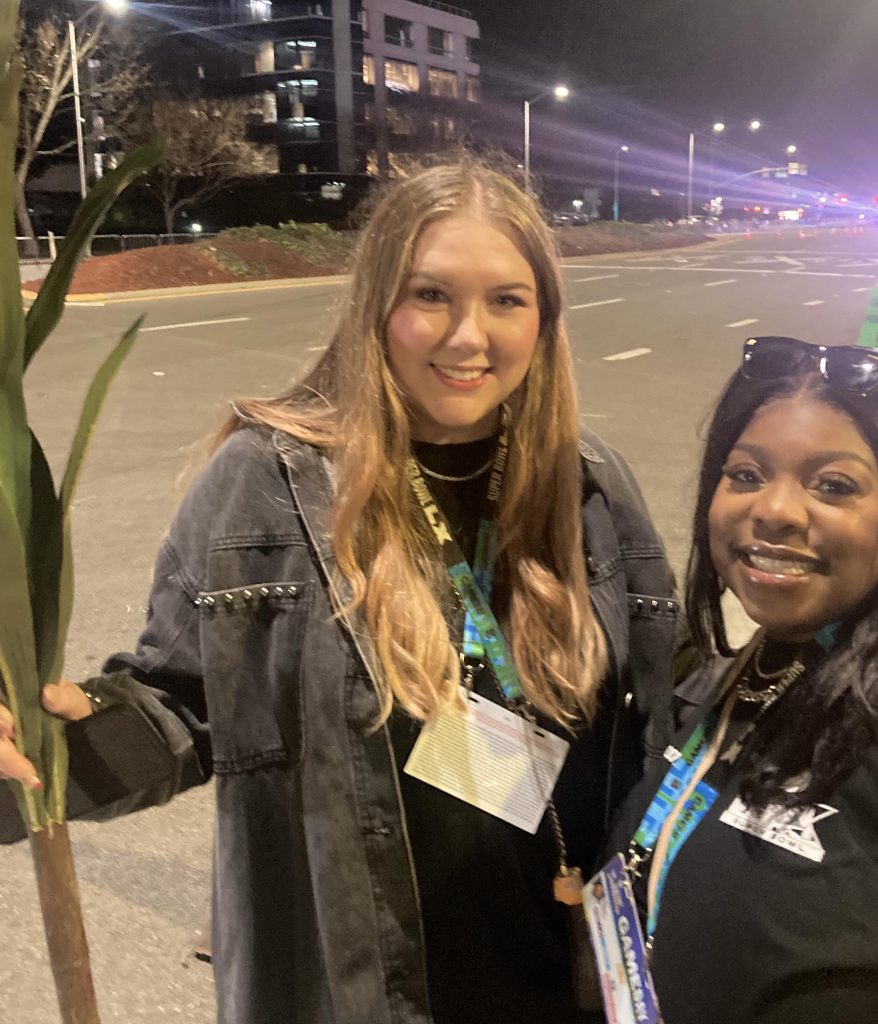
(Drew Penner / Los Gatan)
It took leaders of the Puerto Rican abolitionist movement, such as José Julián Acosta, Francisco Mariano Quiñones, Julio L. de Vizcarrondo, Ramón Emeterio Betances and Segundo Ruiz Belvis to bring that about, per the Library of Congress.
Jada Thomas, a 28-year-old white woman from Atlanta, was thrilled to be able to take one of those sugarcane stalks home with her. She was on the production team for the halftime show, as was Maggie Mitchell, a 27-year-old Black woman from Atlanta.
“He is really the sweetest guy ever,” Mitchell said of Bad Bunny. “We got to meet his family. We’ve been practicing—hard—for like two-and-a-half weeks. It’s been crazy-nonstop. Long hours, but definitely worth it.”
Thomas also showed off a glittering costume watch.
“It was life-changing,” Mitchell said. “Because this is a moment that I think was really big, especially for Puerto Ricans…Even though they’re part of the United States, sometimes they’re not always looked at as that way…It was great to be part of something so monumental…I think we all cried at some point, because we were like—all the blood, sweat and tears—we really felt every moment of it. And it was just so good.”
“It was beautiful,” agreed Thomas. “It was more about unity. Like, I think at the end with all the flags that come together, it’s like, Hey, we’re not trying to be, you know, this way or that way politically. It’s just, Hey, let’s all come together and support each other, no matter where you’re from, what color you are, who you are, come together and unite.”