

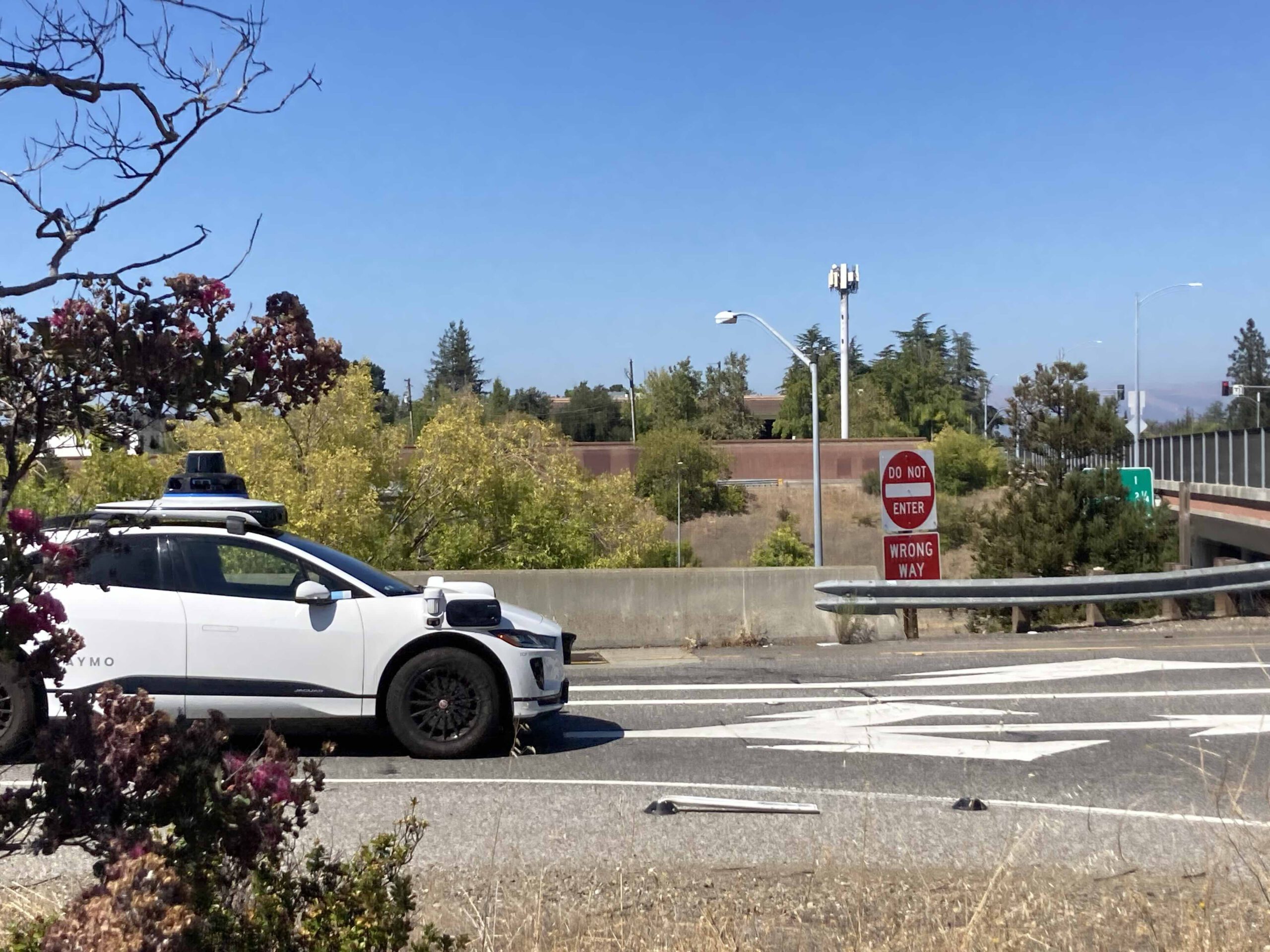
Waymo has expanded its operations into Los Gatos for the first time, making driverless rides available to around 100 residents in the North 40 neighborhood.
The autonomous vehicles’ service area currently extends south to Pollard Road and Lark Avenue, and autonomous specialists were seen riding in the driver’s seat outside of Waymo’s current boundaries last week. These trained drivers often sit behind the wheel during certain testing and validation phases to monitor the technology, according to Waymo’s website.
On Friday, the Mountain View-based company announced that it received state approval to dramatically expand its taxi services across the Bay Area. The California Department of Motor Vehicles released an updated map showing Waymo’s new approved operating range in Northern California, including the addition of East Bay and North Bay counties.
“Our goal is to make Waymo accessible to more communities across the entire San Francisco Bay Area over time,” Sandy Karp, communications manager at Waymo, wrote in an email to the Los Gatan. “Waymo regularly drives in and around the cities where we operate with human specialists present.”
“Currently, our fully autonomous service area in the Bay Area stretches from San Francisco to San Jose. This covers a 300-square-mile region and includes many neighborhoods in between, including parts of Los Gatos,” Karp said. Los Gatos Residents can currently request pickups and drop-offs within the North 40 neighborhood through the Waymo app.
As Waymo’s footprint expands farther into Los Gatos, town officials will have little say over when and where those boundaries are drawn. State regulators, like the Department of Motor Vehicles and the Public Utilities Commission, instead oversee autonomous vehicle approval and deployment in California.
“I think one of the big challenges is that the town didn’t ask for this, and yet our police officers, for instance, have to get up to speed very quickly on how to deal with this technology,” Mayor Rob Moore said.
Los Gatos police have received formal training from Waymo representatives on how to safely navigate interactions with autonomous vehicles if they encounter them on call or while conducting traffic-related duties, according to an email from the Town. Waymo has also reached out to Santa Clara County’s fire department to familiarize them with the technology, Moore said.
“Police and fire emergencies often evolve very quickly and can be very complicated. I just want to make sure that our [first responders] have all of the resources they need to deal with these, like they would deal with any other vehicle,” Moore said.
He said his priority is to ensure the autonomous vehicles offer a “net benefit” for the residents. The inherent safety aspects of a driverless vehicle — its inability to drive impaired or distracted, adherence to the speed limit and constant 360-degree awareness — are the most compelling aspects of Waymo’s expansion, Moore said.
A Los Gatos male recently suspected of driving under the influence was arrested Aug. 4 after crashing into a vehicle and killing the driver on Highway 17 in Campbell, according to the California Highway Patrol.
Waymo vehicles were found in late June to be involved in 68% fewer crashes per vehicle mile traveled than human drivers, according to a study by the Insurance Institute for Highway Safety, an independent nonprofit that conducts vehicle safety research.
David Kidd, vice president for vehicle research at IIHS, said the organization analyzed Waymo vehicle crashes most likely to be reported to the police — those with more severe outcomes, such as injury or property damage — to calculate the percentage.
As these automated vehicles expand into suburban areas, Kidd said there will be new “edge cases” the vehicles encounter.
He added that autonomous vehicles operate in more ideal conditions, such as better-mapped roadways, so there will be more attention to the construction of those streets.
“[Urban areas] are going to receive a little bit more money or attention from local jurisdictions to keep them in working order than perhaps your extremely rural roadway that may be in disrepair,” said Kidd.
Kidd said cities need to make sure they have access to the right information to take action when faced with an automated vehicle-related incident or encounter.
“Do they know how many miles are being traveled in their area? Do they know how many times that automated vehicle has caused a disturbance in traffic flow or an issue with emergency response?” Kidd said. The more collaboration an automated vehicle company has with a town it expands into, the better, he said.
Moore said the police and public works department will work with Waymo to ensure pickup and drop-off zones and times are optimal, particularly in more congested areas, such as downtown and schools.
Downtown Los Gatos, especially in the summer months, has significant traffic issues, said Moore.
“We have seen in cities like San Francisco how Waymos can really worsen traffic when there are power outages or emergency situations — and that would be a real headache for people in town,” Moore said.
Moore also said he has concerns for residents who drive for Uber that could potentially lose their jobs.
“I think though the reality is that Waymo is coming to Los Gatos — it already exists in Los Gatos,” Moore said. “They are here, and we are going to have to figure out how we can best work with Waymo to make sure that the technology is of benefit to people in town.”