
Congressman Sam Liccardo (CA-16) announced a workforce training bill built on private sector and public-education-institution partnerships at a press conference Monday at West Valley Community College, in Saratoga.
“We do have a future and an AI-empowered economy, and the antidote to this dystopian narrative that we continue to hear is straightforward,” Liccardo said during the press conference. “We need to invest in people.”
Under the plan, a $2,500-per-student tax credit would be available for companies supporting workforce programs through curriculum design, skill development, internships, apprenticeships, lab access and staff expertise. And they could secure an additional $2,500 credit for each graduate they hire.
“Simply throwing federal money (at the problem) doesn’t help, if the folks who are making the investment aren’t doing the hiring,” said Liccardo.
The former San Jose mayor was joined by Louis Stewart, head of ecosystem development at NVIDIA and Bradley Davis, chancellor of West Valley-Mission Community College District.
The Supporting Knowledge Through Industry-Led Learning (SKILL) Act is designed to promote workforce development programs of two years or less.
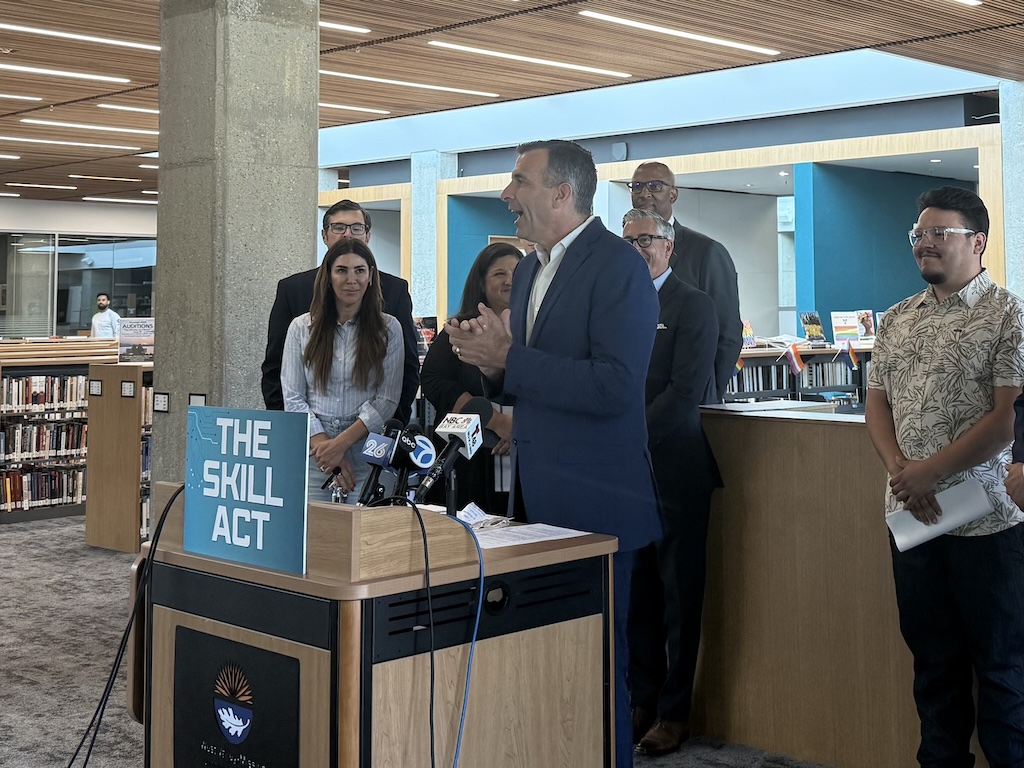
(Anika Kapasi / Los Gatan)
“For AI leadership, it depends on building the human layer,” Stewart said during the press conference. “Infrastructure alone doesn’t actually build or create the opportunity—people do.”
The SKILL Act would authorize up to $500 million in tax credits each year, with funding distributed based on state population numbers. Each state would select an agency to award credits to eligible partnerships—such as colleges, universities or registered apprenticeship programs.
Any credits left unused would roll over and return to the national pool for the following year.
“Employers know the skills gap before government sees the job loss,” Stewart said. “No one can actually predict what jobs are going to look like over the next 10 years, but industry can already see where capabilities are missing across the advanced manufacturing space, healthcare, logistics, energy, the skilled trades and expanding the range of AI-enabled jobs and roles that are out there.”
Davis called the SKILL Act “common sense legislation.”
“Frankly, higher education has moved at a rather glacial pace,” Davis said. “This program will incentivize us to move at the pace of innovation to get students the skills they need to move tomorrow into the job force.”
Another participant at Monday’s press conference, Santa Clara Valley Water District instrumentation and control technician Gabriel Huerta, was held up as an example of the sort of person who could benefit from this kind of federal initiative.
Huerta graduated from the Mechatronics program at Mission College. And though the program did not directly place him in his current job, it helped him build the technical expertise that allowed him to be more competitive, he said. Before joining Valley Water, he worked in the audio industry, then later, as an engineering technician at Tesla.
“For me, it was just the knowledge and learning stuff on the job, and it stood out on my resume that I was taking the steps to be working towards that kind of job (at Valley Water),” Huerta said in an interview with the Los Gatan. “I was able to dig deeper in class and be like, ‘Oh, I use this at work.’”
California has already signed AI-education and workforce agreements with a variety of companies, including NVIDIA, Google, Adobe, IBM and Microsoft.
The NVIDIA-California partnership was considered “first-of-its-kind AI collaboration” in August 2024, when Gov. Gavin Newsom signed a memorandum of understanding between community colleges and the Santa Clara-based firm to bring artificial intelligence resources to students, educators and workers.
The SKILL Act is meant to build on that experience.
In an interview with the Los Gatan, Stewart said he was thrilled with the bill, as the company is already working with educational institutions “to prepare people for the next economy.”
NVIDIA announced a $25 million K-12 initiative at an event at the White House in September.
“We are trying to reach 2.2 million students across the US,” he said, remarking that a large portion of these pupils live in California.
Liccardo’s district is home to the headquarters of Google, xAI, Meta and many other tech giants. By having companies invest in educational programs and training at local colleges, the Congressman said the bill can mitigate concerns around students finding their place in an AI-driven labor market.
The bill also falls in line with the Democrats’ Innovation Agenda, which calls for employer tax credits tied to curriculum development, hiring commitments and partnerships with community colleges.
“History teaches us that there’s a certainty of disruption in every technological change, and—no question—we’re seeing and feeling that disruption already with AI,” Liccardo said. “This is something we critically need, and this is one tool—of what will need to be many tools—in the toolbox, to help us become resilient to the disruption that we know is coming.”