

The latest Leapfrog Hospital Safety Grades show a mixed picture for South Bay hospitals, with several facilities earning B or C grades as the rating system itself faces scrutiny over its methodology.
After a federal judge in South Florida ruled in March 2026 that Leapfrog’s methodology violated Florida’s unfair and deceptive business practices law, the organization stopped assigning Spring 2026 grades to hospitals that did not participate in its 2024 or 2025 hospital survey.
“Leapfrog’s change in methodology has no scientific basis, unfairly penalizes non-participating hospitals, and misrepresents hospital safety,” Judge Donald M. Middlebrooks wrote.
While the ruling directly involved only five hospitals, Leapfrog did not assign grades to 450 hospitals that did not participate in the survey, according to their press release.
Out of the 2,363 hospitals that were assigned grades, 38.8% received an A; 31.3% were given a B; and 27.3% a C.
The two closest participating hospitals to downtown Los Gatos that received an A this spring were Stanford Health Care and Kaiser Permanente Redwood City Medical Center.
Leapfrog assigns hospitals a grade ranged A-F based on how safe they are for patients. These grades are determined twice a year and use up to 22 patient safety measures, according to their Spring 2026 scoring methodology report.
The Los Gatan analyzed four hospitals’ grades within a 10-mile radius of downtown Los Gatos that all scored a C this spring to determine which patient-safety measures most weighed down their scores and whether the hospitals shared common weaknesses.
None of the hospitals seemed to want to talk about their patient safety report card. None were willing to make officials available for an interview.
El Camino Hospital Los Gatos dropped a letter grade two consecutive reports in a row. The main contributors to this semester’s grade drop were: catheter-associated urinary tract infections (CAUTI), foreign objects retained after surgery (FORS), and C. difficile.
(CAUTI measures infections tied to urinary catheter care, or tubes used to drain urine from a patient’s bladder. Foreign object retained after surgery measures how often a surgical item—such as a sponge or needle—is accidentally left inside a patient’s body after surgery. C. difficile infection rates measure infections caused by a bacterium that causes severe intestinal illness.)
All of the hospitals contacted by the Los Gatan balked at setting up an interview to discuss Patient Safety Issues Identified in the Leapfrog report
The hospital saw a sharp increase in CAUTI, its worst-performing measure. Its Spring 2026 score was more than four times the national average, jumping from 0.462 in Fall 2025 to 2.281 in Spring 2026—the lowest mark in the country.
Foreign objects left behind after surgery was a repeated contributor lowering El Camino LG’s rating. Its score was far worse than the national average, with a z-score of -3.676, nearly as severe as its CAUTI score. C. diff infections also worsened over the past two years of reports, making them one of the hospital’s more significant safety concerns.
“Changes in Leapfrog’s Hospital Safety Grades reflect updates to its methodology and the timing of data used in its analysis,” Ross Coyle, a senior external communications specialist for El Camino Health, wrote in a statement to Los Gatan. “In some cases, these ratings incorporate data from prior years and may not fully reflect more recent investments and improvements in patient care, safety protocols and technology.”
Leapfrog’s Spring 2026 CAUTI and C. diff measures used data from July 2024 through June 2025, while the foreign-object measure used data from July 2022 through June 2024.
One of the strongest outcome measures for Los Gatos, however, was their central line-associated bloodstream infections (CLABI), producing one of the highest positive scores and indicating an improvement since Spring 2024.
(CLABSI measures bloodstream infections tied to central lines, which are tubes placed into large veins to deliver medication or fluids to patients.)

(El Camino Health)
“We are constantly looking to refine our processes when it comes to patient care and safety. And we value the third-party evaluators that help us strive,” Coyle wrote. “We will continue to participate with Leapfrog, as we do with all third-party evaluators that advise how we pursue excellence in delivering evidence-based care to patients and families.”
While El Camino LG’s operation has seen falling grades this past year, Santa Clara Valley Medical Center has received a consistent C grade for at least the past five cycles.
For C. diff and foreign objects retained after surgery, SCVMC performed better than the national average — unlike El Camino Hospital Los Gatos.
However, surgical site infections after colon surgery significantly weighed them down. The hospital performed worse than the national benchmark, scoring a 2.959, compared with a national average of 0.819.
(SSI: Colon tracks infections that develop in surgical wounds after intestinal operations.)
Another major negative for the center was PSI 4, which measures death rate among surgical inpatients with serious treatable complications. The hospital scored lower than the national benchmark, here too.
Hand hygiene was a persistent weakness, with a score of 40 across five reporting periods (the national mean this spring is 78.21).
While core safety-style measures were strong, such as computerized physician order entry and nursing care hours — alongside an increase in ICU physician staffing over the years — the strengths were offset by poorer scores in surgical infections, hand hygiene and patient safety outcomes.

(Drew Penner / Los Gatan)
“(Leapfrog) is one of several entities that provides hospital ratings,” Roger Ross, assistant director of communications and public affairs for Santa Clara Valley Healthcare wrote in a statement to the Los Gatan. “SCVH has historically focused on clinical patient outcomes, such as mortality — where we outperform national rates for heart disease, pneumonia, stroke, COPD and other major conditions.”
Ross wrote that their specialty services, such as their trauma and burn services, have earned regional and national recognition through accreditations, regulatory reviews, peer surveys and U.S. News & World Report rankings.
Leapfrog identified similar weaknesses at O’Connor Hospital, which is part of SCVH. O’Conner improved to a B grade in Spring 2025, but fell back to a C this spring.
Like Santa Clara Valley Medical Center, SSI: Colon, PSI 4 and hand hygiene were all significant negative contributors for their grade.
For PSI 4, O’Connor scored 214.59, compared with a national average of 173.37. That marked a notable downturn from Spring and Fall 2025, when the hospital scored 168.59 and performed better than the national benchmark.
CLABSI, however, improved substantially. O’Connor scored 0.170, better than the national average of 0.550. This was a major improvement from Fall 2024, when it scored 1.453 and performed well below the national average.
Santa Clara Valley Healthcare declined a request for an interview.
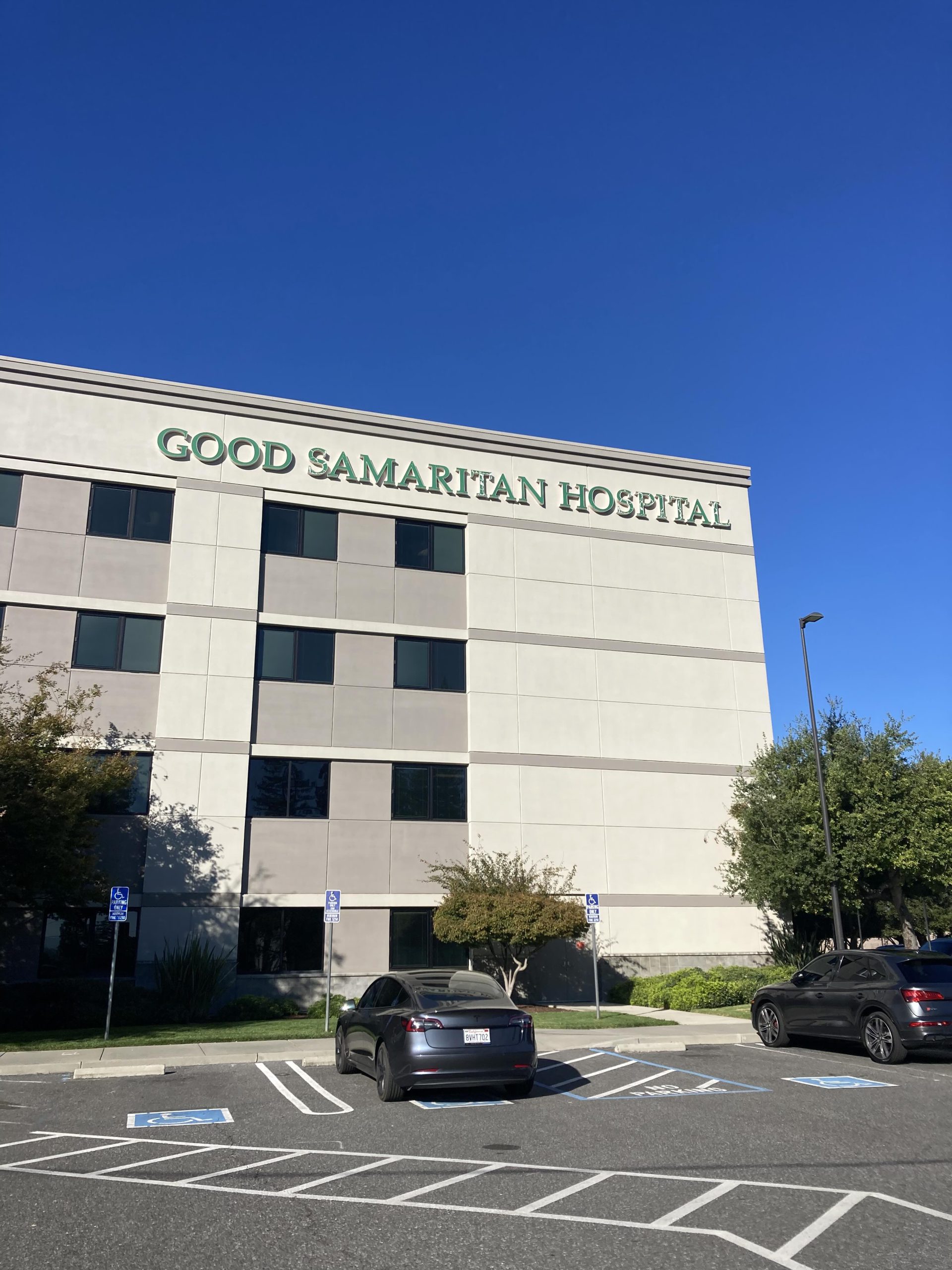
Good Samaritan Hospital of San Jose showed a similar grade trend to Santa Clara Valley Medical Center with Spring 2026 marking its fourth consecutive C grade.
Total nursing care hours per patient day was the clearest weakness. Good Samaritan scored 15 (the lowest mark given out), compared with a national mean of 79.73. And the grade has remained unchanged over the past two years.
SSI: Colon and CAUTI were two notable weaknesses, alongside patient communication, which scored consistently below average.
At the same time, Good Samaritan performed better on some broader patient-safety measures.
Its PSI 4 score was stronger than the two Santa Clara Valley Healthcare hospitals, and its PSI-90 composite was a strength. Because PSI-90 is one of Leapfrog’s more heavily weighted measures, that likely helped offset some of the hospital’s weaker infection, staffing and communication scores.
(PSI-90 is a broad patient-safety score. It combines several types of preventable hospital complications into one composite measure, including issues such as pressure ulcers, collapsed lungs caused by medical care, hip fractures from in-hospital falls, postoperative bleeding, kidney injury, respiratory failure, blood clots, sepsis, reopened surgical wounds and accidental punctures or lacerations.)
“Our physicians, nurses and colleagues remain committed to providing exceptional care and continuously improving the patient experience,” Regina Vaccari, associate vice president of strategic communications for HCA Healthcare, wrote in a statement to the Los Gatan. “Good Samaritan Hospital continues to invest in advanced technology, expanded clinical services and enhanced patient care, while earning national recognition from Healthgrades for clinical quality and patient safety, including ranking among the top 5% of hospitals nationwide for the past three years.”
Good Samaritan Hospital declined a request for an interview.
*Updated June 19 to note that El Camino Health’s grade for CAUTI and Good Samaritan Hospital’s grade for “nursing care hours per patient day” were the lowest in the country.