

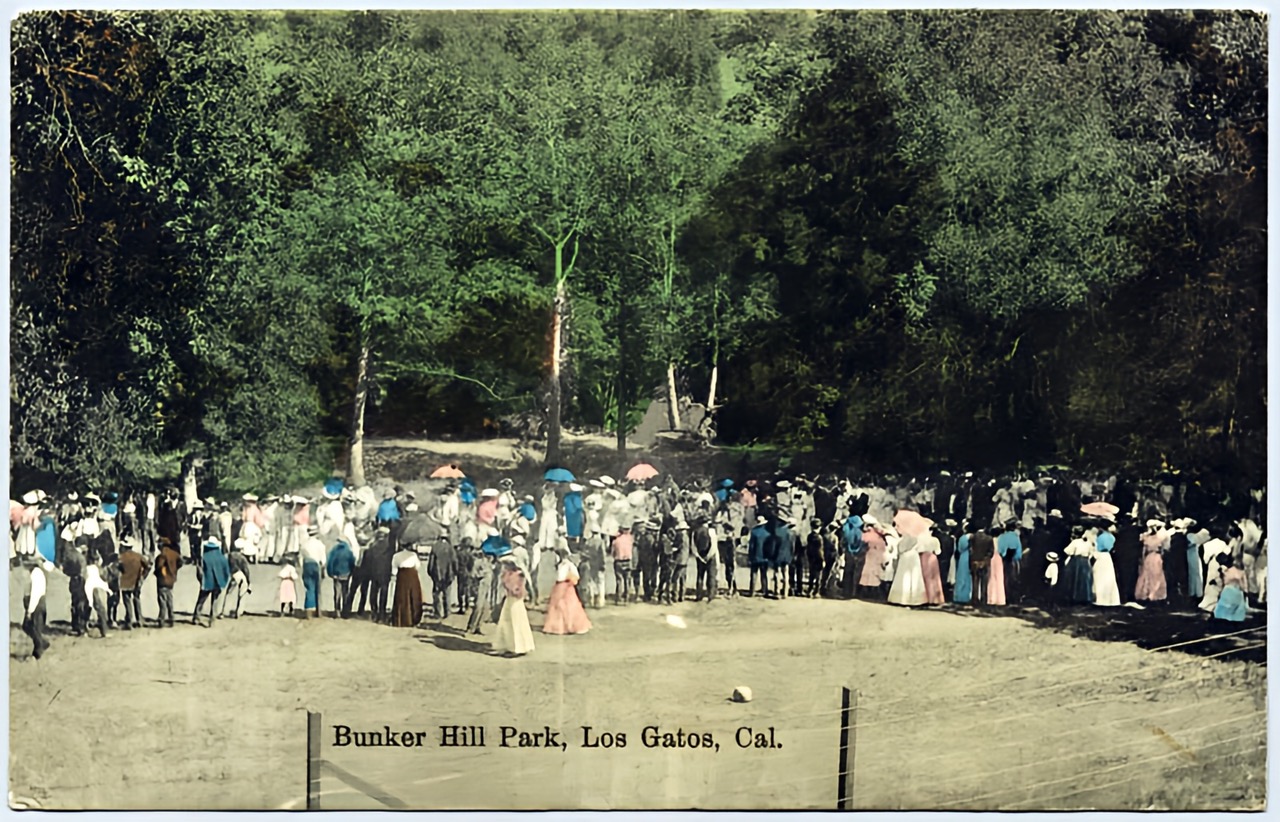
By 1897—just 10 years after incorporation—Los Gatos had lost its reputation as a sleepy rural town. Modern infrastructure such as sidewalks, sewers and electric street lights had been installed to support a rapidly growing population. The next big civic project for the Board of Trustees (now known as the Town Council) was the creation of a downtown municipal park.
A large tract of land for the park was donated by Los Gatos pioneer William C. Shore (1830-1905). Like many young men of his era, Shore crossed the plains to California hoping to strike it rich in the Gold Rush of 1849. He worked the mines in El Dorado County without much success, then relocated to San Jose and began farming. Shore settled in Los Gatos in 1891 and became quite successful after founding the Los Gatos Ice Company.
The Trustees were grateful for Shore’s donation and had a grand vision for our town’s first municipal park, which would be located south of the Main Street bridge along Los Gatos creek. They cleared the property of ivy and scrub brush, leaving behind towering sycamore and oak trees. A large outdoor dance pavilion constructed for concerts was also used for roller skating.
June 17, 1897 was opening day for Bunker Hill Park, named in honor of the hundreds of Minutemen who perished in the famous Battle of Bunker Hill. Thousands reportedly attended an inaugural ceremony with live music, speeches by local dignitaries and games. It was the 122nd anniversary of the battle and someone arranged for the shipment of a pail of earth from Bunker Hill so that it could be ceremoniously sprinkled over the site. The reason why our local town park was named for a Revolutionary War battle remains a mystery.
Los Gatos creek ran freely through the park without an upstream dam to restrict the flow. Fishing for speckled trout was especially popular. It was reported that trout were so plentiful that you could almost reach down and catch one with your bare hands. Boys waded up the creek to the “boogang,” their not-so-secret swimming hole.
The popular park was enlarged and renamed Memorial Park after WWI to honor all war dead. In 1927, the town added a large public swimming pool called the Municipal Plunge where you could rent a bathing suit and a towel for 25 cents.
In their wildest dreams, no one in the park on that June day could have imagined that 70 years later—in the name of progress—the park and all its majestic trees would be bulldozed. The creek was rerouted to a concrete channel to make room for what we now know as Highway 17. The only clue that a park once existed on this site is a dead-end street called Park Avenue which led from Main Street to the main entrance.
The uproar from townspeople over what they had lost prompted Town officials to quickly begin development of a new park. The only available site was the recently-closed municipal landfill and sewer farm on Blossom Hill Road. They established Oak Meadow Park there in 1957.
Alan Feinberg is a local historian and founder of the LOST Gatos Project lostgatos.com.
Since 2015, his mission has been to generate enthusiasm among Los Gatos residents for remembering and preserving our town’s unique character and historic treasures before they’re lost forever.
For more Los Gatos history, download the free mobile app Discover LOST Gatos and take a self-guided walking tour through our historic downtown.