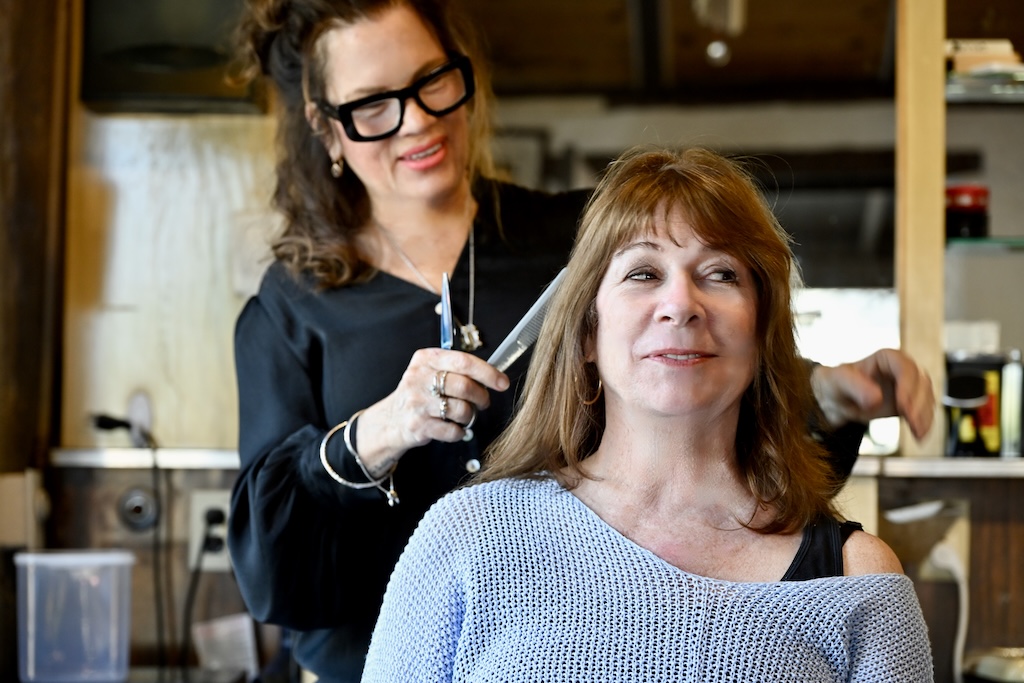
Andrea Swan bought The Old Adobe Hair Shop just over 31 years ago after working as a hairdresser at the salon for eight years. March 1, 1995 was Swan’s official purchase date for the salon and barbershop. She says that despite being located in Silicon Valley where technology advancements have erased industries, and economic downturns (and the layoffs that come with alongside) can result in frugal habits, the salon’s business hasn’t been affected negatively.
The original owner, Laurie Roberts, started the business in the early 1980s in the back of the Los Gatos Lodge before moving to the current location in 1984. After eight years of working as a hairdresser, Roberts asked Swan,“Could you take over the business?”
The Old Adobe is unique because it’s located on a high-traffic street that’s recognizable to most town residents. And when sitting down with Swan, she made it clear that through the dot-com bust, the Great Recession of 2008 and most recently the global pandemic, their clientele has remained a constant. The Old Adobe salon is part of a sector—the human services world—that still requires human interaction and touch to stay alive.
Swan made a down payment of $20,000 when taking over The Old Adobe. Back then, rent was around $1,100 at 16461 Los Gatos Blvd. “It was scary to take over the shop, because I had two kids and was a single mom,” Swan said. Her kids are nothing but proud of her to this day. As previous owner Roberts was coming up on her one-year anniversary at the Los Gatos Lodge, she was told by the now-shuttered hotel that she needed to move locations to make room for offices.
Los Gatos has quite the heritage when it comes to barbershops, as one of the oldest such businesses—University Ave Barbers—is located here. And The Old Adobe is one of the most iconic, due its central location where thousands of drivers pass by each day. It boasts charming Spanish-style architecture, as its name suggests. Swan says she was approached to sell her business in 2019 for $100,000, but declined.
A lesson in economics
Typically, when signs of economic hardship start to bubble up—like during the lead-up to the 2008 recession—some of the first cuts are to consumer spending.
Of course, lockdown policies during the Covid-19 upheaval spelled big changes for beauty industry companies.
According to the Professional Beauty Association, the pandemic had a significant impact on salon industry revenues in 2020 (it saw a 26% drop from $34.5 billion in 2019).
In fact, between February 2020 and April 2020, the number of jobs at salons cratered by 84%, according to data from the Bureau of Labor Statistics.
However, haircare businesses saw a relatively quick bounce-back recovery, and government stats suggest job growth at salons will outpace the overall economy in the years to come.
When Swan was asked if she noticed any lows in the business since she acquired it in 1995, she shook her head.
They come for more than a trim
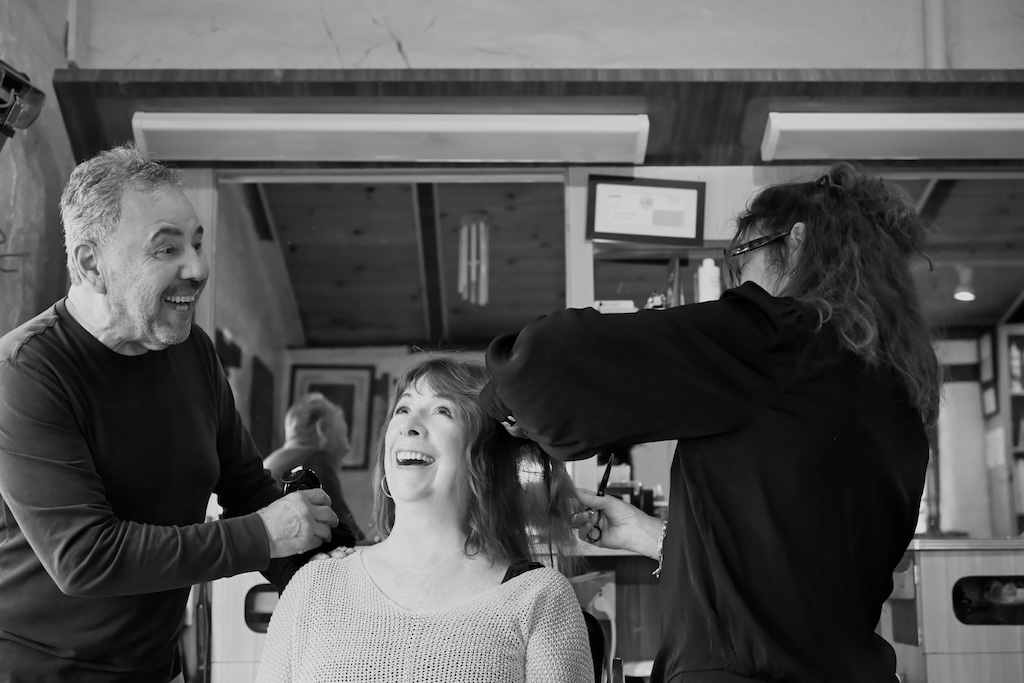
Dan Osuna started at The Old Adobe as a barber in 1987. “Ninety percent of our clients stay with us,” he said. “I stopped taking new clients 10 years ago.” Swan talks about the consistency of her business and not needing new clients in the last decade. To cover overhead costs, Swan says she focuses on controlling her energy. “People share things with me about my life because they’re comfortable,” said Swan. “And when I leave the shop, I forget about everything. So, it only exists in the moment.” Though Swan doesn’t want to share personal details about her clientele, she says there’s been no limits in what they’ve shared with her over the years.
“They tell me, Thank You, I should give you more money because it was not just a haircut, it was a therapy session.” Swan says the connections made in her shop have given her a bigger purpose. She mentions that when she ultimately decides to hang up her hat, she will miss that aspect of work more than anything. And that’s why she doesn’t want to give up her job for any reason. “I’ve been here since the (1990s) crash and the ‘tech-wreck.’ Never have I seen a drop, never,” said Swan. “When people have to look for jobs, they have to look decent. They wanna look good when they’re single.” I just had a guy come in today that had a knee replacement surgery, and this was the longest he’s driven (since the operation).” Clearly people will go the distance for an authentic connection.
When discussing the threats to her shop—and the industry as a whole—the only concern that she has is rising rent costs. Just across the street from The Old Adobe, an “SB 330” condo complex is in the works, and she worries this could cause her landlord to hike her rent bill.
Around 15 years ago, Swan noticed a child standing outside in the rain while his father got a cut. She offered him a lollipop. Shortly after, when the weather became warmer during spring, the same kid started bringing his friends to get lollipops after school. This quickly turned into a tradition: kids began coming everyday after class to get a piece of candy—until Swan limited it to just Fridays. Five years ago, the same kid that began the tradition came home from college and spoke to Swan. “I just bought 700 lollipops and we hand out 100 pieces of candy per week. This is a great neighborhood thing, as these kids will look back and remember.” Remember that shop?
Lizbeth Maggetti has worked at The Old Adobe as a hairdresser for 17 years under Swan. “I think just listening to the stories from my customers is key,” Maggetti said. “People are transparent and real at The Old Adobe—and aren’t pretentious. You won’t always find that in other parlors. I had an aesthetician tell me she likes to come here because she can be real.”
Maggetti used to pass out lollipops every Friday and says she loved it. After some personal turbulence in Maggetti’s life, she recognized that she needed the connection from her work with her clients. Connection with others is as essential a component for a full life as drinking fresh water, she says.
Shoe shining to barber
Born and raised in Madera, Calif., Dan Osuna migrated to San Jose in his teenage years. Osuna started out as a shoe shiner at barbershops as a teenager, until he worked his way up to a barber position. Osuna has worked at The Old Adobe, almost since its opening in the 80s. Though he’s had seasons of working elsewhere, he’s always found himself back here. “I’d rather be alone than have bad love,” he laughed. “You establish an element of familiarity and trust—I know something about my customers, their children and their work.” Osuna remembers big milestones in town, such as the 1989 Loma Prieta earthquake. “It was strong,” he said. “The Incredible Hulk picked up the building and, Boom! You could feel the earthquake right through you.”
Personal care is a priority
Most industries have been shifted significantly by advancements in technology—at least to some degree (and some have been almost entirely replaced). Many young hairdressers and barbers used social media to develop relationships with clients. By posting quick updates and new hair styles, followers can stay in touch with what their hairdresser is up to.
But where is the industry headed? According to Technavio, the US haircare market is expected to increase by $4.61 billion from 2025 to 2030—a rate of 4.7%.
And vintage-style The Old Adobe seems poised to stand the test of time, along with several other local barbershops, here in one of the wealthiest locations in the world.
Because despite the rise of AI, robots cannot replicate the personal touch of a barber or hairdresser.
“Thank you for supporting small businesses,” Swan said.