

Last week, when Planning Commission held a second hearing for the West Valley Muslim Association’s efforts to extend their mosque’s hours of operation to better align with official prayer times, neighbors brought up noise and traffic concerns, and urged the decision-makers to claim the project could harm the environment, in contradiction of staff’s findings.
The Los Gatos Islamic Center at 16769 Farley Rd. is a Sunni facility which used to be a Jehovah’s Witness church, but welcomes people of other branches of the faith—as well as the public, such as during community iftars.
Proponents on both sides of the debate have been careful to make considered arguments. Listening to the statements from the record number of participants, one would scarcely know a joint American-Israeli operation had assassinated the top Shia leader in Iran, Ayatollah Ali Khamenei, days earlier.
Based on the March 31 special hearing alone, you wouldn’t have been able to predict that just a few days later—and on Easter Sunday no less—the commander-in-chief of the United States, Donald Trump, would post, “Praise be to Allah” in a mocking fashion on social media. Or that he’d vow residents over there would be “living in Hell” if the Strait of Hormuz wasn’t reopened by yesterday.
Indeed, supporters of those who live in the upscale single-family-home neighborhood where the local mosque is situated took great pains—almost to a person—to stress their concerns have nothing to do with religion.
But several comments on the Los Gatan’s Facebook post of last week’s article about prominent Jewish community members speaking for the conditional use permit modification were less civil. User Marvin Humphrey posted a meme of a transparent beaker suggesting Islam is incompatible with American values: with “ISLAM” the yellowish oil at the top, and “WESTERN CIVILIZATION” the much larger, clear liquid below that. Another Facebooker, Linda E Lopez, whose location is set as San Jose, wrote, “No more mosques, no more Muslims.” Other comments were removed or hidden because they were even more toxic.
On the other side of things, designer Sydnee Elocin accused the neighbors of making a “classic NIMBY” case, for stating they aren’t against a mosque in Los Gatos—they just don’t want to have to deal with the traffic and noise it’s brought.
No one mentioned during either hearing that WVMA could’ve proposed a by-right high-density housing project with at least some units for lower-income individuals, during the period Los Gatos was out of compliance with State housing laws, but didn’t.
Ironically, it was apparently anti-development attitudes in the neighborhood that helped open the door to the mosque in the first place.
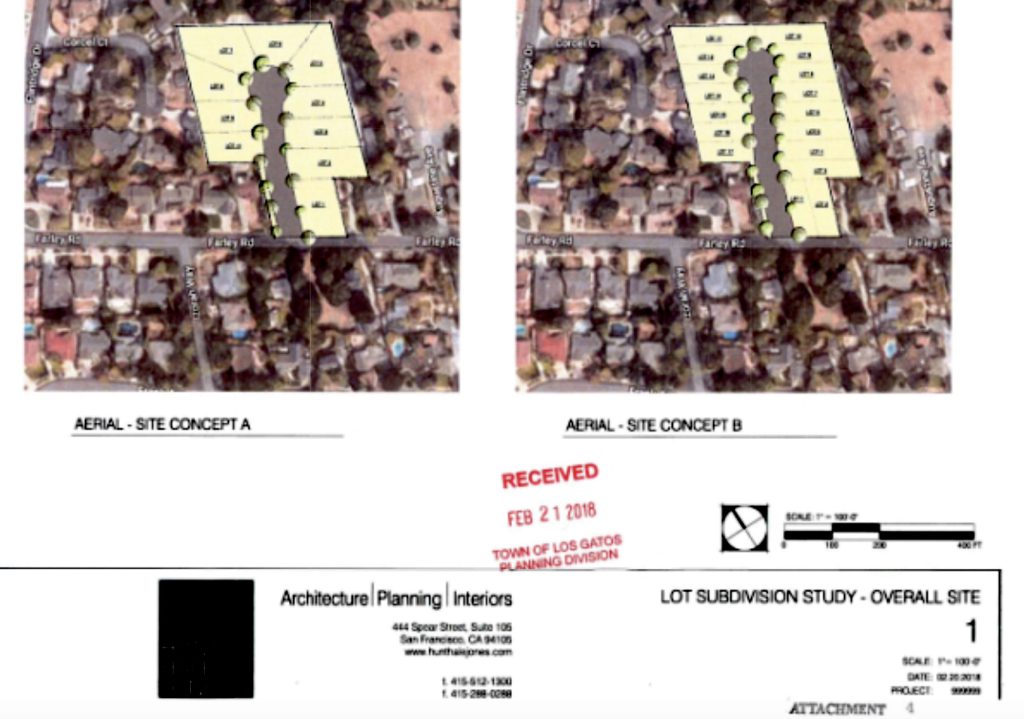
On March 6, 2018, Peter H. Benson, a Farley Road resident, wrote to Jocelyn Shoopman at the Town of Los Gatos, to oppose a single-family home development pitched for the site.
“We and many neighbors want to keep the lot zone for a church. Any increase in homes in that area will only add to traffic congestion and noise pollution during construction,” he wrote. “Knock on any door and you will know that all our neighbors share in this hope.”
Kim Ratcliff also emailed Shoopman to fight against the up-to 17-home proposal—and specifically for keeping the location a place of worship.
“We already have a ton of traffic on Farley Road from Jack in the Box and Affordable Treasures,” she wrote. “Distracted speedsters race up and down the street making it dangerous to walk our dog or children to ride bikes and scooters. No sidewalks exacerbates the problem. A large scale development project will add more traffic to our neighborhood both during the building phase and afterward with an influx of new residents.”
(Town LG)
Al Honorio & Kristi Branch derided the idea that the Jehovah’s Witness organization could get to “profit” from a development that “could negatively impact our safety, our financial investment, and our neighborhood tranquility,” in another email.
Other neighbors shared similar concerns.
The submission from Hunt Hale Jones Architects for the 2.76-acre site promised to hew to existing Town guidelines—which would be a welcome change for many local residents, who, these days, are used to developers seeking density bonuses and invoking the Builder’s Remedy to go far beyond what would normally be allowed.
According to minutes for the March 14, 2018 Conceptual Development Advisory Committee meeting, a variety of public comments about a potential residential development for the Jehovah’s Witness site were considered, including that the developer be urged to go with larger lot sizes for the subdivision.
The CDAC, which issues non-binding feedback, said it would be more supportive of a maximum of 10 lots, of at least 8,000 square feet each. But, aligning with the residents, the body declined to encourage a church sale.
“It is recommended to continue talks with neighbors,” the minutes read. “With two-story homes, privacy could be a huge problem.”
The neighbors got their way, as the residential development was scrapped.
Less than two years later—at the outset of the pandemic on March 11, 2020—Planning Commissioner Jeffrey Barnett made the motion to modify the original Jehovah’s Witness CUP to allow the West Valley Muslim Association to operate there, with current Council member Matthew Hudes seconding it.
The minutes record no opposition, and only two public commenters (including a representative for the mosque).
WVMA Community Outreach Director Kareem Syed said that they’d expect just a handful of cars leaving towards the 11pm cutoff—but did point to things being somewhat different (*updated April 11, 2026 upon re-checking the minutes) for the month of Ramadan.
Planning Commission unanimously approved the change, including that hours of operation “shall not extend past 10:00 p.m. except for 30 days during religious service for the month of Ramadan which hours of operation shall not extend past 11:00 p.m.”
“shall not begin prior to one and a half hours before sunrise or extend past 10:30 p.m., seven days a week to accommodate indoor, morning and nighttime prayer services; and / During the 30-day month of Ramadan, indoor nighttime prayer services shall not extend past 11:30 p.m. whenever sunset is prior to 7:30 p.m., or until 12:00 a.m. whenever sunset is after 7:30 p.m.” *updated April 10, 2026 to accord with what was approved
The second Planning Commission hearing
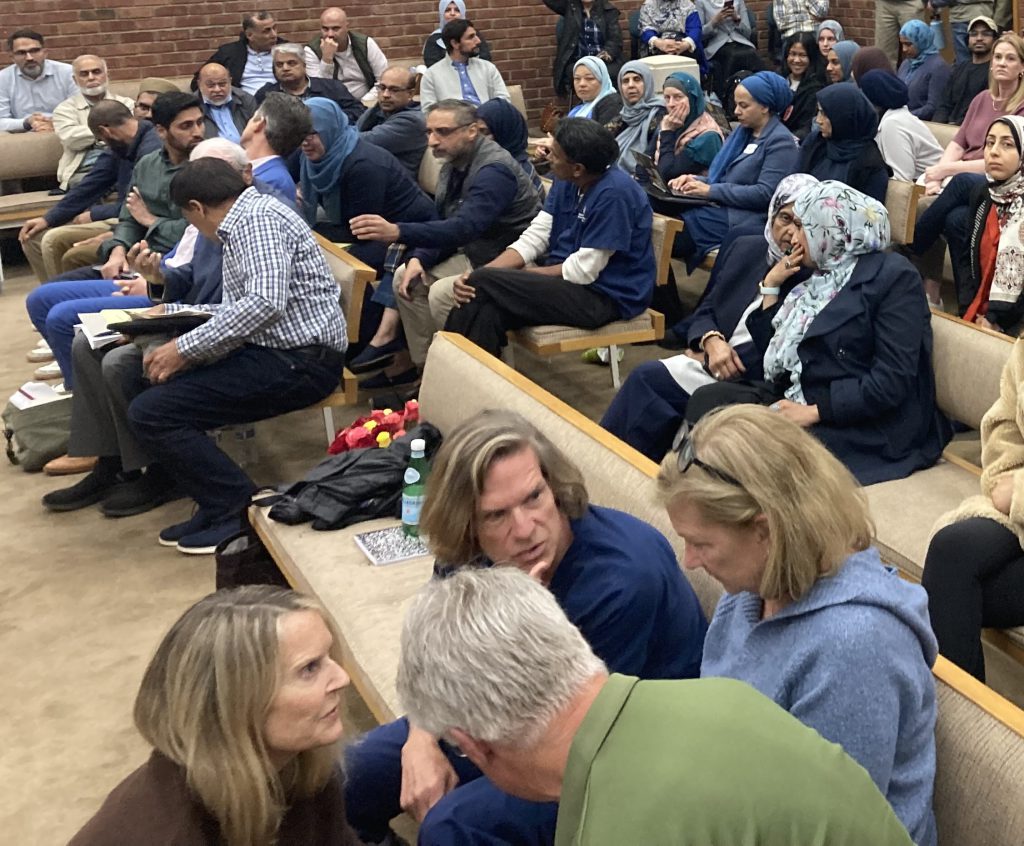
So many people showed up to the special Planning Commission session on March 31, that some—including female attendees wearing head-coverings—sat on chairs set out in the Council Chambers foyer. At least one woman at the meeting wore a veil that left just her eyes exposed.
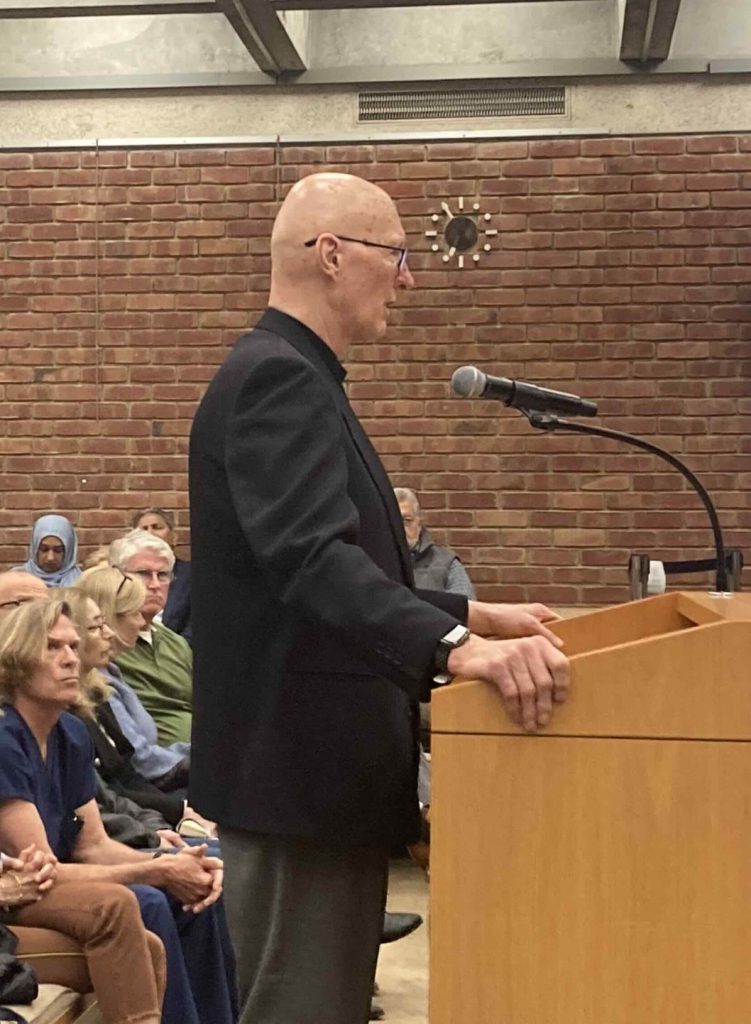
One of the neighbors who provided public comment, Bill Hoeft, spoke of the stream of vehicles to-and-from from the mosque as like a “water-drip torture treatment.”
(Drew Penner / Los Gatan)
“It’s light after light, after light,” he said, adding he worries things could get worse, as mosque attendance continues to grow. “Is it going to double, triple, quadruple?”
Another resident characterized the house of worship as “a permanent disclosable nuisance onto our property records” and asked for another noise study that might better capture the decibel level at peak transit times.
Noise-measurement company Salter, Inc. conducted three long-term ambient noise surveys between Jan. 31 and Feb. 11.
The highest reading clocked while the congregation was leaving an event was on Friday, Feb. 7, when the sound rose to 53 decibels (dBA) at one location.
The weekday ambient noise level at a time when no WVMA event was happening rose to 55 dBA, between 8 and 9pm, at the same reading point. The noise level for congregant arrivals, between 9 and 10am, was 56 dBA, at Farley Road—compared to ambient noise readings of up-to 64 dBA between 9 and 10am, when no WVMA event was happening.
This is well below the non-commercial vehicle noise limit in California’s Vehicle Code of 95 dBA—and even within the Town zoning maximums (of 61 dBA on weekdays in the morning, and 65 dBA until 10pm—and 54 dBA on weekday overnights).
“Our measurements and analysis indicate that the requested extended use hours would not violate the Town’s applicable noise standards,” read a letter from the consultant. “Additionally, measured event arrival and departure activity did not noticeably increase noise levels above ambient.”
But residents say the study should’ve been conducted during peak times, such as during the month of Ramadan.
Greg Slack said it would be unfair to allow extra hours for the mosque, since a Burger King development he’d worked on in the area was denied due to the impact it would’ve had on the neighborhood.
Scott Hepworth, a member of the Church of Jesus Christ of Latter-day Saints, signed a letter alongside other faith leaders in support of WVMA’s application.
“My main message is to thank everyone here—these wonderful Muslims, and these wonderful neighbors,” he said, when it was his turn at the podium, adding he knew it would be a difficult decision for commissioners. “Congratulations on your assignment.”
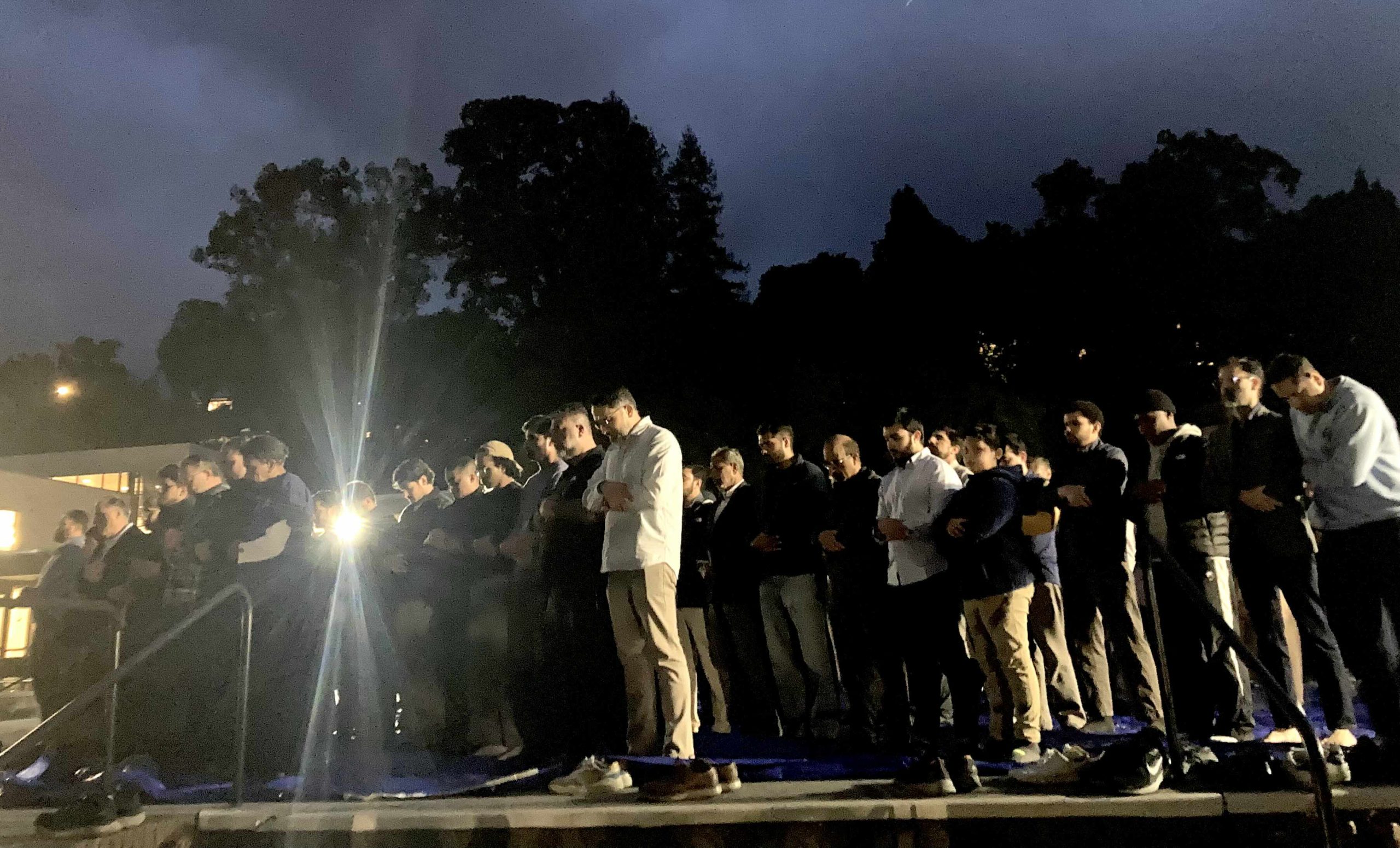
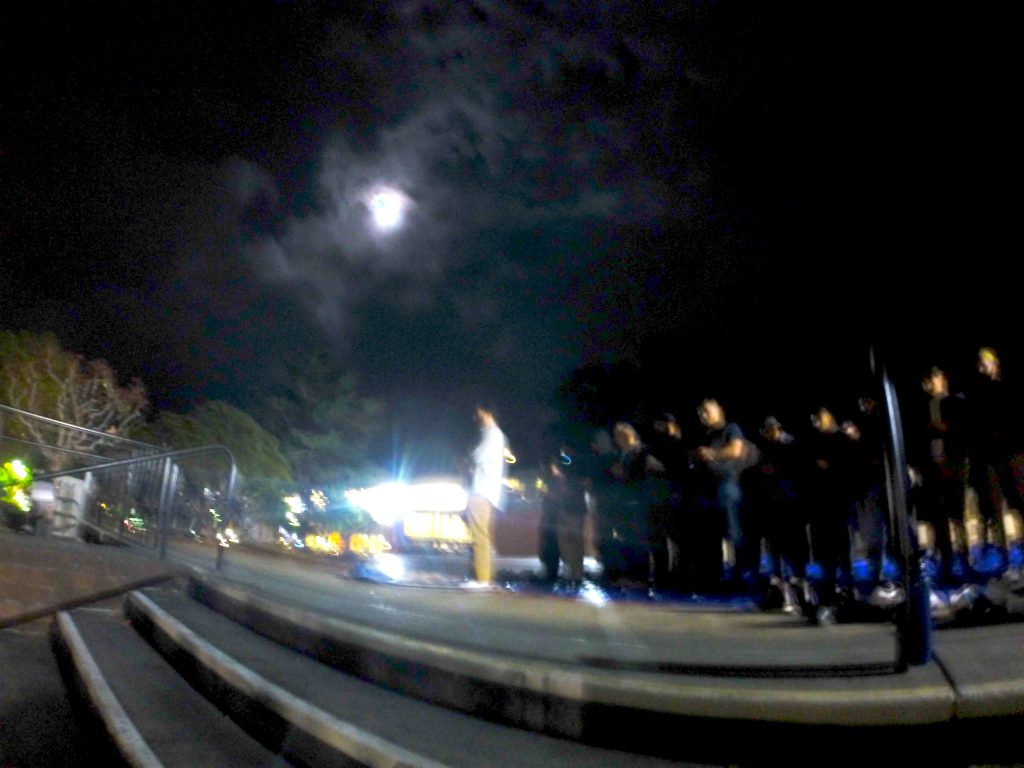
During an intermission, a good chunk of the audience went to the roof of the structure, next to a fountain that was not running, removed their footwear, turned towards the Adult Recreation Center and performed the Maghrib prayer—men in front, women behind—on a tarp that had been spread out.
Dueling legal opinions were provided that evening.
Erica Hagelberg, of Hoge Fenton Jones & Appel, ran through examples of court cases she said show the Town needs to do a better job of assessing the environmental impacts of the mosque (for example, Spirit of Aloha Temple v. County of Maui; New Harvest Christian Fellowship v. City of Salinas; Sunflower Alliance v. Cal. Dept. of Conservation).
But a lawyer for the Islamic Center said some of the case law cited by Hagelberg—specifically Sunflower Alliance v. Cal. Dept. of Conservation—makes his point better than hers, since a California appeals court found minor alterations to a project would not trigger a California Environmental Quality Act review.
“The fundamental point is there’s no expansion of use,” he said, adding noise levels may even drop, since mosque attendees will be able to disperse over a longer period of time. “And the number of trips doesn’t go up either.”
The Town Engineer said the road is in such good condition—including boasting plenty of extra space for pedestrians—that it’s pretty far down the priority list of capital upgrades, to, say, add a sidewalk.
“My opinion is, I don’t think there’s an unsafe situation out there,” he said.
But Commissioner Rob Stump said he was caught off-guard by an apparent Muslim pedestrian while driving to the site recently.
(Drew Penner / Los Gatan)
“I didn’t want to become a statistic,” he said, adding he thought it might be a good idea for fire officials to inspect the facility in order to reevaluate the 1,217-capacity limit.
Vice Chair Barnett said he’s never seen a controversial matter like this where the parties were as polite.
“And in my six years, it’s the most difficult decision,” he said.
Barnett made a motion to approve a draft resolution to allow an extension of hours, but included a number of conditions, including for increased police patrols and an electronic speed sign during Ramadan, and that the mosque complete a parking lot improvement within a year, as well as granting the right to build a taller-than-normal fence.
But under the new system of government that the Town Council recently adopted, up to three motions are allowed on the floor at once.
So, Commissioner Rob Stump jumped in before Barnett’s motion could find a second and poured cold water on what had looked, seconds earlier, like a considered compromise.
He proposed delaying a final decision so the Muslim group and the neighbors could enter formal negotiation at the mosque’s expense.
“We’re concerned that this just creates more tension for our community—and uncertainty for our community,” said WVMA founder Razi Mohiuddin, though he said they’d be open to the idea “reluctantly”—if they could split the cost of a (likely expensive) mediator who understands the Islamic perspective and relevant legal frameworks.
(Drew Penner / Los Gatan)
The neighbors huddled to discuss this option, but didn’t want to commit right away, without knowing the price tag.
In the end it was a third motion that won the day—to continue the hearing to give the parties time to explore the possibility of mediation.
“We had asked them to really delay the vote, because we wanted to get more testing,” Kim Ratcliff told the Los Gatan afterwards, suggesting if the parties can sort out their differences it could serve as a playbook for the rest of the country. “We want to be the first neighbors-and-mosque that can come to a mutually-beneficial resolution.”




Frankly speaking, it feels like the Planning Commission took the path of least resistance here. Choosing mediation is fine in principle, but stepping back from committing to a fair three-way cost-sharing arrangement—especially when the applicant agreed to it, albeit reluctantly—comes across as avoiding responsibility rather than resolving the issue.
The real concern is that the applicant has made consistent, good-faith efforts over the years to work with the neighbors, yet no lasting solution has been reached for either side. They’ve agreed to multiple compromises—raising fence heights, planting trees in neighboring yards to reduce headlight impact, and even hiring security personnel and volunteers to manage noise and traffic. At some point, “going the extra mile” starts to look more like running a marathon with no finish line.
Given all this, it’s disappointing to see the Commission default to a hands-off approach instead of providing clear leadership and accountability. If the role of the Commission is to guide and resolve complex community issues, then this was an opportunity to do exactly that—not to pass the baton and hope for the best. Otherwise, it risks looking less like leadership and more like refereeing a game without ever blowing the whistle.
It’s about traffic not religion. Stop inflaming the situation.
@ Just me a Concerned resident, spot on. very weak leadership by affording the opposing party an undue leverage.