
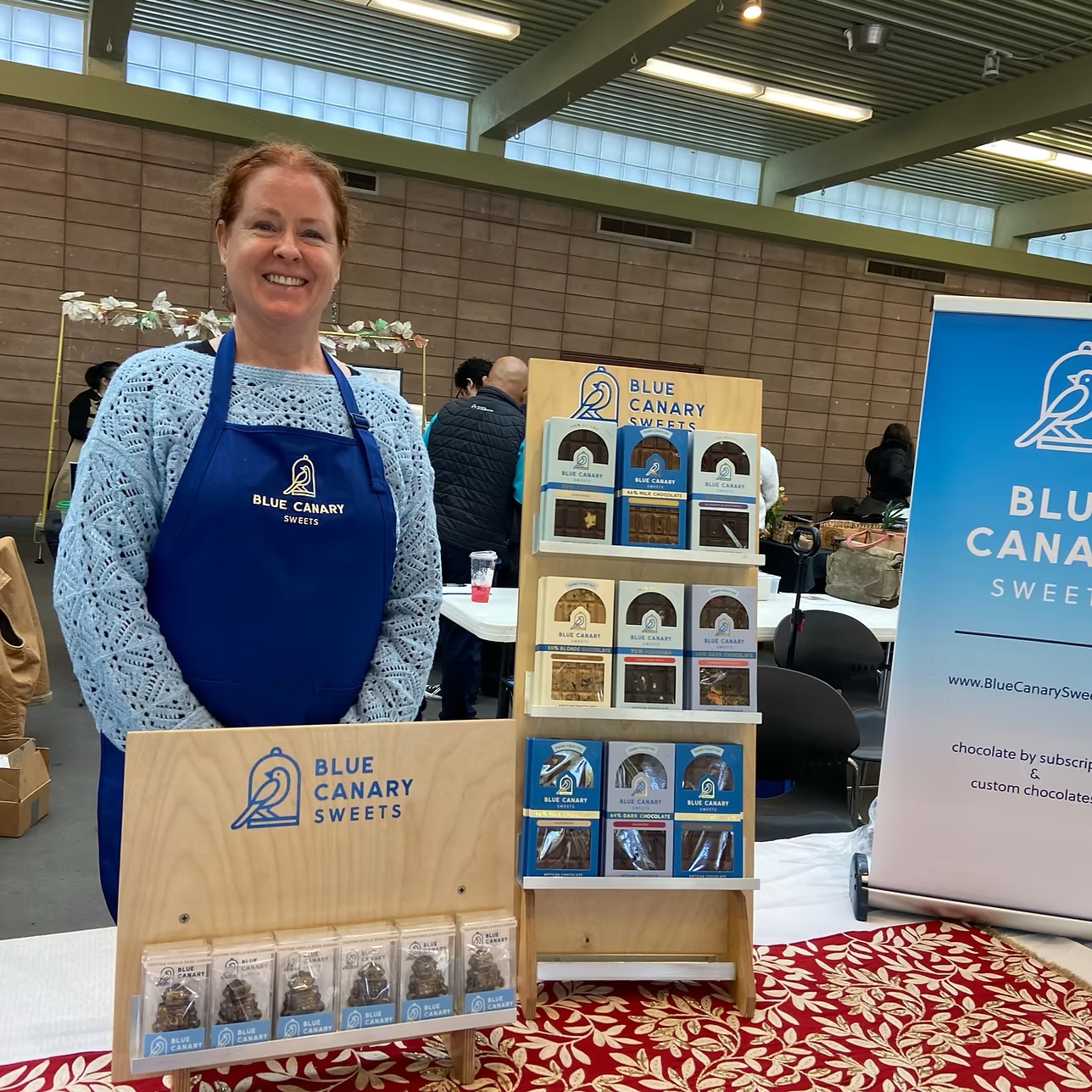
Julia Anderson lives a sweet life. Under the banner of Blue Canary Sweets, the former restaurant owner, culinary professional, pastry chef and chocolatier, gets to create chocolates for a living, without the stress of a brick-and-mortar operation.
You might remember Anderson from her time as proprietor of Fleur de Cocoa in Los Gatos, which she and her husband, Craig, purchased in 2012 from the original owner, master French pastry chef and chocolatier, Pascal Janvier, and his wife Nicola, who founded the shop in 2000.
The Andersons operated it until December of 2019, just before the pandemic, when they sold it to the current owners. Two of their former staff are still happily working there, including a pastry assistant who is now a sous chef and a dishwasher.
“We were really picky about who we sold it to,” says Anderson. “Fleur de Coco will always have a special place in my heart.”
But with Blue Canary, launched in 2023, Anderson is following her true passion: creating chocolate bars and experimenting with flavors and textures in a format that isn’t constraining.
Life as a chocolatier is about more than bon bons.
“At Fleur de Cocoa, I was literally spending most of my time creating truffles,” says Anderson. “One of my favorite things to make are bars. I decided to focus on the fun stuff: to be creative and play. I can make each bar a tablet for my love of chocolate.”
With Blue Canary, which is an online business with a subscription service, she makes about 30 different chocolate bars, although not all are available at the same time. Typically, she has between 10 and 15 flavors available at bluecanarysweets.com
You can also find some of her specially-made chocolates at Gali Wines tasting room in Los Gatos. And she participates in a variety of pop-ups, including several large chocolate festivals. Chocolate lovers pay heed: the next one, Chocolate Salon, is March 28, in Golden Gate Park. With one small admission fee, attendees can sample and purchase chocolates from dozens of artisan vendors. “It’s an adjudicated event, and I’ve won a bunch of awards,” says Anderson. “Judges tend to like the new kids on the block.”
Before she dedicated her life to chocolate, Anderson and her husband owned an Italian restaurant they’d purchased in the Midwest, but after the birth of their daughter, they decided to return to the West coast so Emily would grow up with family.
Now, says Anderson, her daughter is her only employee, helping with packaging and sales at the various festivals she relies on for sales.
Anderson herself had a similar beginning. “I worked in a chocolate shop as my first job during high school, and it was a lot of fun,” she said. “I was their assistant. We didn’t do hard core tempering, but we did things like coconut haystacks and caramel turtles.” At that point, she had no interest in a culinary career. She graduated from UCLA with a degree in photography, and promptly did something completely different, working in HR.
“The last job I had was to lay everyone off including myself,” Anderson says. “I figured it was time to do something else.” So, off she went to Le Cordon Bleu in Pasadena and graduated second-in-class, with a general culinary degree. Then came the gig with the Italian restaurant. “I’m not Italian, but my general background helped me plop right into it,” says Anderson. “I love savory cooking, where I can have fun playing, and I love pastry, where I can really nerd out.”
Chocolate bars are where it’s at for her now: simple, approachable, and unfussy, with a sophistication that rewards both gift-giver and giftee. And considering she uses amazing source material, you’re sure to discover a taste like no other.
Careful sourcing is seriously fundamental for making standout bars. For Anderson, it’s Valrhona. “It’s the one I really want to work with because they provide an array of ethically sourced choices with great flavor profiles.”
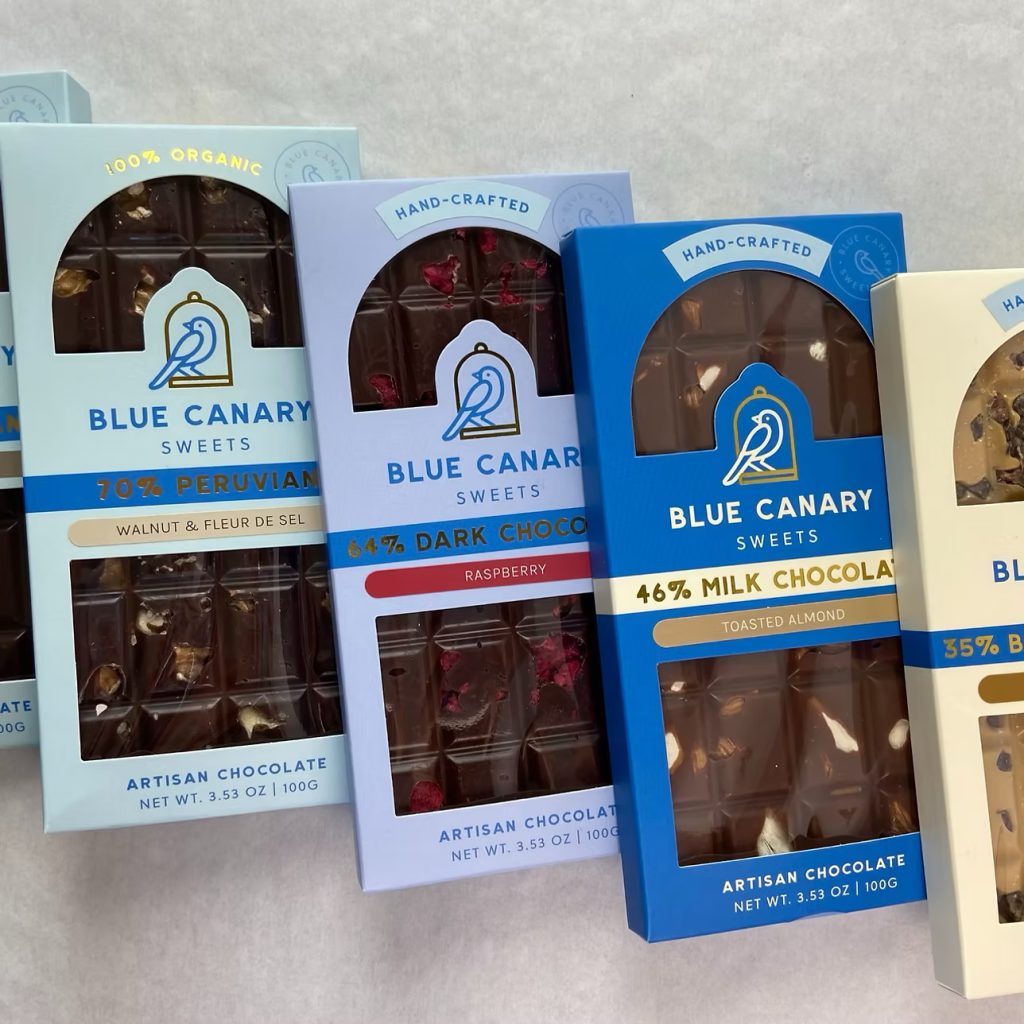
Her four primary sources include 70% dark organic cocoa from Peru, which she says has a nice balance of bitterness, but is not over the top. It makes the perfect base for nuts and dried orange peel. She also likes the 64% dark from Madagascar, for its fruit forward flavor of berry and cherry, that welcomes the addition of freeze-dried fruits.
For her milk chocolates, she procures a 46% base from the Dominican Republic. “This has more intense cocoa notes than the typical milk chocolate base, which is usually around 35%. It’s ideal for dark chocolate lovers who want something a little more mellow,” she explains.
She also uses a white chocolate base that is caramelized to give it more complexity from the bit of bitterness it brings. To this, she adds things called “crunchy cocoa nibs” to create a bar named “Golden Ticket.”
Most of her collection is based on dark, and the current selections include mandarin orange, shortbread, pistachios and Montmorency cherries, walnuts and fleur de sel, toasted almonds, and, of course, plain.
You can also find some of her special creations at the Gali Wines tasting room in Los Gatos, including a Dubai bar, which Janice Gali asked her to create. “Honestly, I don’t do fads,” says Anderson. ”And I thought for sure Dubai bars were a fad.” But it’s a fad that’s still growing.
She’s also given in to everyone’s love of bon bons, those little bites of joy that can uplift and inspire when the need arises. In her case, she’s created a cute little robot bon bon of dark chocolate Tahitian vanilla bean caramel. She says it’s “super awesome.”
What sweeter way to exact revenge on the tech world than to bite its head off? Significantly more pleasurable than trying to work your way through an endless phone tree that ends up disconnecting you.
I asked Anderson about the challenges of growing a sensitive plant in a world where the ecosystem is constantly at risk. Cacao only grows in a very temperate zone surrounding the equator, and like coffee, is under constant threat from climate change, especially the rise in temperature and more intense storms which raise fungal disease pressure. As crops diminish, the price continues to climb.
Tariffs also play an enormously costly role, and the only place in the US that can produce cacao is Hawaii, where there are now a few plantations on the Big Island, Oahu and Kauai. It’s a growing but very niche product there, with only 250 acres of trees. Compare that to 25 million acres worldwide, largely concentrated in West Africa.
Still, Anderson is betting on the universal and endearing appeal of chocolate to keep her blue canary alive and well.