

The mountains of Los Gatos have housed several Christmas Tree Farms for decades. It can be tricky to keep the business afloat when sales are concentrated around one month each year, particularly given the rise in popularity of artificial trees. So, how have these family farms been able to maintain such a loyal customer base? And will there eventually be a change in trend, or is this industry resilient enough to persevere through anything? According to the American Christmas Tree Association, more than 80% of American families will put up a fake tree this year. But here in Los Gatos, our local Christmas tree farms aren’t deterred by statistics.
There are other trendlines the industry is following: Renting live, potted trees, which can be returned, or reused for many years. There are around 350 million Christmas trees growing in the United States, and only about 10% of those get sold. Plus, 80% of artificial trees come from China. So what happens when tariffs are thrown into the mix? And what happens when those fake trees aren’t purchased?
Sure it may be difficult, at first, to imagine how an industry with such a concentrated selling-cycle can be financially stable. But, our Los Gatos-area farms prove that it’s more than possible. To help us understand the economics of the sector, a few evergreen growers were kind enough to take time out of their extremely busy season for a chat.
Castle Rock Ranch
Joe Dickson bought Castle Rock Ranch in 2010 from the Whalen family, who’d owned it since the mid 1940s. Previously, Emmit Whalen purchased it, but died in the 70s. Dickson bought it from son Bob Whalen, who passed away a few years ago.
“I’ve known Bob Whalen my whole life, because he was our tractor man, and working at this farm was one of my first jobs at the age of 12,” Dickson said. “Working for him, we developed a lifelong friendship and he became like a father figure to me and he never had any kids, and in 2010 he offered to sell me this place. He died in 2022, and I took care of his wife until she passed in November of 2024—until she passed after suffering from dementia. It’s 14 acres with roughly 5,000-7,000 trees planted on the farm.”
Wife Angie Dickson works at Castle Rock State Park next door. They have a good relationship with the park. And they say the last 15 years have been phenomenal. It’s been a lifelong dream for them to live on Skyline Boulevard and run a Christmas tree business, after all. They say it’s a blast, as they’re now on the third and fourth generation of customers coming to the farm.
“I think overall people like a fresh tree,” he said. “It’s a tradition for the family.”
He says they were truly honored to get to take over the business. And, he adds that they plan on continuing it. They say, after putting in a lot of effort to improve the property, they’ve actually seen a steady increase in sales.
Summit Christmas Tree Farm
The first tree at Summit Christmas Tree Farm was planted in 1966 by Debbie Livingstone’s father. And now, her two sons maintain the location. “It’s been in the family since then, and I’ve always been a part of it,” she said, in an interview last week. “Well, we were open this season and we closed last Wednesday. A lot of people come early—like Thanksgiving weekend mostly—which is the bulk of the sales. It seems silly to be open just for 10 people. They’re really open for less than three weeks, though the land is taken care of the whole year.”
The Livingstones rent the property and don’t own it. Livingstone and her husband live in Groveland, near Yosemite. “Emotionally, I’ve done it my entire life because my father planted my first farms up there. But financially, we had other jobs, so it wasn’t our only income.” She put her kids into it, since they were very young—showing them all about shearing and planting. Almost like something sacred.
Livingstone says some of the tree farms have trouble surviving, because it’s hard to find help. That makes it difficult. But, it’s expensive to live in the area. If you hire someone for the Christmas rush, it’s probably not going to turn into a full-time year-round job. The Livingstones say the industry is full of unique challenges like this. But they also note that they will sometimes work together to overcome them.
Patchen Farms
Kelly Beck, of Patchen Farms, says the big difference this year was that people wanted to come by earlier. Typically it’s pretty quiet the week before Thanksgiving, she says. But this season, that wasn’t the case. And that’s good news.
“We need to save trees for next year because we’re all sold out,” she said, adding they’re not just focused on selling a product, but also providing something more intangible. “We’ve been doing this for 57 years…We’re all about the experience for the tradition.”
They added a pumpkin patch a few years ago. That’s open on the weekends, providing an alternative to corporate stores, or patches by the Pacific Ocean. “It was absolutely amazing, as the third year I was doing it,” she said, noting she plans to continue doing this into the future. The rest of the year the property is closed to the public as the trees and property are tended to.
Lone Star (1982) and Skyline Ranch Tree Farm (1958)
A change in the economy is what owner of Lone Star and Skyline Ranch Tree Farm Donna Ducca blames for the slight decline in sales they saw this year. Potential customers are being a little more conservative with their spending, she says.
“They’re a little more leary about spending money, and they’re not as happy as I’ve seen them,” she said, noting the artificial tree industry pitches their product as something that lasts more than a single year. “We are a renewable crop, and we sell a live tree. They don’t always understand, even after the tree is gone, it goes in the mulch, or we can replant it. People have a hard time understanding that we’re farmers. We’re just local small-selling farms.”
But some people do return, once they realize their fake plastic trees ultimately find a forever home in a landfill somewhere.
There’s not really much to distinguish the two farms other than the location. Skyline attracts bigger parties, as well as families and friends getting together to have a picnic. “It’s not just about getting a tree, it’s about seeing people connect and be happy,” she said. “It’s about connecting with nature.”
In the end, Ducca says, to drive incentive, she needs people to become more aware of the overall environmental impact of artificial trees, compared to natural trees.
Peacock Tree Farm
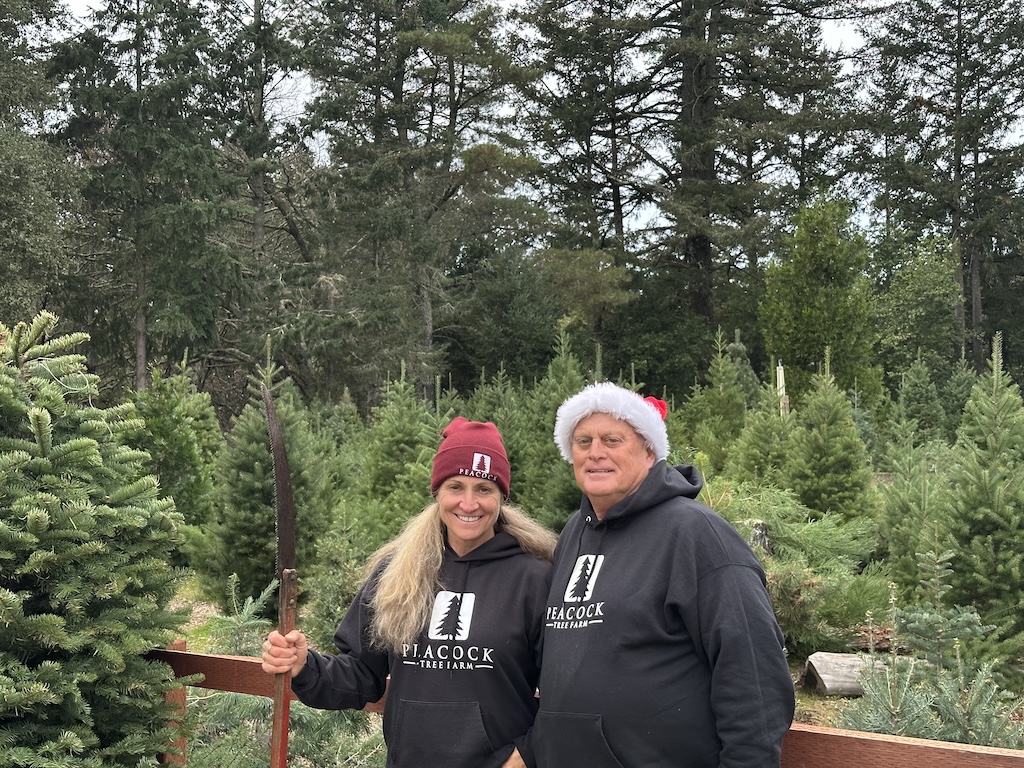
Great weather and consistency of sales were the highlights of the season at Peacock Tree Farm for owners Lisa and Eric Hoffner.
They take appointments as early as before Thanksgiving, due to high demand. And they’re not too worried about the rise of the artificial tree industry.
They acquired the farm in 1999.
Mr. Peacock, who started the agricultural operation, had originally planted 60,000 trees, they were told. A couple thousand are planted each season.
The Hoffners had been in South Africa for a year. And when they came back, they were looking for a home. They came upon this Santa Cruz Mountains spot and decided to purchase it.
Looking back, they say they have no regrets.
The only setback, this year, was that it was harder to hire, they say, echoing the human resources challenges described by Summit Christmas Tree Farm.
The Hoffners say they make sure to employ local people and donate to charities like the Wildlife Conservation Network and Words and Deeds, a California nonprofit that honors the legacy of former ambassador J. Christopher Stevens, who was killed in the 2012 Benghazi attack.
A year ago, the Los Gatan sat down with three Christmas tree farms to find how they’d fared after Covid. Our article covered how this industry offers a valuable real-world experience for those who may have felt disconnected during the pandemic, despite the rise of telecommunications technologies like Zoom meetings.
This niche industry continues to maintain its prominence in Los Gatos life. Despite the growth of artificial tree sales, our Christmas tree farms have been resilient.
*Kelly Beck’s name was mistakenly printed as Kelly Patchen in a previous version of this article. She has not spoken to Debbie Livingstone, as the earlier article suggested.